


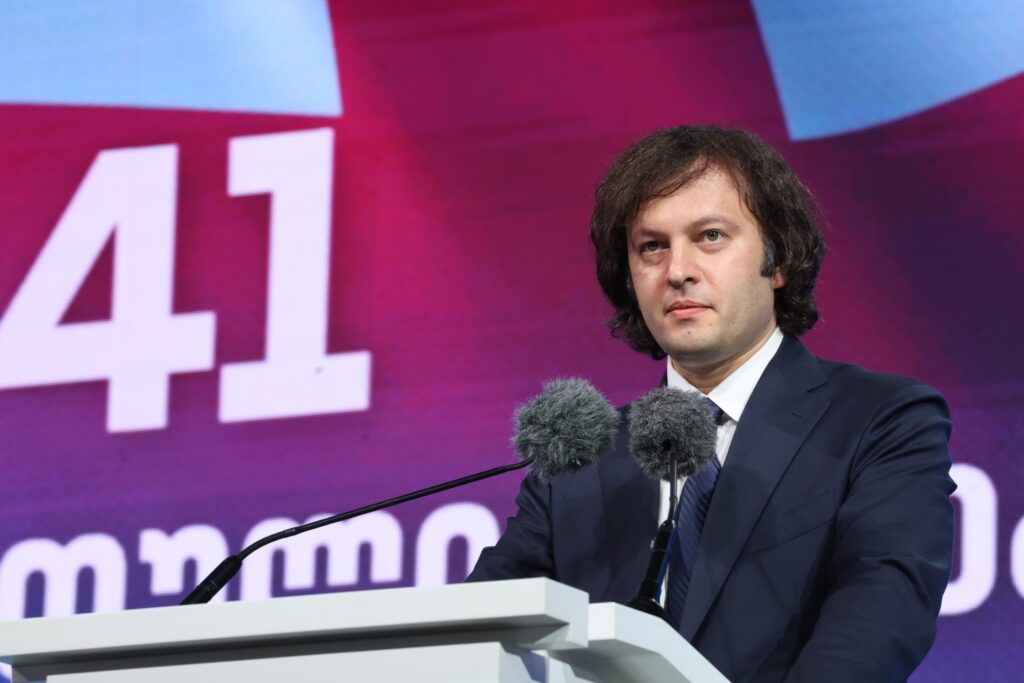
Georgian Prime Minister Irakli Kobakhidze, marking the 14th anniversary of the registration of the “Georgian Dream” party, wrote that 14 years ago, on April 21, a “turning point occurred in Georgia’s modern history — the political union ‘Georgian Dream – Democratic Georgia’ was founded.”

According to him, Georgia today lives in a completely different reality. The head of government assessed that the level of public trust in institutions has grown, the judicial system has become more transparent and independent, and the security forces “have been liberated from political influence and today serve the law and society.”
Regarding the media environment, Kobakhidze stated that it is now diverse and pluralistic.
The Prime Minister also noted the role of the founder and Honorary Chairman of the Georgian Dream party, stating that Bidzina Ivanishvili has made a significant contribution to the formation of the modern Georgian state.
The text notes that April 21, 2012, was “logically followed by the victory over the regime of the ‘United National Movement’ (UNM) — the official registration of the party symbolically became the point from which Georgia,” as Kobakhidze put it, “transformed from an authoritarian model of governance and subordination to external interests into a modern, democratic, and dignified state.”
And “Dream” began the movement toward building a sovereign, stable, and developed state; today, the Prime Minister emphasized, it is already evident that the heavy legacy created by the “UNM regime” has been left in the past forever.
Irakli Kobakhidze further spoke about the difficulties overcome by Ivanishvili’s political team.
“We must not forget that it was since 2012 that the country set out on a path of irreversible development and turned into a state where the individual is at the center, and the main priorities are sovereignty, democracy, and national values. Before 2012, Georgia faced systemic problems that not only hindered a free life but also undermined the foundations of statehood.
Our team took over a country where justice was selective and the public had practically no trust in the judicial system; mass and systemic human rights violations were part of everyday life; all major media outlets with national broadcasting were subordinated to the interests of one party, and the level of restriction on media freedom was such that even talking about pluralism and critical opinion was difficult; politicized security forces served as an instrument of pressure and terror rather than the protection of citizens; prisons functioned as the primary repressive mechanism, where many people ended up for political reasons,” the politician noted.
The head of the Georgian government separately highlighted the problem of unprecedented pressure on private property and business.
“Tens of thousands of citizens were deprived of property and could not protect their rights due to fear of the repressive system. Against the backdrop of social insecurity and high levels of inequality, the country effectively lacked effective state institutions, and dissent was perceived as a threat,” he stated.
It was precisely such a country, according to Kobakhidze, that external forces presented as a “beacon of democracy.”
The Georgian Prime Minister stated that “Georgian Dream” took full responsibility for governing the country and began systemic reforms aimed at building a fair, democratic, and stable state.
“Today, 14 years later, Georgia lives in a different reality: the rule of law has been strengthened, trust in institutions has grown, and the judicial system has become independent and oriented toward the supremacy of law and the protection of human rights. The protection of rights and freedoms has become a real practice rather than a formality.
The media environment has become diverse and pluralistic, with media outlets of various editorial policies functioning freely, ensuring access to information and freedom of expression.
Security forces have been liberated from political influence and serve the law and society, with their main task being to ensure the safety of citizens. In the economy, a stable and predictable environment has been created that protects business and promotes investment growth and the development of the private sector, which is ultimately reflected in the country’s economic growth.
Under the governance of ‘Georgian Dream,’ social policy has become one of the state’s priorities — a universal healthcare program was introduced, social protection programs were expanded, and their scale and accessibility were increased, which is particularly important for vulnerable groups of the population. Furthermore, the level of extreme poverty has decreased, and state support for citizens has strengthened. Along with this, state institutions have been bolstered, and their independence and efficiency have grown, creating a solid foundation for the country’s sustainable development.
The political environment, despite existing differences, today recognizes and protects diversity as a necessary element of democracy, while the state is capable of preventing any radical, extremist actions directed against the country’s foundations.
Given all of the above, it is natural that citizens’ trust in the state has grown, as today Georgia is a country where the authorities are accountable to the people and institutions serve society,” the Prime Minister wrote.
A special, “fundamental role,” Kobakhidze emphasized, belongs to Bidzina Ivanishvili, who, as the Honorary Chairman of “Georgian Dream – Democratic Georgia,” has made a great contribution to the formation of the modern Georgian state.
“It was his vision and personal responsibility to the country and the people that determined the path that led Georgia to a turning point. Under his leadership, it became possible to unite society around a national goal, peacefully implement democratic changes, and dismantle the systemic problems that had hindered the country’s development for many years,” the Prime Minister wrote.
Kobakhidze acknowledged that challenges remain — against the backdrop of the modern world order, where geopolitical interests often intersect with the interests of small and developing states.
“In such conditions, one of the main challenges for Georgia remains the protection of sovereignty and the preservation of an independent political course. Attempts to influence the country’s internal processes — of a political, economic, and informational nature — have already been recorded multiple times,” he wrote.
Against this background, “Dream,” according to the Prime Minister, possesses the ability and courage to make decisions “exclusively in the national interest and to prevent the strengthening of forces that are guided by narrow political goals and are linked to the heavy experience of the past.”
“Dream,” he continued, receives legitimacy from the Georgian people, and this, Kobakhidze emphasized, is confirmed by democratic elections and public support.
“Therefore, the main task of the political team is the development of the country in accordance with the expectations of its citizens,” noted Irakli Kobakhidze.