


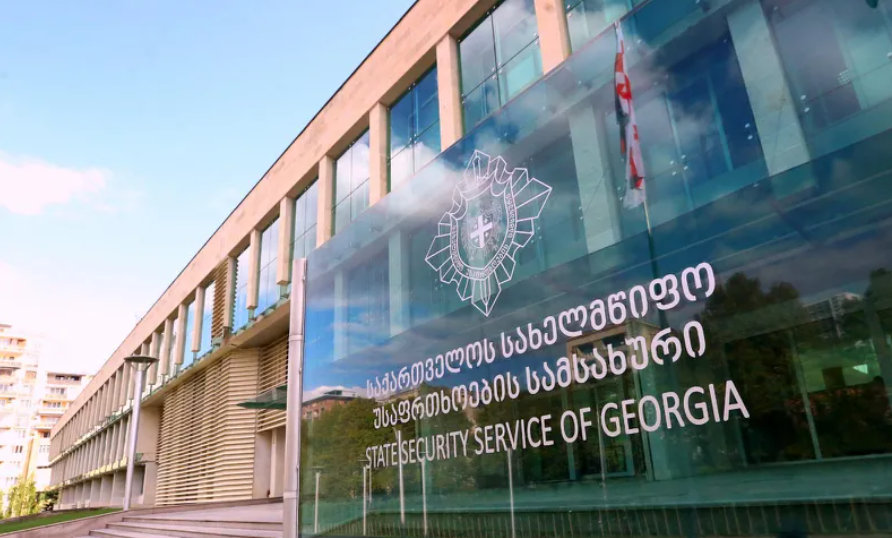
The 2025 report of the State Security Service of Georgia (SSG) emphasizes that information presented in a BBC investigation regarding the alleged use of the so-called chemical weapon “Camite” against protesters in Georgia is targeted disinformation.
The agency stresses that the statements by the British corporation’s journalists serve to damage Georgia’s interests. It notes that Georgian citizens were also involved, and their actions, alongside the authors of the BBC film, were well-planned, organized, and part of a campaign “aimed at achieving specific hostile goals.”
According to the SSG’s assessment, trends in recent years have clearly shown that disinformation and double-standard information campaigns originating from Western countries and institutions have contributed to effective anti-Western propaganda by individual social and political groups in Georgia, as well as foreign intelligence services, fostering nihilism toward Western institutions in parts of society.
It is in this context that the State Security Service mentions the BBC investigative film in its report, which concerns the use of chemical substances against demonstrators during the protest actions of November–December 2024.
The SSG states that the story broadcast by the British outlet became, to a certain extent, part of a disinformation campaign against Georgia and could have caused negative consequences for the state.
However, as noted, thanks to the timely reaction of the state and the SSG specifically—through rapid investigative actions and proactive public information—the negative consequences sought by the BBC disinformation story were successfully prevented.
The SSG states that the substance “bromobenzyl cyanide” (CA), known as “Camite,” was never purchased by the Ministry of Internal Affairs (MIA) of Georgia.
The agency reported that more than 160 investigative actions were carried out in this criminal case, and 93 witnesses were questioned, including current and former MIA employees, doctors, experts, respondents from the British broadcaster’s story, representatives of non-governmental organizations, and others.
Additionally, various documentation was seized from the MIA and the Customs Department of the Revenue Service.
«From the databases of the first and second directorates of the MIA Special Tasks Department, investigators seized 25 research samples, which underwent chemical examination at the Levan Samkharauli National Forensics Bureau.
As a result of these operational and investigative measures, it was established that the chemical powder purchased by the Ministry of Internal Affairs of Georgia and used for many years when necessary for crowd control during ongoing protests is “chlorobenzylidenemalononitrile” (CS gas).
This substance was purchased by the MIA from an Israeli company on December 18, 2007, and March 27, 2009, along with the solvent “trichloroethylene.” During transportation, it was assigned the international shipping code UN 3439, and the solvent liquid was assigned code UN 1710.
These codes are recorded in customs documentation, as well as in all other documents, including write-off acts compiled during the subsequent period of use. A 17.5-kilogram container (barrel) in which the powder was stored was seized as a sample. It bore an information label produced by the supplier organization, which, among other data, specified the name of the substance “chlorobenzylidenemalononitrile” and the assigned international transport code UN3439.
The investigation also established that the international shipping codes UN3439 and UN1710 mentioned in the BBC story have been used over the last 20 years not only by the Georgian MIA but also by various Georgian organizations, including “Aversi-Rational,” “GPC,” “Rustavi Azot,” and others—a total of 606 times. Specifically, code UN3439 was recorded 507 times, and code UN1710 was recorded 99 times in the customs department’s databases.
As for the substance “bromobenzyl cyanide,” known as “Camite,” the Ministry of Internal Affairs of Georgia has never purchased such a substance,» reads the SSG report.
The agency points out that witnesses were questioned as part of the case, upon whose statements and “conclusions” the BBC story about the alleged use of a poisonous chemical substance was partially based. During questioning, all of them stated that their data did not concern the substance “Camite” and did not confirm its use. According to them, they could not have made such conclusions as they had not conducted the relevant research.
Furthermore, during the investigation, questioned members of the medical and expert communities reported that the substance “bromobenzyl cyanide,” known as “Camite,” can cause severe and, in some cases, fatal consequences when exposed to humans, which is why it was banned as early as the 1930s.
Additionally, according to MIA data, after November 28, 2024, ambulance crews transported 54 people to hospitals. Five of them were found to have mild intoxication; all were discharged the following day.
«The investigation also established that in the first days of December 2024, specifically on the night of December 4–5, the substance “chlorobenzylidenemalononitrile” was used for crowd management, with “propylene glycol” used as a solvent. Neither of these substances is classified as prohibited.
According to the chemical examination, the substances seized by investigators from the MIA Special Tasks Department include:
- the chemical substance “chlorobenzylidenemalononitrile”;
- the chemical substance trichloroethylene (referring to the remainder of a written-off volume of 880 liters);
- the chemical substance propylene glycol.
Of the persons of interest to the investigation, it was not possible to question the single witness on whose information the BBC story’s author largely based their conclusions. He appears in a case from October 4 related to the purchase and storage of the explosive TNT,» the agency’s 2025 report states.
Thus, the SSG points out, the reliable evidence gathered by the investigation allowed for the conclusion that the information voiced in the BBC film about the alleged use of the so-called chemical weapon “Camite” against protesters in Georgia is targeted disinformation intended to damage Georgia’s interests, involving Georgian citizens.
«Accordingly, regarding this matter, the State Security Service continues its investigation solely into a possible crime under Article 319 of the Criminal Code of Georgia, which involves assisting a foreign organization in hostile activities,» states the SSG report presented to Parliament.