

For the first time in the 14-year rule of the Georgian Dream party, a detention has occurred in the country on charges of espionage in favor of Russia. Initially, the State Security Service (SSG) reported the arrest of a Georgian citizen working for a foreign state—for monetary compensation, he photographed the locations of security forces and strategic facilities. Later, the pro-government TV channel Rustavi-2 released an “exclusive” stating that the country in question was Russia. Subsequently, Radio Liberty discovered that the detainee is 27-year-old Tamaz Goloev, a native of occupied Akhalgori.
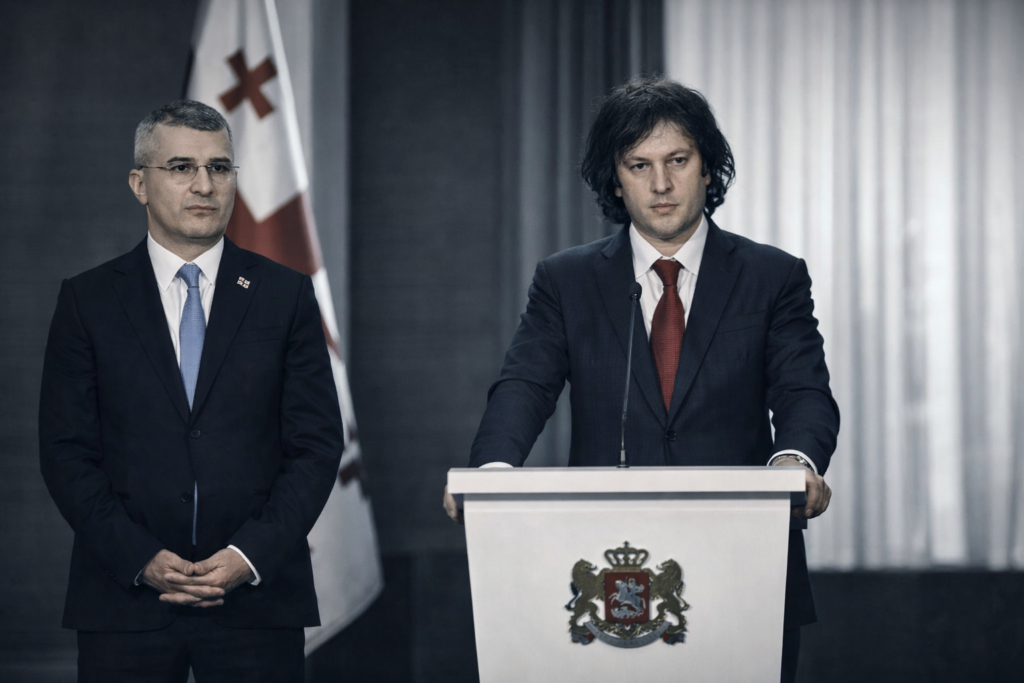
Experts point out that this unprecedented case occurred almost immediately after the announcement of personnel reshuffles in the SSG—one of Georgia’s most influential state agencies. Prime Minister Irakli Kobakhidze dismissed the head of the service, Mamuka Mdinaradze, a man considered a reliable member of his team.
Following his resignation, the politician gave an interview to the pro-government channel Rustavi-2, in which he commented on the espionage case. When asked by the hosts to clarify which country was involved, Mdinaradze did not answer. However, the journalist made a pointed comment: “We can assume that your opponents will no longer have grounds to say that you have never identified spies from that country.”
Some critics of the government viewed the arrest case specifically as a “box-ticking exercise” to show work done. Former Ombudsman Ucha Nanuashvili, for instance, stated that the State Security Service detained a young man engaged in small-scale trade, while tens of thousands of Russians currently reside in Georgia, among whom there may indeed be agents of foreign intelligence services.
Regardless, while announcing Mdinaradze’s resignation as head of the SSG, Prime Minister Irakli Kobakhidze thanked him for his “successful work” and “important achievements.” Simultaneously, he announced the creation of a new structure effectively tailored for Mdinaradze—the Office of the State Minister for Coordination of Law Enforcement Agencies—as well as his appointment as Vice Prime Minister. But the most striking demonstration of recognition for Mamuka Mdinaradze’s achievements was his early promotion to the rank of Major General.
In the opposition and expert community, these decisions were viewed exclusively as a consolation prize amid a serious demotion. Gela (Geka) Geladze—a high-ranking official from the Ministry of Internal Affairs and a veteran of the security system since the time of Mikheil Saakashvili—has been nominated for the post of SSG head. The Ministry of Internal Affairs portfolio was handed to the head of the government of the Adjara Autonomous Republic, Sulkhan Tamazashvili, while the latter’s position will be taken by Zurab Pataradze, who has held the post in the past.


Despite the chain of personnel reshuffles, experts and government critics consider the change of the State Security Service head to be the key link. “I have never heard of a person being promoted to general and fired from their position on the same day,” reacted opposition leader Nika Gvaramia.
The promotion to Major General of the SSG was Mdinaradze’s fifth rank advancement in the last five months. Therefore, the unexpected resignation from the post of service head gave rise to numerous rumors in society. Some believe the reshuffles are aimed at even greater centralization of control in the security bloc, while others see it as evidence of government instability and a lack of trust within the system.
Mdinaradze himself told the pro-government Imedi TV channel that the personnel decision was actually made seven or eight months ago, and he held the post of SSG head only temporarily, which was supposedly obvious from the start: “There was a necessity then, and we hadn’t decided 100% exactly how everything would develop—whether it would follow this dynamic or not.”
Political analyst Gia Khukhashvili suggests viewing Mdinaradze’s resignation as preserving his persona solely in the status of a “figurehead.” The expert considers reports about the creation of a State Minister’s apparatus for coordinating the security bloc to be unserious:
“Firstly, such a position does not exist at all. It simply doesn’t exist. It’s like naming a position that will either be formed or not—we don’t even know that yet. So, in principle, these reshuffles must, of course, be interpreted as his dismissal. At this stage, at least.”
Eka Beselia, former head of the parliamentary Legal Affairs Committee, considers the new position to be a facade. She finds it unclear how Mdinaradze will coordinate the work of security structures, as the Georgian Cabinet of Ministers does not control all of them today. Beselia points out that the State Security Service is no longer subordinate to the government and is accountable to Parliament, while the Prosecutor’s Office is an independent institution, also removed from government structures.
Berdia Sichinava, a member of the “For Georgia” party, also believes that “there can be no talk of any coordination”: “He will have the function of a postman. The National Security Council was the coordinating body, but it was abolished. Kobakhidze himself said he would be the coordinator. How a ministry that won’t have its own building and will be housed in two rooms of the chancellery can perform serious functions—I find that hard to imagine.”
A number of experts viewed the change in the SSG leadership as part of a policy to limit the powers of Prime Minister Irakli Kobakhidze. A series of previous personnel reshuffles was perceived as strengthening Kobakhidze’s position, which, according to some analysts, could have caused concern for the founder of Georgian Dream and billionaire Bidzina Ivanishvili. In a conversation with SOVA, Gia Khukhashvili suggested that the true goal of the regrouping might be the removal of the current Prime Minister.
“He is closing in on Kobakhidze. He is being sterilized. Now, in principle, after these reshuffles, Kobakhidze is already caught between heaven and earth, because if he had the illusion that he controlled at least something, he is now in total limbo. This technology of madness is well-known: he [Ivanishvili] creates an illusion of power for people and then gradually shortens the leash. And we get a picture where Kobakhidze—already a formal Prime Minister—is distanced even further from real power. Well, the next step will likely be hanging him on that very leash, which has already been shortened to the maximum.”
Overall, Khukhashvili believes that Ivanishvili, as the initiator of these reshuffles, is interested in replacing “young figures who, as I understand it, have become tiresome” with people without particular “political ambitions.” This is how the political analyst describes the new heads of the Ministry of Internal Affairs and the SSG.
Notably, Georgia’s highly influential State Security Service has changed leaders five times in the last 10 years. Vakhtang Gomelauri headed it for four years, followed by Grigol Liluashvili for over five. Both were considered close associates of former Prime Minister Irakli Garibashvili. Today, all three are figures in criminal cases, which experts viewed precisely as a consequence of clan warfare, where Kobakhidze’s group gained the upper hand.
In 2025, after Liluashvili’s resignation, MP Anri Okhanashvili headed the SSG, but he lasted in the intelligence chief’s chair for only a little over four months. Okhanashvili was replaced by Mdinaradze—his colleague from parliament. That decision was then seen as the final victory of the Kobakhidze clan in the internal party struggle. And, as analyst Gia Khukhashvili believes, such a turn alerted Bidzina Ivanishvili.
According to the expert, at a certain point, individual representatives of the government developed a sense of autonomy and the possibility of acting outside previous constraints. This “illusion of independence,” Khukhashvili believes, led to attempts to redistribute influence within the elite:
“There was a moment when Bidzina seemed to be losing control. Then the system began to stir, and this illusion of power played a cruel joke on Kobakhidze, Kaladze, and others. They believed he had stepped away and they could act more freely.”
Now, as Khukhashvili believes, the situation has been brought back under control, and the internal configuration of power has been reformatted. According to the analyst, the key decision-making center has “restored order” and effectively rebuilt the balance within the system, “putting everyone in their place.”