


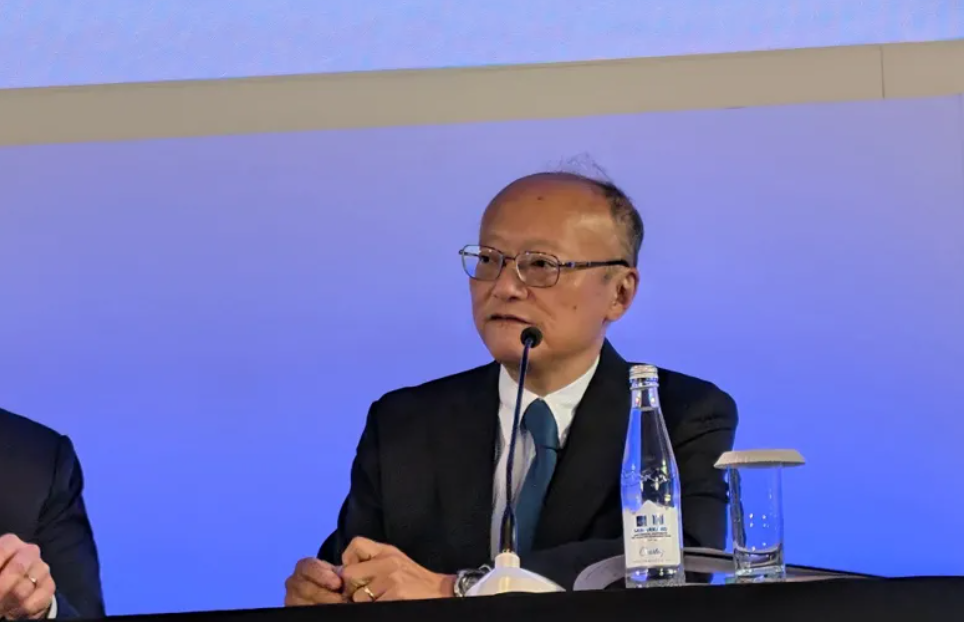
Masato Kanda, President of the ADB (Asian Development Bank), stated that the crisis in the Middle East further increases the importance of the Middle Corridor, and Georgia continues to play a central role in its development.
Kanda was quoted by the IPN news agency. The ADB President emphasized that the bank will strengthen its support for the modernization of key transport corridors in Georgia, which serves as a vital link between Asia and Europe.
The head of the Asian Development Bank noted that he visited Georgia several months ago and believes the country continues to play a central role in the Middle Corridor. Masato Kanda pointed out that against the backdrop of shifting global trade routes and rising geopolitical risks, the importance of the Middle Corridor is growing. Consequently, the crisis in the Middle East further underscores its significance.
“Georgia is an important link between Asia and Europe. In this regard, the Asian Development Bank supports the development of the corridor passing through Georgia through investments in infrastructure projects and the implementation of reforms. This contributes to improving the country’s connectivity, economic growth, and tourism development.
The ADB recently completed the Rikoti section of the East-West Highway. Within the framework of planned road and rail projects, the ADB will continue to strengthen its support for the modernization of major transport corridors,” he stated.
As a reminder, the 59th Annual Meeting of the Asian Development Bank (ADB) is taking place in Samarkand from May 3 to 6.
The Middle Corridor project (Trans-Caspian International Transport Route, TITR) is a multimodal logistics route connecting China and Southeast Asia with Europe via Kazakhstan, the Caspian Sea, Azerbaijan, Georgia, and Turkey. It serves as a key alternative to northern routes bypassing Russia and is being actively developed for cargo transportation bypassing the Suez Canal.
The Asian Development Bank (ADB) is a leading multilateral financial institution established in 1966 to reduce poverty and stimulate sustainable economic growth in the Asia-Pacific region. The bank provides loans, grants, and technical assistance, and is headquartered in Manila, Philippines. It comprises 69 members, the majority of which are from the region. As of 2024, the membership includes 50 regional countries and 18 countries from other regions.