


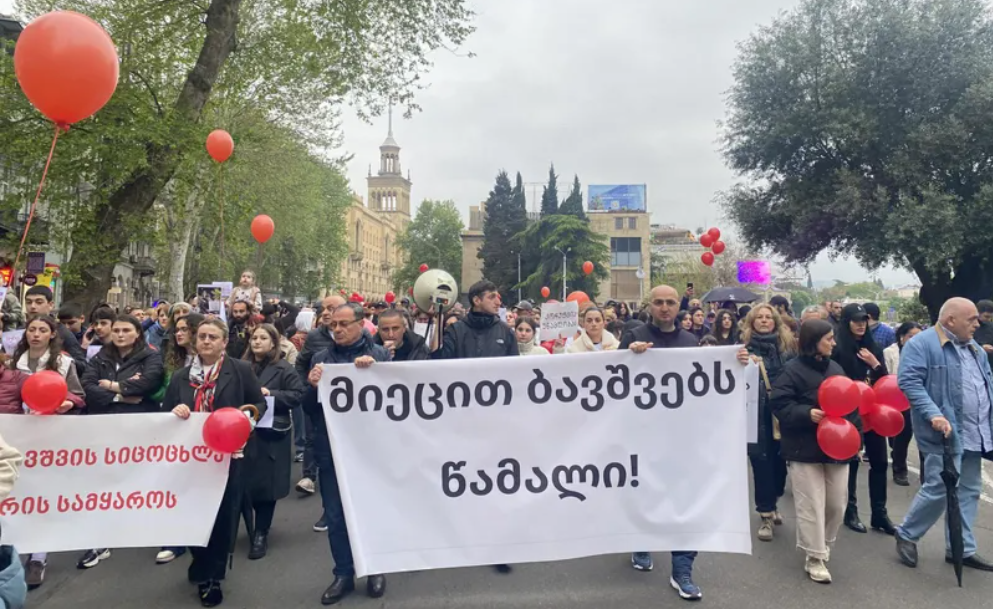
Parents of children suffering from Duchenne muscular dystrophy (DMD) are holding a protest rally. The march began at the Rustaveli metro station and will conclude at the Government Administration.
Participants are chanting: “Give the children medicine! Medicine for the children! Give the children medicine!” and “What if it were your child?!”
Protesters are demanding that children suffering from Duchenne muscular dystrophy be provided with necessary medications.
Demonstrators are carrying symbolic red balloons and protest banners. The march is being escorted by police officers.
Tako Gogaladze, one of the parents, stated that the protests will continue until the children receive the necessary medication. She emphasized that it is vital for children with Duchenne to receive these drugs, as the disease is fatal.
“Our sole and clear demand is the timely provision of medicines to children to extend their lives. Every week, starting at 6:00 PM, we will announce a march in support of children with Duchenne muscular dystrophy.
Also, every Monday at 5:00 PM, a rally will be held at the Chancellery building.
The protests will continue until our demand is met and the children receive the medications we are fighting for. Every day, the children wait for their condition to improve,” she stated.
Gogaladze emphasized that Georgia’s Minister of Health, Mikheil Sarjveladze, is misleading the public by speaking about drugs that the authorities claim the state cannot purchase until there is a real evidence base and EU approval.
“We have been following these drugs for 10 years, watching how they are recognized. This is propaganda used to try and mislead society. Parents are fighting their children’s fatal illness, while the Health Minister comes out and says that we supposedly don’t want what’s best for our children and that this drug yields no results. The disease is killing children—that is the reality.
It is critically important to import these medications as soon as possible. This man is already a criminal: we engaged in a civilized dialogue with him for two years, but he deceived us, stole two years from us, and deprived us of time, which is a serious crime against these children. Two years for these children means minus two years of life,” Gogaladze stated.
As a reminder, Georgian Health Minister Mikheil Sarjveladze stated during a parliamentary interpellation hearing regarding children with Duchenne disease that the ministry’s “door has never been closed” and remains open. He emphasized that the department will continue its ongoing work on these issues and expressed hope that a full-fledged drug that is truly accessible and safe will soon appear.
Sarjveladze stressed that those who think he does not understand when an article by a “funded doctor” praising a particular drug is circulated on social media, or when praise is heard from an organization, are mistaken.
What is the conflict?
Since April 20, parents of children with Duchenne muscular dystrophy in Georgia have been demanding that the state import drugs to slow the progression of the disease and provide state funding for these medicines. Additionally, they are calling for the creation of a multidisciplinary team of doctors in the country to monitor and treat such patients.
According to open sources, several drugs have been approved in the US and the EU, but the situation remains ambiguous and depends on the specific medication.
For instance, the drug Elevidys—the world’s most expensive gene therapy ($3.2 million)—has not received EU approval but was approved in the US. Parents most frequently demand the use of this specific medicine.
However, the Georgian Ministry of Health cites the EU’s position, arguing that it cannot be used under state funding in Georgia either—the authorities consider such therapy “experimental.”
Parents insist that this is the only chance for their children and point to the drug’s approval in the US as an argument.
The disease is a severe genetic condition that progresses rapidly and leads to the loss of motor functions, which is why families insist on the urgency of these decisions.
More on the issue can be found in the SOVA blog.