


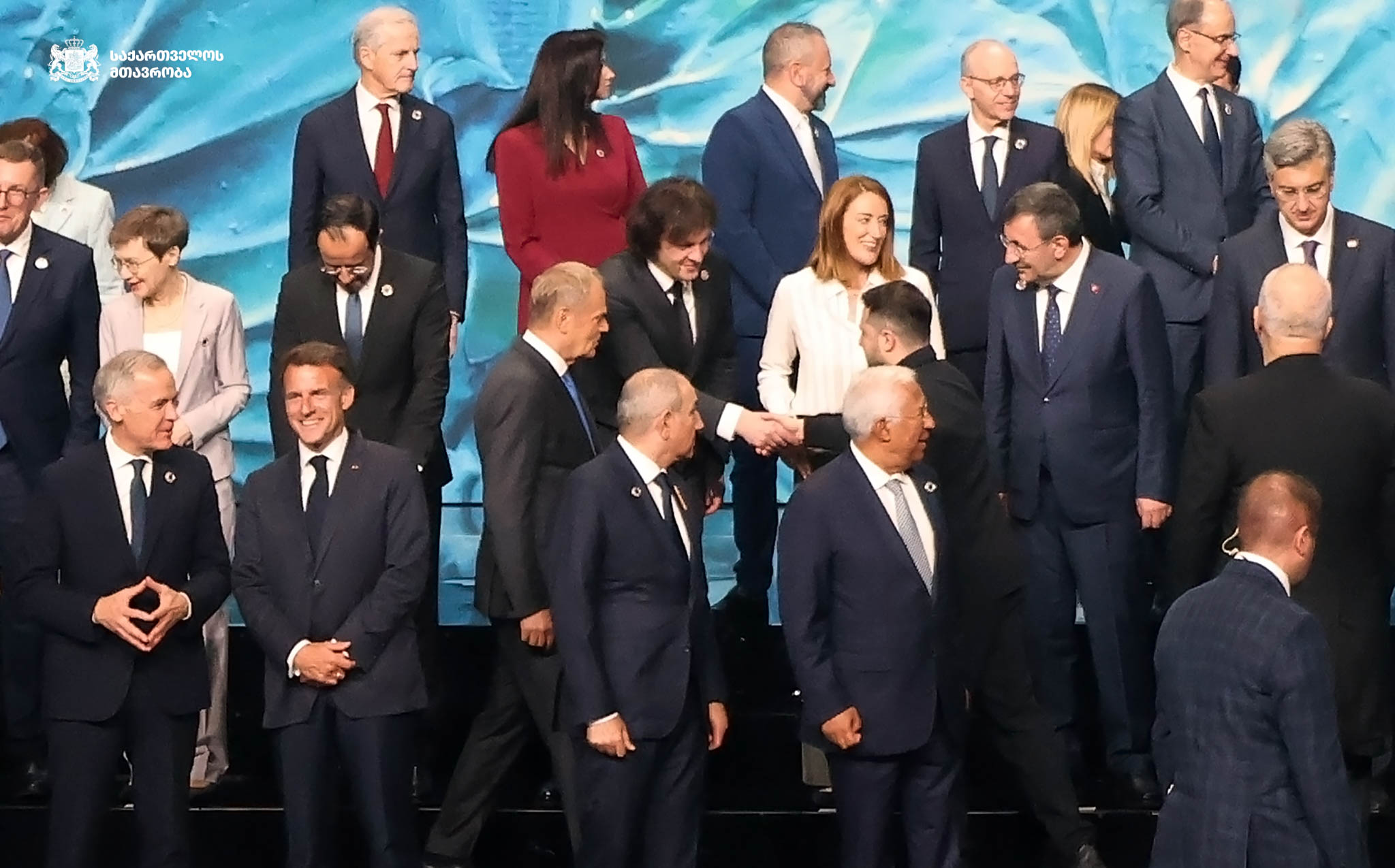
“Unresolved issues indeed remain between our states. It is important to maintain dialogue at all levels.” This was how Volodymyr Zelenskyy commented on his “short conversation” with Irakli Kobakhidze in Yerevan.
According to information from the Georgian side, the initiative for the meeting came from the President of Ukraine. As Kobakhidze noted, they “immediately” confirmed their readiness for dialogue, after which the parties discussed bilateral relations.
The Georgian Prime Minister emphasized that the conversation was held in a closed format, refusing to disclose its contents. At the same time, he described the talk as “friendly and interesting,” noting that the atmosphere of the communication itself was the key outcome of the contact.
According to Kobakhidze, he and Zelenskyy “did not delve” into the problematic issues of bilateral relations during the talk: “Problems, of course, existed, and they haven’t gone anywhere; we simply must be oriented toward the future.”
The politician also stated Tbilisi’s readiness to take “all reasonable steps” for the “maximum restoration of relations with Kyiv,” despite the persisting disagreements.

Former Georgian Ambassador to Ukraine Valery Chechelashvili notes that Kobakhidze’s words after the meeting with Zelenskyy quite clearly outline the essence of the conversation. He did not rule out that recent events might indicate geopolitical changes—perhaps the authorities in Tbilisi are preparing to “depart from the course we are used to”:
“I think President Zelenskyy’s interests were quite clear, because the task of any diplomacy is to turn opponents into neutral players and transform neutrals into friendly countries. What guided the Georgian Dream [the ruling party] government? That is an interesting question. To be honest, I think that as a result of internal reflections, they are beginning to realize that Russia is weakening, losing its levers of influence in general and in the South Caucasus in particular. In this regard, they conclude that it is necessary to restructure their foreign policy priorities and begin maneuvering.”
According to the analyst, if his assumptions prove correct, we will soon see “an ambassador of Ukraine in Tbilisi and an ambassador of Georgia in Kyiv” as evidence.

For several years, diplomatic relations between the two countries have been complicated by a deep crisis, partly caused by the position of Georgian Dream after the start of Russia’s full-scale invasion of Ukraine. Since March 2022, there has been no Ukrainian ambassador in Tbilisi, and since September 2024, not even a chargé d’affaires. Only about three months ago, President Zelenskyy appointed diplomat Mykhailo Brodovych as ambassador to Tbilisi.
The Georgian ambassador left Kyiv in 2023. At that time, due to the situation surrounding the health of Mikheil Saakashvili (a Ukrainian citizen), Zelenskyy suggested the diplomat return to Tbilisi for consultations. Georgia’s MFA (Ministry of Foreign Affairs) called the incident “interference in the internal affairs of a sovereign state.”
Tbilisi also criticized Ukraine over alleged attempts by external forces to open a “second front” in Georgia against Russia. Pro-government propaganda claimed that Western capitals and Kyiv were trying to drag the country into the war.
Counter-criticism came from Ukraine. Moreover, amid the suppression of mass protests in Tbilisi following the government’s decision to freeze European integration, Volodymyr Zelenskyy signed a decree placing Irakli Kobakhidze and 18 other Georgian officials on a sanctions list, and later stated at a UN summit that “Europe has lost Georgia” due to the ruling party’s anti-democratic policies.
Now, after the meeting in Yerevan, Parliament Speaker Shalva Papuashvili essentially stated that Kyiv is having to adjust its position: “Any policy that is inherently unjust is doomed to failure.”
“President Zelenskyy included Irakli Kobakhidze in Ukraine’s sanctions list. However, he himself had to come and talk to him. <...> I hope this is a sign of a rethink—that actions against the Georgian people do not yield results.”


Former Ambassador to Kyiv Valery Chechelashvili notes that overall, despite Georgian Dream’s hostile rhetoric, the authorities pursued a policy toward Ukraine that was not so negative.
“First, in all UN General Assembly votes, the government consistently supports Ukraine’s position, which, by the way, Armenia and Azerbaijan have not always done. And I want to remind you that a very serious convention was signed—the Hague Convention—on ensuring the payment of reparations by the Russian side to the Ukrainian side as a result of the barbaric war.”
The foreign ministers of the two countries may have attempted to launch the process of normalizing relations at the Yerevan summit. On the sidelines of the European Political Community meeting, Maka Bochorishvili and Andrii Sybiha held talks. According to the Georgian Foreign Minister, the parties discussed bilateral contacts, the challenges existing between Tbilisi and Kyiv, and the need for further development of cooperation.
Andrii Sybiha, in turn, reported that they exchanged views on a wide range of bilateral, regional, and international issues, including European integration, and agreed to maintain contact in the future.
According to Chechelashvili, this contact with Kyiv may indicate that Tbilisi is increasingly clearly noting the decline of Russian influence in the region and the need to adjust its foreign policy course. The expert believes this involves a gradual review of priorities: Georgian Dream assumes that Moscow’s potential for influence in the South Caucasus is shrinking, meaning “conclusions must be drawn and policy reformed.”
In this context, he assesses that changing regional dynamics play an important role. Chechelashvili points to the strengthening of Yerevan’s interaction with Brussels—specifically, the EU-Armenia summit and agreements reached in security, economic cooperation, and visa liberalization.
According to him, the growing involvement of the European Union in the region and the strengthening of Yerevan’s positions are additional factors that Tbilisi is forced to consider when forming its foreign policy.
Continuing this logic, Chechelashvili points out that the Kremlin, despite its declining influence, will continue to try to maintain its positions in the region, including through pressure on Georgia and Armenia. According to him, Moscow acts through contradictory signals: on one hand, demonstrating readiness for dialogue; on the other, regularly reminding of “red lines” and allowing for the possibility of economic pressure. The expert notes, however, that such tactics do not always produce the expected effect:
“We have been through this before. There was a period when Russia was not even among Georgia’s top ten trading partners—that was 2009-2011. Despite this, Georgia showed double-digit GDP growth at the time.”
Not long ago, Russian MFA spokesperson Maria Zakharova stated that Moscow does not want to, but given new EU requirements and in the event of Tbilisi’s further European integration, it would have to “include Georgia in the list of countries with unfriendly regimes.” According to Zakharova, this would involve extending “our retaliatory economic measures, with all the resulting consequences for Georgian producers of mineral water, fruit, and wine—everything brought into our country.”
According to Chechelashvili’s assessment, however, such use of economic levers of pressure could have the opposite effect and lead to the further displacement of Russia from the region. Tbilisi and Yerevan already have experience adapting to such scenarios, which reduces the effectiveness of threats.
“Conflicting messages from Moscow do not increase Russia’s influence. On the contrary, they greatly irritate civil society, the Georgian population as a whole, and I think even the Georgian Dream government is beginning to find this gradually irritating.”