Photo: AI


From the very beginning, the authorities framed the commission’s work as an attempt to identify exactly where in the supply chain “illogical markups” are formed, publicly suggesting that there might be collusion among market participants. Even the State Security Service (SSG) joined the process: documents were seized from major retail chains and distributors, and contracts, accounting data, and information on wholesale and retail prices were requested. Formally, this was explained by the need to investigate potential cartel agreements and identify the cause of inflated prices.
However, in its final conclusion, the commission reached a different verdict: pricing in the consumer goods sector is a multi-factor process and cannot be reduced to the actions of a single link—whether producers, distributors, or retail chains.
The commission points out that prices are formed throughout the entire supply chain and depend not only on cost or markup but also on commercial terms, logistics, the cost of working capital, and external economic factors. According to this logic, responsibility for price increases is distributed across the entire system rather than being assigned to specific market players.
Furthermore, the document asserts that Georgia’s retail market is characterized by competitive dynamics and a low level of concentration. Profitability indicators allegedly align with international practices and do not indicate excess profits or systemic price gouging by retail chains.
The conclusion lacks concrete solutions. However, shortly after the report was published, sector representatives announced the launch of their own initiatives aimed at short-term price reductions. The Retail Association reported that companies have begun forming a list of essential goods under the “Family Basket” program, which will be subject to a special pricing policy.
The statement emphasized that the effectiveness of such an approach depends on all participants in the supply chain. Soon after, similar initiatives were launched by individual market players, such as Daily Group, Goodwill, and Nikora.
Economic expert Nika Shenghelia believes that the price situation in Georgia is primarily explained by the country’s high dependency on imports. According to him, a significant portion of goods—food, fuel, medicines—comes from abroad; therefore, any weakening of the lari (GEL) automatically makes them more expensive for the end consumer.
According to the expert, the domestic market is directly influenced by international prices—primarily the cost of oil, grain, and other basic commodities. Additional pressure is created by transport costs, regional instability, and disruptions in logistics chains, which increase the cost of production even before the product reaches the store shelf.
Shenghelia emphasizes that under such conditions, government attempts to lower prices through regulation or negotiations with businesses can only yield a temporary effect.
“If key factors—imports, exchange rates, and global prices—remain unchanged, the overall impact of such measures will be limited.”
The expert identifies weak market competition as a separate issue. In several sectors, the Georgian economy remains highly concentrated: a few large players effectively control pricing, which reduces market flexibility and creates conditions for potential cartel agreements.
According to Shenghelia, this refers to situations where companies coordinate prices or have no interest in increasing competition. As a result, even when import costs or other expenses decrease, the final cost to the consumer may remain artificially high. This is particularly acute in areas with high barriers to entry for new players:
“Consumers lose real choice because prices remain inflated even when objective costs could have already decreased.”


Prime Minister Irakli Kobakhidze first announced the need to combat high prices in December 2025. Following this, the topic of food inflation quickly moved beyond economic discussion and became a political issue.
To combat prices, the government created a special coordination commission headed by Kobakhidze himself. Its members included the ministers of economy, finance, agriculture, and health, along with other officials and MPs. Representatives of large retail chains, distribution companies, food producers, the pharmaceutical sector, and the fuel business were invited to the commission’s meetings.
Formally, the commission was supposed to complete its active phase by the end of April. However, on the 23rd, the Prime Minister stated that the results would only be presented in May, with the caveat that the report would indicate the degree of “favorability” of the current price situation and how it could be changed “for the better.”
Overall, based on the commission’s work, Kobakhidze concluded that the rise in prices in Georgia is “a lie.” According to him, inflationary processes have, on the contrary, slowed down, but work will still continue: “Our task is to reduce prices as much as possible.”
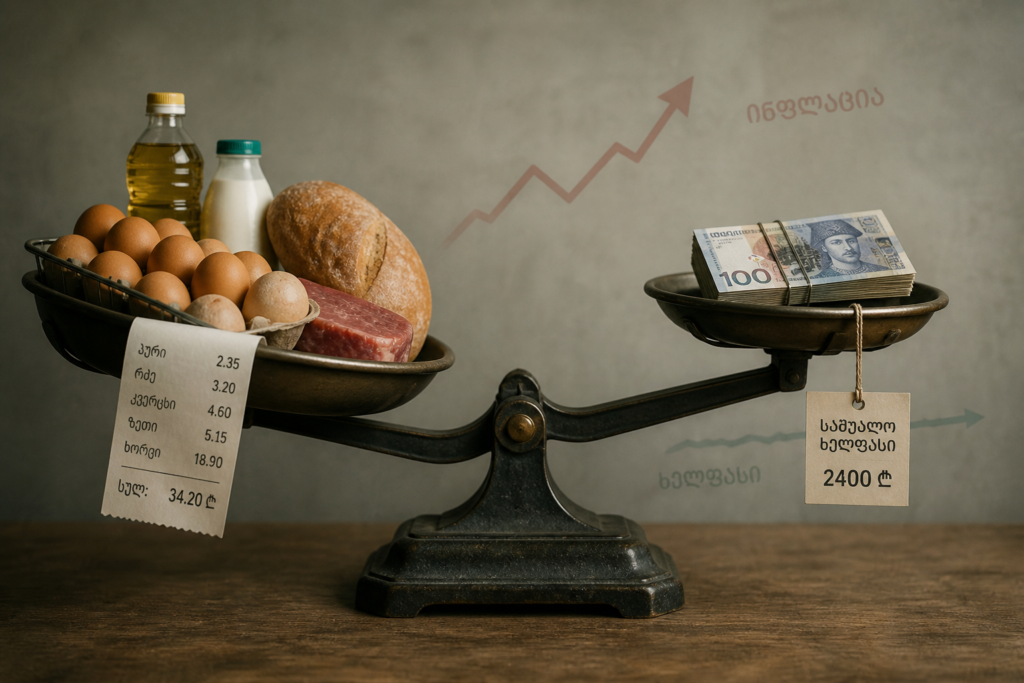
On the eve of the report’s publication, Kobakhidze also pointed out that the key problem in the country is not citizen spending, but their income: “Our prices are nominally lower than in France, Germany, and other Eurozone countries; however, the second point is that salaries in Georgia are significantly lower. Our average salary is about 2,400 lari, while in France it is an average of 2,680 euros. The difference is large.”
At the same time, Kobakhidze’s comments regarding the prices of certain products in Georgia sparked a wave of indignation. For example, the Prime Minister claimed that eggs could be bought for 4.60 lari for 10 pieces, and half a kilogram of beef or pork for 10 lari. Critics of the government accused the head of government of lying, stating that such prices do not exist in Georgia.
Egg Index
From the beginning, the commission and the Prime Minister himself paid special attention to egg prices. In economics, this product is often used as a clear example to explain basic processes. For instance, it is used to demonstrate the concept of “inelastic demand”: even with a noticeable price increase, people continue to buy eggs because they are a staple daily product.
Eggs are also frequently used to explain inflation and the so-called “supply shock”—a situation where supply falls due to reduced deliveries or production, causing prices to spike. This led to the emergence of a specific term—the Egg Index—where the cost of eggs becomes a simple and understandable indicator of how strongly ordinary consumers feel inflation.
A few months after Kobakhidze announced plans to fight high prices, egg producers Savaneti, Dila, Koda, and Kumisi reported a price reduction of up to 5%.
The National Statistics Office of Georgia (Geostat) also recorded a decrease: in February, prices in the “milk, cheese, and eggs” category fell by 3.5%. However, an important nuance is that in January 2026, this same category had increased by the same 3.5%. Thus, the February decrease effectively only compensated for the January growth rather than representing a new, sustainable reduction.
Zurab Uchumbegashvili, head of the Poultry Development Association and co-founder of Kumisi, admitted that in January, producers increased egg prices by 5.5%, and the necessity of such an increase had been warned about as early as November. Reasons cited included rising wages, increased distribution costs, and other production overheads.
Furthermore, the prerequisites for the price hike appeared even before the Prime Minister’s December statement. Back in November, Uchumbegashvili spoke of a sharp decline in egg imports to Georgia—by 93.1% compared to the same period in 2024. As a result, by December, the import level was at its lowest in 11 years, and talk of shortages and supply disruptions began in the market.

Notably, in the first quarter of 2026, Georgia imported 11.1 million table eggs worth 847,000 dollars, whereas in the same period last year, table egg imports were zero. The main supplier was Turkey, which provided about 10 million eggs, with another million coming from Belarus. Usually, the country imports hatching eggs to support its own production; however, this time the market had to be covered by ready-to-sell table eggs.
Against this backdrop, domestic production was declining: in the fourth quarter of 2025, 165 million eggs were produced in Georgia, compared to 171 million a year earlier. This means the market stabilized not so much through domestic production cost reductions, but through external supplies.
Inflation Has Slowed, but Not Vanished
Economic expert Nika Shenghelia notes that Geostat data does not always reflect the public’s real perception of inflation. Formally, the agency uses standard international methodology and calculates inflation based on a consumer basket. However, it should be considered, for example, that for low-income segments of the population, food accounts for a significantly larger share of expenses than is reflected in the averaged basket.
Furthermore, there is a time lag between changes in market prices and the publication of statistics, as well as a noticeable difference between prices in Tbilisi and the regions. Therefore, as the expert says, the public perception that “everything is getting more expensive” is often stronger than official inflation figures.
“A slowdown in inflation does not mean a decrease in prices. It only means that prices are continuing to rise more slowly than before.”
Shenghelia also believes that the problem goes far beyond food inflation and concerns the very structure of the Georgian economy. A significant portion of economic activity is generated not by production or exports, but by consumption, which is largely supported by lending.
According to the expert, people are spending more not because their real incomes have grown substantially, but because access to loans has expanded. This creates a partially artificial character of economic growth and makes the system vulnerable to any changes in the banking sector.
Shenghelia points out that the banking sector in Georgia remains one of the strongest and, at the same time, most concentrated: a few large banks effectively determine the country’s financial dynamics.
“If growth is largely driven by credit, any tightening of credit policy automatically impacts economic activity.”
Additional vulnerability, according to him, is created by the economy’s dependence on external inflows—tourism, remittances, and foreign investment. This means that internal resilience remains limited, and even one serious external shock could quickly slow down existing growth.
Shenghelia considers the lack of economic diversification and weak reliance on domestic production to be the main problem.
“When a country consumes more than it produces, this imbalance becomes evident sooner or later. Then the main question becomes very simple: do we have real sustainable development, or are we just in a temporarily favorable phase?”