


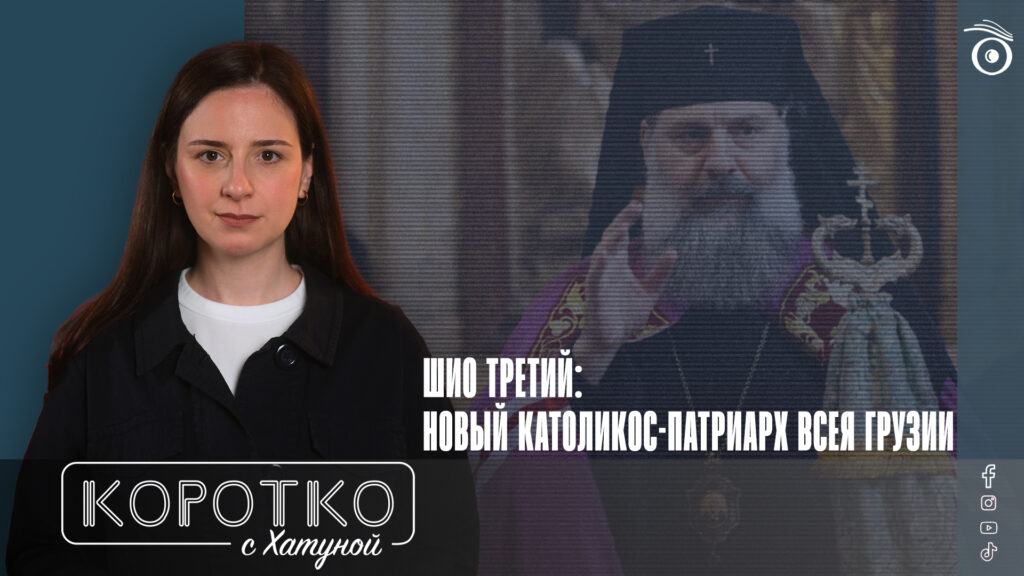
Georgia has a new spiritual leader. This event is, without exaggeration, epochal. For the first time since 1977, the fate of the patriarchal throne was decided at the Sameba Cathedral. Although the suspense lasted until the very end, there was no sensation: 22 out of 39 members of the Holy Synod cast their votes for Metropolitan Shio Mujiri.
A new chapter in the history of the GOC (Georgian Orthodox Church) officially opened on the 56th day following the passing of Ilia II. Shio III conducted his first service as Catholicos-Patriarch in the ancient Svetitskhoveli Cathedral in Mtskheta. This was preceded by an enthronement ceremony.
The 57-year-old Metropolitan of Senaki and Chkhorotsqu, Shio Mujiri, had been tipped for the patriarchal throne from the very beginning. During Ilia II’s lifetime, he was appointed as his locum tenens (acting head of the church). For supporters, Shio’s election was the long-awaited fulfillment of the late Patriarch’s will. For critics, it was a reminder of a visit from Moscow nearly nine years ago. In 2017, Metropolitan Hilarion Alfeyev, head of the ROC’s (Russian Orthodox Church) Department for External Church Relations, visited Tbilisi. Following his departure, it was announced that Shio Mujiri would serve as the locum tenens of the patriarchal throne.
Over time, critics dubbed the Metropolitan of Senaki and Chkhorotsqu one of the hierarchs most loyal to the ROC. This may have been the reason why, in his speech at Ilia II’s funeral service, the then-locum tenens listed nearly all foreign guests but pointedly omitted any mention of the Russian delegation.
Notably, the “Russian chapter” of the new Patriarch’s biography is quite extensive: Shio Mujiri received his higher theological education in Moscow, graduating from the correspondence department of the Moscow Theological Seminary and St. Tikhon’s Orthodox University for the Humanities. In 2015, he defended his dissertation there, earning a Candidate of Theology degree. Alongside his studies, until his appointment as bishop in 2003, he served directly in the Russian capital as the rector of the Georgian parish at the Church of St. George on Malaya Gruzinskaya.
Prior to the election, neither the Russian authorities nor the ROC publicly expressed support for Shio Mujiri. However, even before the Holy Synod’s vote, Russian intelligence claimed that Ecumenical Patriarch Bartholomew was attempting to bring the GOC under his influence. Metropolitan Grigol of Poti and Khobi was identified as the hierarch favored by the latter. Notably, Grigol was among the top three candidates for the patriarchal throne but received only 7 votes.
Ultimately, the patriarchal koukoulion (monastic hood) was not the only thing to rest on the shoulders of Catholicos-Patriarch Shio III; he also carries a heavy burden of suspicion. He is described as a private and extremely cautious hierarch who now faces his greatest challenge: emerging from the shadow of his predecessor and proving through his actions that he is an independent leader. The half-century era of Ilia II, built on unquestionable personal authority, has officially come to an end. For the new head of the GOC, the journey is just beginning.