


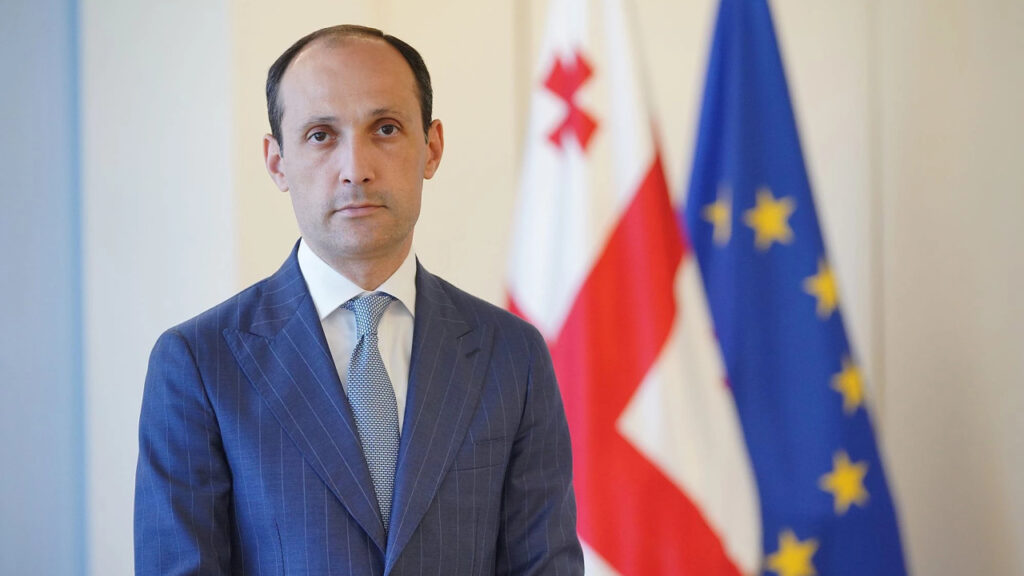
Former Georgian Minister of Economy and Sustainable Development Levan Davitashvili has been appointed CEO of the Italian oil and gas company Italiana Petroli (IP) following its acquisition by the State Oil Company of the Azerbaijan Republic (SOCAR).
SOCAR announced his appointment as CEO (Chief Executive Officer) after completing the deal to purchase 99.82% of IP’s share capital.
In a press release dated May 13, IP stated that Davitashvili would lead its operations in Italy, “focusing on ensuring business continuity, maintaining and further strengthening the company’s position in the national energy market, and overseeing the company’s integration into the broader SOCAR group structure.”
The company noted that Davitashvili is “fluent in Italian” and “has over 25 years of experience in leadership positions in both the public and private sectors.” It was noted that during his tenure as Georgia’s Minister of Economy, he “led the country’s economic strategy and supported the implementation of major infrastructure initiatives.”
It was also specified that Davitashvili managed “Georgia’s participation in the ‘Green Energy Corridor’ initiative, connecting the South Caucasus with European Union member states,” and that “since November 2025, he has held the position of advisor to the President of SOCAR.”
As a reminder, Levan Davitashvili served as Georgia’s Minister of Economy and Vice Prime Minister from 2022 until June 2025, when he was succeeded by Minister Mariam Kvrivishvili.
After leaving office, Davitashvili was appointed as the Chief Economic Advisor to Georgian Prime Minister Irakli Kobakhidze and Secretary of the Economic Council, a coordinating body.
Davitashvili also chaired the board of directors of Black Sea Petroleum, which operates the recently opened oil refinery in Kulevi on Georgia’s Black Sea coast.
In recent months, the refinery has come under scrutiny for its alleged role in facilitating the export of Russian oil.
The scandal also affected the port of Kulevi, which, for its part, is owned and operated by SOCAR. Initially, this port was considered for inclusion in the European Union’s 20th sanctions package against Russia. Ultimately, the EU decided not to include the port in the sanctions package, citing “positive commitments” from the Georgian authorities and the terminal operator, SOCAR.
In February 2026, Davitashvili was questioned by the Anti-Corruption Agency of the State Security Service of Georgia (SSSG) regarding what authorities later described as “part of an ongoing investigation into a contract concluded with one of the largest oil companies.”
Davitashvili stated that the “discussions” concerned, in particular, possible risks related to Georgia’s facilitation of gas supplies to Europe. Later, the agency corrected him, explaining that he was under interrogation rather than in a discussion, and that the questions concerned risks related to Georgia’s own gas supplies and contract terms affecting the country, rather than gas supplies to the EU.