


This material is part of a partnership with OC Media. You can read the original English version here.
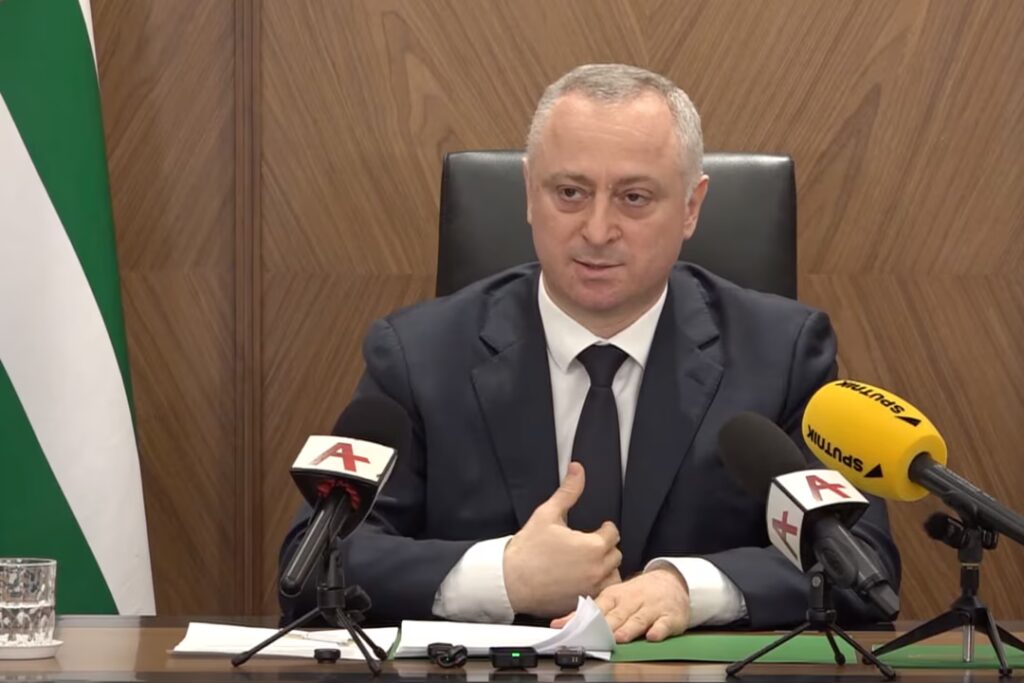
Abkhaz President Badra Gunba held his first major press conference since his election in March 2025. Although formally dedicated to the government’s performance over the past year, it effectively turned into a detailed discussion on the state of the economy, infrastructure constraints, and Abkhazia’s dependence on external factors, primarily concerning engagement with Russia.
Gunba began his press conference on 15 May by listing positive statistical data, including GDP growth of over 30%, an increase in budget revenues to 21.7 billion rubles ($300 million), and a rise in the share of domestic revenue to over 61%.
However, the very first question from a journalist regarding inflation and rising prices soon shifted the focus of the conversation, revealing that behind the macroeconomic figures lies a more vulnerable economic structure, where growth largely coexists with limited stability and a significant shadow economy.
Indeed, Gunba explicitly acknowledged the impact of inflation on the decline of citizens’ real incomes, noting that inflation “grows annually” and that this trend “is observed not only in Abkhazia but also in neighboring countries, and its causes are quite obvious.”
Regarding government measures, he mentioned public sector wage increases and attempts to stimulate the private sector. However, the main focus was elsewhere: the need to bring the economy out of the “grey zone.”
A large-scale reform of tax administration and the implementation of cash register equipment were identified as key tools for this. According to Gunba, the process of installing over a thousand cash registers has already begun, despite resistance from some businesses. “The state can no longer allow the economy to remain in the grey zone. No compromise is possible here,” he emphasized.
Gunba then dedicated an entire section of the press conference to energy — one of the most acute issues in Abkhazia.
“Every one of you remembers 2024, when scheduled power outages lasted from 10 to 12 hours. Every one of you felt firsthand how difficult it is to live without heat and light,” he said.
The Sukhumi leader further emphasized that the energy system suffers from a chronic deficit, and network losses require not only technical solutions but also stricter control. In response, the government announced the reconstruction of substations, the upgrading of power lines, and the introduction of consumption metering.
At the same time, Gunba also noted that a significant portion of current stability is ensured through support from Russia.
“This is enormous support. If converted into monetary terms, it amounts to more than 2 billion rubles,” he said.
Gunba also paid special attention to logistics, highlighting the launch of the airport in Sukhumi and stating that the resumption of air travel should become a key driver of the economy.
He also focused on the development of transit routes through Abkhazia, the modernization of railway lines, and increasing transit through maritime infrastructure, including the port of Ochamchira.
Gunba made it clear that the government expects increased tax revenues, job creation, and tourism growth as a result of these changes; however, in essence, these measures represent an attempt to transform Abkhazia into a more active regional transport hub through participation and investment from Russia.
In addition to questions of further financial aid, a significant part of the press conference was devoted to interaction with Russia in the social sphere. One of the most sensitive issues in this regard remains the situation of Abkhazian citizens who received payments and maternity capital (state subsidies for families with children) in Russia and subsequently faced legal consequences.
“For me personally, this is a priority issue,” Gunba noted, adding that work is underway on legal mechanisms to resolve this problem.
The Sukhumi leader also specifically thanked his Russian colleagues for their involvement in finding solutions, emphasizing that the dialogue on social guarantees will continue.
In conclusion, Gunba touched upon the topic of demographic policy and repatriation, acknowledging that the current model has not yielded the expected results.
“We need to revise the entire concept of repatriation. This applies not only to Turkey but also to Russia, as well as interaction with Abaza communities in the North Caucasus,” he said.
At the same time, his speech also suggested a broader shift in approach — from the idea of settling repatriates in separate enclaves to a more integrative model involving cohabitation and inclusion into existing social structures, including support for young families within the country.
Overall, Gunba’s performance left a dual impression: on one hand, there was growth in macroeconomic indicators, a budget increase, and the launch of infrastructure projects; on the other, structural limitations were acknowledged: inflationary pressure, the shadow economy, energy shortages, and high dependence on external support.
OC Media: For ease of reading, we have chosen not to use qualifiers such as “de facto”, “unrecognized”, or “partially recognized” when discussing institutions or political positions in Abkhazia, Nagorno-Karabakh, and South Ossetia. This does not imply that we take any position on their status.