


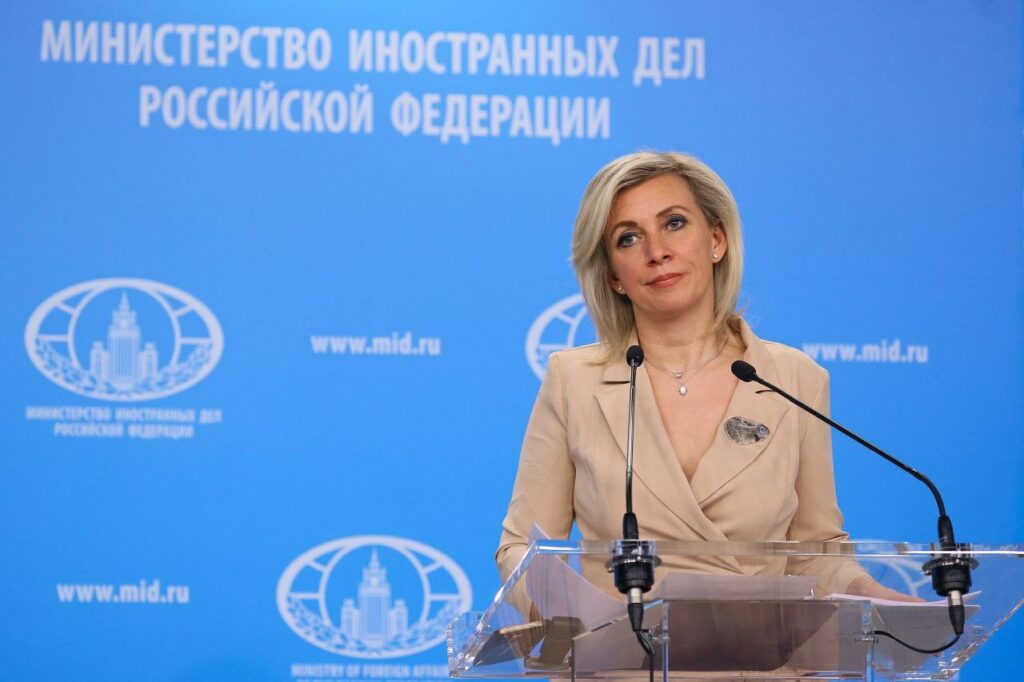
According to Maria Zakharova, the official spokesperson for the Russian Ministry of Foreign Affairs (MID), despite pressure from the West, Georgia has chosen a multi-vector policy. During a briefing in Moscow, Zakharova was asked to comment on how the Ministry assesses current relations with the countries of the South Caucasus and which areas of cooperation it considers priorities.
“Despite well-known disagreements, we strive to build ties with this country based on the principles of pragmatism and equality. Taking into account all the rich, positive, beautiful, and wonderful experience we shared in the past. Despite the unceremonious attempts of EU bureaucrats to impose a confrontational course toward Moscow on Tbilisi, to introduce anti-Russian sanctions, and essentially (to put it simply) to sacrifice their own interests for the sake of the West’s political madness, Georgia has chosen a multi-vector policy,” Zakharova stated.
According to her, economic cooperation between Moscow and Tbilisi is actively expanding. Last year, trade turnover reached a record $2.7 billion, and the tourist flow from Russia amounted to 1.4 million people.
“Our country remains a key export market for Georgia and, at the same time, a leading supplier of strategically important products—energy resources and grain. We strive to create all the necessary conditions for the development of humanitarian contacts between our peoples, who are united by common values and long-standing historical and cultural ties.”
Separately, Maria Zakharova commented on Moscow’s relations with the occupied regions of Georgia. According to her, Sukhumi and Tskhinvali remain “Russia’s closest allies in the South Caucasus.”
“A shared historical past, aligned cultural and moral values, and common approaches to international and regional issues underpin the close cooperation between our states at the current stage. The priority tasks remain ensuring the reliable protection of the republics’ sovereignty, promoting their development and strengthening their foreign policy positions, and expanding trade, investment, and humanitarian cooperation and interaction,” the Russian Foreign Ministry spokesperson stated.
She also added that the sides would continue their “joint movement toward shaping common security contours and socio-economic spaces.” In this context, Zakharova mentioned the “Treaty on Deepening Alliance Integration and other international legal acts” signed on May 9 by the President of Russia and the de facto leader of South Ossetia.
Overall, according to the Foreign Ministry spokesperson, “Russia—contrary to the wishes of many in the West—is not going anywhere from the South Caucasus and has no intention of leaving.”
“This is impossible by definition—due to historical and geographical reasons. But how serious and long-term the interests of the EU and the US are remains an open question. Unlike those who think opportunistically, our country is sincerely interested in the prosperity, peace, and stability of the region. We are ready to continue working with regional actors and their Maria Zakharova: Georgia Has Chosen a Multi-Vector Policy
According to Maria Zakharova, the official spokesperson for the Russian Ministry of Foreign Affairs, despite pressure from the West, Georgia has chosen a multi-vector policy. During a briefing in Moscow, Zakharova was asked to comment on how the Ministry assesses current relations with the countries of the South Caucasus and which areas of cooperation it considers priorities.
“Despite well-known disagreements, we strive to build ties with this country based on the principles of pragmatism and equality. Taking into account all the rich, positive, beautiful, and wonderful experience we shared in the past. Despite the unceremonious attempts of EU bureaucrats to impose a confrontational course toward Moscow on Tbilisi, to introduce anti-Russian sanctions, and essentially (to put it simply) to sacrifice their own interests for the sake of the West’s political madness, Georgia has chosen a multi-vector policy,” Zakharova stated.
According to her, economic cooperation between Moscow and Tbilisi is actively expanding. Last year, trade turnover reached a record $2.7 billion, and the tourist flow from Russia amounted to 1.4 million people.
“Our country remains a key export market for Georgia and, at the same time, a leading supplier of strategically important products—energy resources and grain. We strive to create all the necessary conditions for the development of humanitarian contacts between our peoples, who are united by common values and long-standing historical and cultural ties.”
Separately, Maria Zakharova commented on Moscow’s relations with the occupied regions of Georgia. According to her, Sukhumi and Tskhinvali remain “Russia’s closest allies in the South Caucasus.”
“A shared historical past, aligned cultural and moral values, and common approaches to international and regional issues underpin the close cooperation between our states at the current stage. The priority tasks remain ensuring the reliable protection of the republics’ sovereignty, promoting their development and strengthening their foreign policy positions, and expanding trade, investment, and humanitarian cooperation and interaction,” the Russian Foreign Ministry spokesperson stated.
She also added that the sides would continue their “joint movement toward shaping common security contours and socio-economic spaces.” In this context, Zakharova mentioned the “Treaty on Deepening Alliance Integration and other international legal acts” signed on May 9 by the President of Russia and the de facto leader of South Ossetia.
Overall, according to the Foreign Ministry spokesperson, “Russia—contrary to the wishes of many in the West—is not going anywhere from the South Caucasus and has no intention of leaving.”
“This is impossible by definition—due to historical and geographical reasons. But how serious and long-term the interests of the EU and the US are remains an open question. Unlike those who think opportunistically, our country is sincerely interested in the prosperity, peace, and stability of the region. We are ready to continue working with regional actors and their Maria Zakharova: Georgia Has Chosen a Multi-Vector Policy
According to Maria Zakharova, the official spokesperson for the Russian Ministry of Foreign Affairs, despite pressure from the West, Georgia has chosen a multi-vector policy. During a briefing in Moscow, Zakharova was asked to comment on how the Ministry assesses current relations with the countries of the South Caucasus and which areas of cooperation it considers priorities.
“Despite well-known disagreements, we strive to build ties with this country based on the principles of pragmatism and equality. Taking into account all the rich, positive, beautiful, and wonderful experience we shared in the past. Despite the unceremonious attempts of EU bureaucrats to impose a confrontational course toward Moscow on Tbilisi, to introduce anti-Russian sanctions, and essentially (to put it simply) to sacrifice their own interests for the sake of the West’s political madness, Georgia has chosen a multi-vector policy,” Zakharova stated.
According to her, economic cooperation between Moscow and Tbilisi is actively expanding. Last year, trade turnover reached a record $2.7 billion, and the tourist flow from Russia amounted to 1.4 million people.
“Our country remains a key export market for Georgia and, at the same time, a leading supplier of strategically important products—energy resources and grain. We strive to create all the necessary conditions for the development of humanitarian contacts between our peoples, who are united by common values and long-standing historical and cultural ties.”
Separately, Maria Zakharova commented on Moscow’s relations with the occupied regions of Georgia. According to her, Sukhumi and Tskhinvali remain “Russia’s closest allies in the South Caucasus.”
“A shared historical past, aligned cultural and moral values, and common approaches to international and regional issues underpin the close cooperation between our states at the current stage. The priority tasks remain ensuring the reliable protection of the republics’ sovereignty, promoting their development and strengthening their foreign policy positions, and expanding trade, investment, and humanitarian cooperation and interaction,” the Russian Foreign Ministry spokesperson stated.
She also added that the sides would continue their “joint movement toward shaping common security contours and socio-economic spaces.” In this context, Zakharova mentioned the “Treaty on Deepening Alliance Integration and other international legal acts” signed on May 9 by the President of Russia and the de facto leader of South Ossetia.
Overall, according to the Foreign Ministry spokesperson, “Russia—contrary to the wishes of many in the West—is not going anywhere from the South Caucasus and has no intention of leaving.”
“This is impossible by definition—due to historical and geographical reasons. But how serious and long-term the interests of the EU and the US are remains an open question. Unlike those who think opportunistically, our country is sincerely interested in the prosperity, peace, and stability of the region. We are ready to continue working with regional actors and their neighbors with a view to letting the South Caucasus breathe with full lungs. And let it be the air of freedom, not the stale air of Western narratives,” Zakharova concluded. with a view to letting the South Caucasus breathe with full lungs. And let it be the air of freedom, not the stale air of Western narratives,” Zakharova concluded. with full lungs. And let it be the air of freedom, not the stale air of Western narratives,” Zakharova concluded., despite pressure from the West, Georgia has chosen a multi-vector policy. During a briefing in Moscow, Zakharova was asked to comment on how the Ministry assesses current relations with the countries of the South Caucasus and which areas of cooperation it considers priorities.
“Despite well-known disagreements, we strive to build ties with this country based on the principles of pragmatism and equality. Taking into account all the rich, positive, beautiful, and wonderful experience we shared in the past. Despite the unceremonious attempts of EU bureaucrats to impose a confrontational course toward Moscow on Tbilisi, to introduce anti-Russian sanctions, and essentially (to put it simply) to sacrifice their own interests for the sake of the West’s political madness, Georgia has chosen a multi-vector policy,” Zakharova stated.
According to her, economic cooperation between Moscow and Tbilisi is actively expanding. Last year, trade turnover reached a record $2.7 billion, and the tourist flow from Russia amounted to 1.4 million people.
“Our country remains a key export market for Georgia and, at the same time, a leading supplier of strategically important products—energy resources and grain. We strive to create all the necessary conditions for the development of humanitarian contacts between our peoples, who are united by common values and long-standing historical and cultural ties.”
Separately, Maria Zakharova commented on Moscow’s relations with the occupied regions of Georgia. According to her, Sukhumi and Tskhinvali remain “Russia’s closest allies in the South Caucasus.”
“A shared historical past, aligned cultural and moral values, and common approaches to international and regional issues underpin the close cooperation between our states at the current stage. The priority tasks remain ensuring the reliable protection of the republics’ sovereignty, promoting their development and strengthening their foreign policy positions, and expanding trade, investment, and humanitarian cooperation and interaction,” the Russian Foreign Ministry spokesperson stated.
She also added that the sides would continue their “joint movement toward shaping common security contours and socio-economic spaces.” In this context, Zakharova mentioned the “Treaty on Deepening Alliance Integration and other international legal acts” signed on May 9 by the President of Russia and the de facto leader of South Ossetia.
Overall, according to the Foreign Ministry spokesperson, “Russia—contrary to the wishes of many in the West—is not going anywhere from the South Caucasus and has no intention of leaving.”
“This is impossible by definition—due to historical and geographical reasons. But how serious and long-term the interests of the EU and the US are remains an open question. Unlike those who think opportunistically, our country is sincerely interested in the prosperity, peace, and stability of the region. We are ready to continue working with regional actors and their Maria Zakharova: Georgia Has Chosen a Multi-Vector Policy
According to Maria Zakharova, the official spokesperson for the Russian Ministry of Foreign Affairs, despite pressure from the West, Georgia has chosen a multi-vector policy. During a briefing in Moscow, Zakharova was asked to comment on how the Ministry assesses current relations with the countries of the South Caucasus and which areas of cooperation it considers priorities.
“Despite well-known disagreements, we strive to build ties with this country based on the principles of pragmatism and equality. Taking into account all the rich, positive, beautiful, and wonderful experience we shared in the past. Despite the unceremonious attempts of EU bureaucrats to impose a confrontational course toward Moscow on Tbilisi, to introduce anti-Russian sanctions, and essentially (to put it simply) to sacrifice their own interests for the sake of the West’s political madness, Georgia has chosen a multi-vector policy,” Zakharova stated.
According to her, economic cooperation between Moscow and Tbilisi is actively expanding. Last year, trade turnover reached a record $2.7 billion, and the tourist flow from Russia amounted to 1.4 million people.
“Our country remains a key export market for Georgia and, at the same time, a leading supplier of strategically important products—energy resources and grain. We strive to create all the necessary conditions for the development of humanitarian contacts between our peoples, who are united by common values and long-standing historical and cultural ties.”
Separately, Maria Zakharova commented on Moscow’s relations with the occupied regions of Georgia. According to her, Sukhumi and Tskhinvali remain “Russia’s closest allies in the South Caucasus.”
“A shared historical past, aligned cultural and moral values, and common approaches to international and regional issues underpin the close cooperation between our states at the current stage. The priority tasks remain ensuring the reliable protection of the republics’ sovereignty, promoting their development and strengthening their foreign policy positions, and expanding trade, investment, and humanitarian cooperation and interaction,” the Russian Foreign Ministry spokesperson stated.
She also added that the sides would continue their “joint movement toward shaping common security contours and socio-economic spaces.” In this context, Zakharova mentioned the “Treaty on Deepening Alliance Integration and other international legal acts” signed on May 9 by the President of Russia and the de facto leader of South Ossetia.
Overall, according to the Foreign Ministry spokesperson, “Russia—contrary to the wishes of many in the West—is not going anywhere from the South Caucasus and has no intention of leaving.”
“This is impossible by definition—due to historical and geographical reasons. But how serious and long-term the interests of the EU and the US are remains an open question. Unlike those who think opportunistically, our country is sincerely interested in the prosperity, peace, and stability of the region. We are ready to continue working with regional actors and their Maria Zakharova: Georgia Has Chosen a Multi-Vector Policy
According to Maria Zakharova, the official spokesperson for the Russian Ministry of Foreign Affairs, despite pressure from the West, Georgia has chosen a multi-vector policy. During a briefing in Moscow, Zakharova was asked to comment on how the Ministry assesses current relations with the countries of the South Caucasus and which areas of cooperation it considers priorities.
“Despite well-known disagreements, we strive to build ties with this country based on the principles of pragmatism and equality. Taking into account all the rich, positive, beautiful, and wonderful experience we shared in the past. Despite the unceremonious attempts of EU bureaucrats to impose a confrontational course toward Moscow on Tbilisi, to introduce anti-Russian sanctions, and essentially (to put it simply) to sacrifice their own interests for the sake of the West’s political madness, Georgia has chosen a multi-vector policy,” Zakharova stated.
According to her, economic cooperation between Moscow and Tbilisi is actively expanding. Last year, trade turnover reached a record $2.7 billion, and the tourist flow from Russia amounted to 1.4 million people.
“Our country remains a key export market for Georgia and, at the same time, a leading supplier of strategically important products—energy resources and grain. We strive to create all the necessary conditions for the development of humanitarian contacts between our peoples, who are united by common values and long-standing historical and cultural ties.”
Separately, Maria Zakharova commented on Moscow’s relations with the occupied regions of Georgia. According to her, Sukhumi and Tskhinvali remain “Russia’s closest allies in the South Caucasus.”
“A shared historical past, aligned cultural and moral values, and common approaches to international and regional issues underpin the close cooperation between our states at the current stage. The priority tasks remain ensuring the reliable protection of the republics’ sovereignty, promoting their development and strengthening their foreign policy positions, and expanding trade, investment, and humanitarian cooperation and interaction,” the Russian Foreign Ministry spokesperson stated.
She also added that the sides would continue their “joint movement toward shaping common security contours and socio-economic spaces.” In this context, Zakharova mentioned the “Treaty on Deepening Alliance Integration and other international legal acts” signed on May 9 by the President of Russia and the de facto leader of South Ossetia.
Overall, according to the Foreign Ministry spokesperson, “Russia—contrary to the wishes of many in the West—is not going anywhere from the South Caucasus and has no intention of leaving.”
“This is impossible by definition—due to historical and geographical reasons. But how serious and long-term the interests of the EU and the US are remains an open question. Unlike those who think opportunistically, our country is sincerely interested in the prosperity, peace, and stability of the region. We are ready to continue working with regional actors and their neighbors with a view to letting the South Caucasus breathe with full lungs. And let it be the air of freedom, not the stale air of Western narratives,” Zakharova concluded. with a view to letting the South Caucasus breathe with full lungs. And let it be the air of freedom, not the stale air of Western narratives,” Zakharova concluded. with full lungs. And let it be the air of freedom, not the stale air of Western narratives,” Zakharova concluded.