


A video from Gori showing a group of police officers beating a man lying on the ground has once again raised the issue of police violence in Georgia. Six Ministry of Internal Affairs (MIA) officers have been arrested, but a criminal case has also been opened against the victim himself. The opposition and human rights activists point to a systemic problem, while the authorities present the incident as an isolated episode to which the state responded promptly.


Footage filmed from a distance showing about a dozen police officers beating a man lying on the ground has sparked a debate on police brutality in Georgia. On May 27, regional media outlet qartli.ge published a video from the Kombinati settlement in Gori. In it, a group of law enforcement officers surrounds and kicks a young man lying on the ground. In the recording, he can be heard screaming: “Don’t beat me!”
As it later became known, the victim is 29-year-old Gori resident Papuna Lotsulashvili. According to his friend, Lasha Abisonashvili, the conflict began after a police car tried to run over Lotsulashvili or approached him abruptly. The man claims that his friend was simply walking along the side of the road during a break at work.
“The conversation went like this: ‘Why did you run into me?’. Then a fight broke out, and I came over. There were only two of us. I don’t know the reason why we were beaten. I’m sure he [Papuna] doesn’t know either.”
Media reports also circulated a version suggesting that one of the beaten men might have had a bladed weapon. Abisonashvili denies this. According to him, he was released after the incident, while Lotsulashvili was taken to the police station. He also said that when his friend mentioned he worked at the Bank of Georgia and would call a lawyer, the police officers became even more aggressive.

Following the incident, the Georgian Ministry of Internal Affairs remained silent for a long time. Later, Deputy Minister of Internal Affairs Aleksandre Darakhvelidze called the beating of Lotsulashvili a “sad fact,” but presented a version of events according to which the incident was preceded by a police operation.
According to Darakhvelidze, officers stopped the citizen for a check, but he refused to comply with police demands, showed aggression, and struck one of the officers with a “blunt object – a stone.” The Ministry of Internal Affairs stated that the officer is currently undergoing medical treatment.
At the same time, the Deputy Minister admitted that the police officers themselves exceeded their authority by using violence, which resulted in the citizen being injured:
“The Ministry condemns any violence and declares its full readiness to cooperate with investigative bodies for a complete and objective establishment of the circumstances of the case and to bring the perpetrators to justice under the law.”
The paradox is that the prosecutor’s office has launched investigations into both the police officers who beat the man and the victim himself. Six law enforcement officers were charged under Article 333, Part 3, Subparagraph “b” of the Criminal Code of Georgia: abuse of official authority with the use of violence. They face five to eight years in prison. All suspects have been detained and placed in pre-trial custody.
A case has been opened against Papuna Lotsulashvili himself under Article 353 – resistance, threat, or violence against a person protecting public order or another representative of authority. This article carries a penalty of house arrest, a fine, or imprisonment for a term of two to six years.
Lotsulashvili’s defense considers the charges against him unfounded and absurd. Defense attorney Lasha Tkesheladze stated that his client was the one beaten and injured, so the police officers should be charged under a more severe article.
“We saw clearly in the footage how about ten or even more police officers pounced on him. This is simply torture. The prosecutor’s office has launched an investigation under the wrong article; it must be reclassified and investigated as torture,” Tkesheladze said.
Following the incident, Lotsulashvili was diagnosed with multiple bruises and a fractured rib. He left the temporary detention facility, was hospitalized, and subsequently discharged, but his condition deteriorated again once he was home. According to his family, the man suffered from severe headaches and lost consciousness twice. After a second examination, he was admitted to the neurology department. 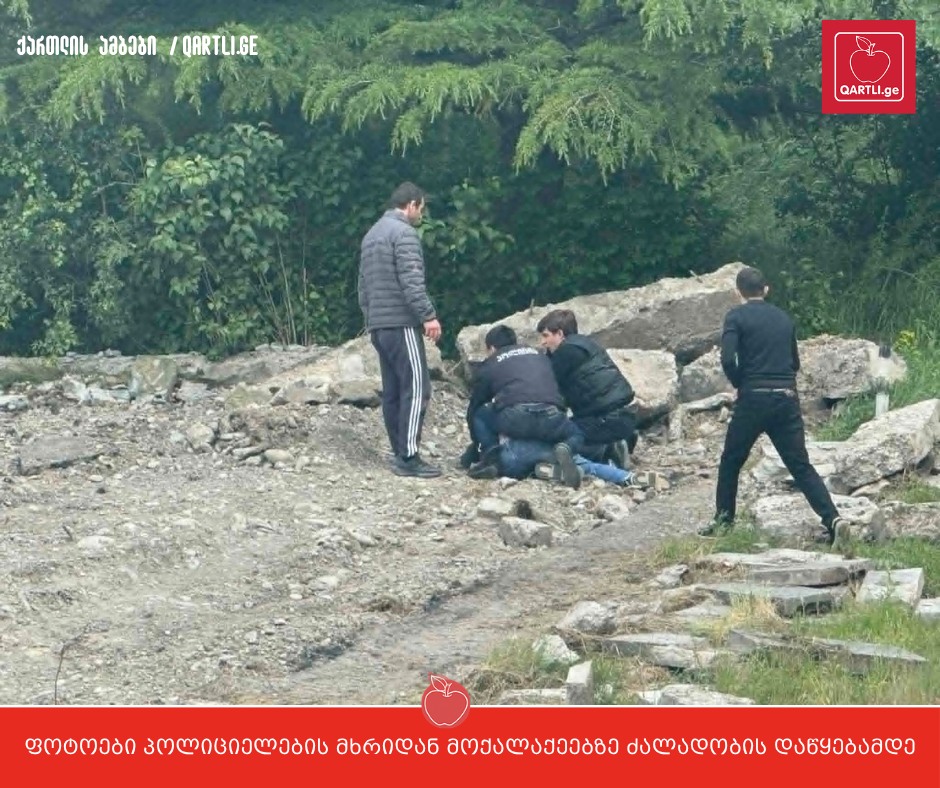

Prime Minister Irakli Kobakhidze called the footage from Gori “absolutely unacceptable.” However, critics of the government pointed out that the Gori incident occurred against the backdrop of harsh statements by representatives of the ruling Georgian Dream party regarding the dispersal of protests in Denmark. The Prime Minister had even addressed an open letter to the leaders of the European Commission, the European Parliament, and the Council of Europe, demanding their reaction to “violence in the Danish capital Copenhagen, where peaceful demonstrators were first beaten with batons and then had dogs set on them.”
Now, Georgian Dream claims that such “abuses” occur all over the world, but the key is the state’s immediate response.
“It was hard to watch these images, not only for me but for everyone who saw them, for every citizen of Georgia. A case has been opened on this matter, and today they [the police officers] have already been detained,” said MP Irakli Zarkua.
However, experts emphasize that in Georgia, this is not an isolated episode, but a systemic problem within law enforcement agencies.
“To realize the gravity of what happened in Gori, we need to ask the right questions: could all this have ended fatally, as in the case of Girgvliani, when the law enforcement system decided that someone had insulted one of their own and resolved to punish him?” notes political analyst Gia Khukhashvili.
This refers to one of the most high-profile cases of Mikheil Saakashvili’s presidency. In January 2006, 28-year-old bank employee Sandro Girgvliani was kidnapped after a conflict in a Tbilisi cafe, taken out of town, and brutally beaten. He was later found dead in a forest. Four Ministry of Internal Affairs officers were convicted in the case, but human rights activists and the victim’s family argued that the investigation failed to target high-ranking patrons within the security apparatus.
Later, Saakashvili pardoned the convicts, reducing their sentences, after which they were released early. Following the change of government, Saakashvili himself was convicted in absentia of abuse of official power over this pardon and sentenced to three years in prison.
In Georgian political memory, the Girgvliani case became a symbol not only of police violence but also of the system’s attempts to shield its own. The “prison footage” case became equally sensitive for Georgia. In September 2012, shortly before the parliamentary elections, video recordings of abuse and torture of inmates in the Gldani prison were published. The scandal triggered mass protests, resignations within the penitentiary system, and dealt a key political blow to the ruling United National Movement. Soon after, the government in the country changed.
In public memory, the “prison footage” was cemented as a symbol of systemic violence within law enforcement and penitentiary structures that only became visible after the videos were leaked. Gia Khukhashvili compares the 2012 case to the current events in Gori:
“When every police officer present there felt it was his duty to land at least one blow, was this a systemic crime similar to the so-called ‘prison footage’? If not for the recording, would we see the victim behind bars today on serious charges? Is the police system still trying to downplay a grave crime and sweep it under the rug with minimal accountability, as happened time and again in the Girgvliani case?”