


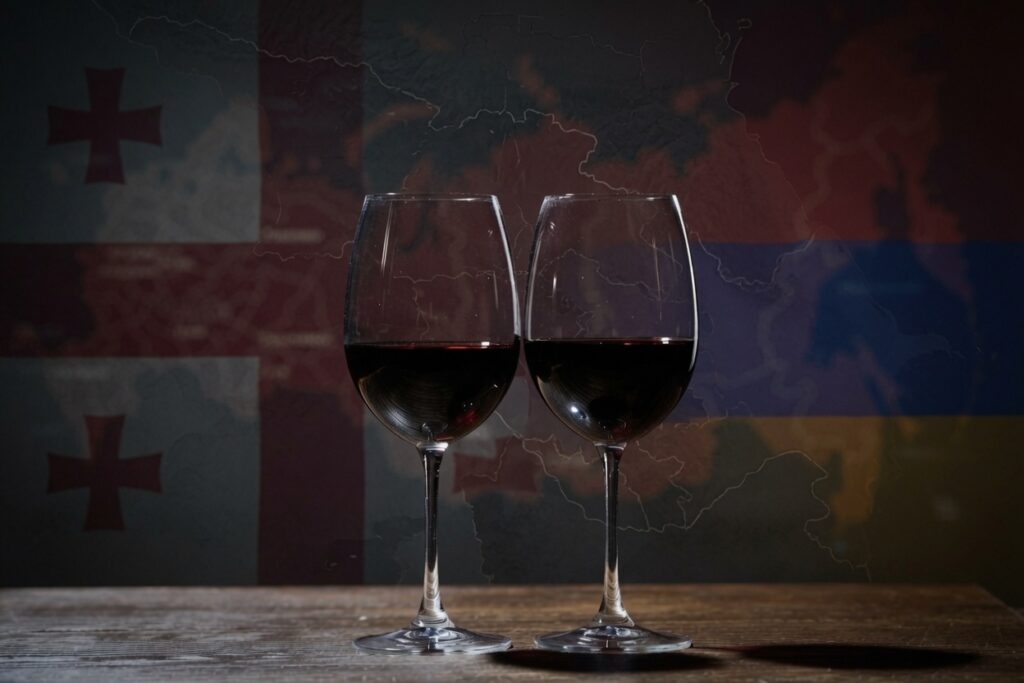
On the eve of the parliamentary elections in Armenia, Moscow declared a food war on Yerevan. The Russian Federation is imposing an embargo on Armenian products—ranging from flowers and mineral water to vegetables, fruits, fish, wine, and brandy. Georgia followed a similar path in 2006: Russian restrictions dealt a painful blow to exports, but simultaneously pushed producers to diversify. Now, following Tbilisi’s example, Yerevan also intends to seek new markets.


In the run-up to the elections in Armenia, Russian agencies began gradually restricting product shipments from the republic. Within a few weeks, several categories of Armenian exports fell under restrictions at once: flowers, Jermuk mineral water, certain types of wine and brandy, fresh tomatoes, cucumbers, peppers, herbs, strawberries, as well as fish and fish products. Later, the list expanded to include seasonal fruits—sour cherries, sweet cherries, apricots, plums, peaches, nectarines, and grapes.
Formally, the Russian side explains these decisions by citing sanitary, veterinary, and phytosanitary concerns. Rosselkhoznadzor (the Federal Service for Veterinary and Phytosanitary Supervision) claimed violations in the supply of fruit and vegetable products and the need to “ensure phytosanitary safety.” In the case of flowers, the agency cited the need to inspect greenhouse facilities. Rospotrebnadzor (the Federal Service for Surveillance on Consumer Rights Protection and Human Wellbeing), for its part, suspended the sale of Jermuk mineral water, citing non-compliance with safety and labeling requirements, and banned the sale of wines and brandies from three Armenian producers following quality checks.
Armenian Prime Minister Nikol Pashinyan characterized the ban as politically motivated. He promised to support companies affected by the Russian restrictions.
“The government has already decided that in all cases where unfair obstacles to exports arise, we will implement support programs, we will implement subsidy programs for these goods, so that there are no victims in our economy,” Pashinyan said, clarifying that this refers to cases where the obstacles are not related to product quality.
The Prime Minister later added that in addition to compensating affected companies, the government is also ready to find new markets. Armenia’s Minister of Economy, Gevorg Papoyan, also announced plans to redirect a portion of exports. According to him, products banned in the Russian Federation will be sold in European Union countries. The Ministry of Economy has already presented a company support program to the cabinet.
In an interview with CivilNet, Papoyan stated that Yerevan cannot “exchange sovereignty for tomatoes.” According to him, economic risks are important, but they have a limit when state interests are at stake.
“Today, I want to say that the products of the Republic of Armenia have resolved the quality issue. Our products are 100% compliant with European market standards,” Papoyan added.


Georgia’s Experience
In the past, Russia has repeatedly used food embargoes and sanitary bans as a tool of political pressure against post-Soviet countries that chose a path of rapprochement with the West.
Georgia and Moldova became classic examples of this policy. In 2006, amid worsening relations with Tbilisi and Chisinau, Rospotrebnadzor completely banned imports of Georgian and Moldovan wines, as well as Georgian Borjomi mineral water, officially citing “quality issues.” For Moldova, the blow was repeated in 2013–2014, when the country was signing an Association Agreement with the EU—not only wines, but also fruits, meat, and vegetables fell under the ban.
However, the geography of Moscow’s “trade wars” was much broader. In 2013, on the eve of the expected signing of the association agreement between Ukraine and the EU, Russia blocked imports of products from the Roshen confectionery company, and later introduced large-scale restrictions on Ukrainian agricultural products.
Over the years, sprats and dairy products from Estonia, Latvia, and Lithuania have also fallen under bans. Even the Kremlin’s closest allies faced economic pressure: due to oil, gas, and customs disputes, Russia regularly waged “milk” and “meat” wars, banning supplies from Belarusian enterprises.
These measures forced the affected states to diversify their markets and redirect exports to the European Union and Asia. This is precisely what happened with Georgian products. When the Russian Federation banned imports of Georgian wine, mineral water, and some agricultural products in 2006, it dealt a sensitive blow to the Georgian economy. Just as in the current case with Armenia, Moscow cited complaints about quality and sanitary standards back then as well.
Before the embargo, Russia remained the main market for Georgian wine: by various estimates, it accounted for the lion’s share of wine exports. In March 2006, the publication Civil Georgia wrote that up to 90% of all Georgian wine exports went to Russia, while the IWPR organization cited data showing that in the previous year, Georgia had exported over 36 million liters of wine to Russia, worth about $63 million.
However, the loss of the Russian market forced Georgian producers to seek new directions, change production standards, and work with more demanding markets. After the embargo, dependence on the Russian consumer was replaced by markets in Ukraine, EU countries, the US, and even China.
A 2013 article in the Journal of Wine Economics noted that after Moscow introduced the restrictions, Georgian wine exports initially declined in volume but “notably improved in quality.”
According to Galt&Taggart, from 2005 to 2012, exports of Georgian wine to the EU more than tripled, reaching about 2.6 million liters worth $9 million; the highest growth rates among EU countries were in Poland and Bulgaria. By 2014, the list of countries to which Tbilisi exported its wines had grown to 120.


Return to Exports to Russia
At the same time, the Georgian example highlights another side to this story: a dependency on the Russian market, once reduced, can be restored. After the embargo was lifted in 2013, Georgian wine quickly began to regain its position in Russia. For producers, this was a large and familiar market where the Georgian product was already recognized, and promotion costs were lower than in the EU or the US.
As a result, the Russian direction once again became the primary one for the industry. According to Transparency International Georgia, in 2021, the Russian Federation imported 55% of the wine exported from Georgia, valued at $131 million. In 2022, the Russian market share rose to 63.8%, and in 2023, it reached 65%—the highest level since 2005.
An article in the International Journal of Wine Business Research on the challenges of Georgian winemaking noted that the National Wine Agency had failed to sustain diversification after the embargo: after returning to the Russian market, exports there surged once again. This trend effectively returned the industry to its old vulnerability: the Russian market became not just a commercial destination, but a potential political lever once more.
Moreover, the issue was not only the volume of sales, but also the quality of the export model itself. A 2021 Galt&Taggart report noted that the average export price of Georgian wine in new target markets—such as the US, the UK, China, Japan, Germany, and others—was 26% higher than in the Russian Federation and other CIS countries. In other words, returning to the Russian market provided quick volume but kept the industry in a lower price segment compared to markets where Georgian wine could sell at higher prices and compete through quality and positioning.