


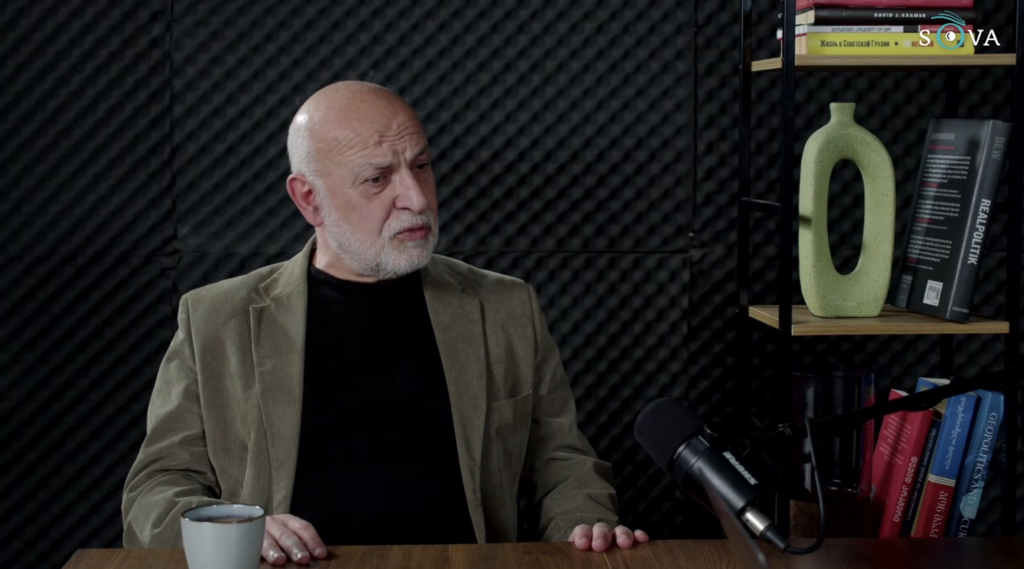
US Secretary of State Marco Rubio has stated that Washington sees certain progress in relations with Georgia, but still expects concrete steps from Tbilisi. SOVA spoke with diplomat and member of the “Georgia First” movement Valeri Chechelashvili about how the US views the South Caucasus today, Georgia’s place in this strategy, and how realistic a new reset in relations between the two countries actually is.
— Marco Rubio stated that despite US concerns over the role of China and Iran in Georgia, there is certain progress in relations with Tbilisi. Can we understand what exactly he meant?
— It is difficult for me to say. I do not know what plans “Georgian Dream” associates with this. Because Rubio did indeed say that there is some progress, meaning that the relevant conditions for resetting relations with the American side have been formulated. He also stressed that he expects corresponding actions from the Georgian government to alter the trajectory, as he put it, of the Georgian government’s movement, including on the international stage. This would make it possible to move to a new stage of interaction between the United States and Georgia. He did not specify what exactly he meant.
But combined with the statements the Americans made earlier, one can conclude that for now, Georgia is not considered a reliable partner in the United States. This is because assessments there have suggested that to become a reliable partner, certain things must be done.
In general, the point is that the Americans have already formed their understanding of relations with Georgia and are taking a clearer stance. They have articulated serious grievances to the Georgian government and are waiting for corresponding actions, rather than just statements from “Georgian Dream” about wanting to start a reset of relations with the US.
Today’s statements by Prime Minister Kobakhidze and other representatives of the government and “Georgian Dream” that Georgia is not a failing student who has to retake exams, and that we are ready to develop relations, are of the same nature as before. In principle, we are ready, but no concrete actions are implied to create the new conditions that the American side expects. This is the situation we find ourselves in right now.
But I have a specific litmus test for how and when US-Georgian relations will truly enter a new phase. This is the withdrawal of the recognition of Abkhazia and the Tskhinvali region by Venezuela and Syria. Because if “Georgian Dream” gains the necessary leverage to ask the American side for help with this issue, it will be resolved immediately and, in principle, very painlessly.
But the point is, this leverage will not be available to the Georgian government until the Americans consider the Georgian government to be a reliable partner. And for this leverage to appear, the actions expected by the American side must be taken, rather than just talking about wanting a reset.
Right now, the ball is clearly in the Georgian government’s court. And to hit that ball back into the US government’s court, simply saying things is not enough. Action must be taken.
This is the state of anticipation we are currently in.
— What is more important for “Georgian Dream” in relations with the US: economic cooperation or political recognition and strategic partnership?
— Georgia already has its place in the Caucasus. Geography cannot be undone. And nobody is canceling geopolitics. The Georgian government and “Georgian Dream” speak about this often.
But the point is, this is by no means the achievement of “Georgian Dream.” The fact that we occupy such a geopolitical position is the achievement of our ancestors, who left us such a country and such geopolitics as our heritage.
But how it will be used and how this geopolitical potential will be leveraged for the sake of the security and well-being of Georgia and its citizens depends on the kind of relations we have with the United States and the European Union.
If these are low-level pragmatic relations, this potential will not be utilized to its full capacity. In part, yes, of course, we will participate in certain projects. This will happen naturally because of where Georgia is located.
But we will not receive serious security guarantees, economic development, or, consequently, well-being and development prospects. To achieve this, we need to become not just a partner in a few isolated projects with the United States and the European Union, but a reliable partner and a pillar for implementing policy in the region alongside the US and the EU.
Then Georgia will gain a completely different quality of reputation and authority in the system of international relations, and specifically in the system of regional relations in the South Caucasus. This is because it will be backed by serious partners who will invest not only financial resources in Georgia, but also their trust. This is what is at stake right now.
And to achieve this, it is not enough to simply say that we are extending a hand and waiting for a response. We need to take appropriate steps both domestically and on the foreign policy stage.
If Georgia becomes a democratic country with a well-developed institutional system of electoral democracy and pursues a corresponding foreign policy based on strategic interaction with the US, NATO, and the European Union, that is one picture. But if it remains a country with limited pragmatic projects, which will indeed take place because major infrastructure projects pass through Georgia, that is a different picture.
Georgia will only be able to fully unlock its potential through deep engagement with the US and the European Union. Both the US and the EU are eagerly waiting for this. But the opportunities for this must be unlocked by the Georgian government.
— What does the US system of priorities in the South Caucasus look like today? Could it change after the elections in Armenia?
— I do not think it will change after the elections in Armenia. The Americans have already made it clear that they are highly interested in partnership with Armenia. Both Rubio’s visit and President Trump’s message very clearly demonstrated support for Nikol Pashinyan.
This means that the United States already clearly sees its role in the South Caucasus, relying on partnerships with Azerbaijan and Armenia, on establishing peaceful relations between them, and on developing diplomatic ties. Turkey is also joining this project for obvious reasons. And we can see progress along this track as well.
The Americans are taking a very active part in all these projects. This is also important because the region is adjacent to Iran. But at the same time, the Americans understand well that to fully unlock the potential of the South Caucasus in cooperation with the US, Georgia represents a very important piece of the puzzle.
The United States has no intention of abandoning Georgia.
But here, everything depends not only on them, but also on how well they can convince “Georgian Dream” and the Georgian government of the need to fully participate in all these regional development processes. Especially with the help of the US, or even better, with the help of both the US and the EU. This would give the US very serious opportunities to strengthen its own influence.
Central Asia is also becoming an important priority for the US. We have already witnessed the development of the “C5+1” format between the United States and the five Central Asian states.
To fully reach Central Asia, the South Caucasus is of great importance. Azerbaijan, Armenia, and a peace treaty between them will unlock the potential of the South Caucasus in a new way. But without Georgia, this project will be incomplete. However, together with Georgia and the formation of a trilateral platform with US participation, it would be ideal.
For me, the ideal structure would be a “3+2” concept: the three South Caucasus states plus the US and the European Union.
Perhaps even “3+3”: the United States, the European Union, and Turkey. This would serve the interests of all parties involved.
I think this is precisely the big picture that the United States sees, for which relations with Georgia are not just a bilateral format, but also the context of US relations with the South Caucasus.
— How likely is it that “Georgian Dream” will actually take significant steps toward the US, rather than limiting itself to rhetoric?
— There is one factor that has changed very significantly recently. This factor is Russia’s ability to influence the region. Because only the blind cannot see that the balance of power between Ukraine and Russia is currently shifting in Ukraine’s favor. Russia already had limited leverage over the situation in the South Caucasus, and now it is narrowing even further.
I think the elections in Armenia on June 7 will be another confirmation of this, where Russia has deployed its entire arsenal of capabilities. It did so very clumsily, incompetently, and without foresight. Through its actions, it is turning the population of Armenia against itself.
An economic embargo—such methods could achieve something in the 1990s. Today, this is completely counterproductive. Therefore, the elections in Armenia will be another blow to Russia and its capabilities in the South Caucasus.
I think “Georgian Dream” also sees this weakening of Russia. Because they too have analysts who lay the corresponding assessments on the tables of decision-makers.
Remaining in the shadow of a Russia that is systematically weakening, also in terms of its influence in the South Caucasus, promises no good prospects… It is in this context that I see “Georgian Dream’s” attempts to reach a new level of relations with the United States. And, by the way, in this same context, I see the readiness of “Georgian Dream” and the Georgian government to begin working with Ukraine, which we are also witnessing.
Therefore, the change in this factor—Russia, its capabilities, influence, authority, and reputation—affects the decision-making of the Georgian government. And here, there is simply no alternative to entering a new phase of relations with the United States.
If this is well understood and realized by the Georgian government, we will see corresponding steps.
I think that right now, a brainstorming session is taking place within “Georgian Dream” and the government regarding what to do next. Because all the arguments are already on the table. The Americans have formulated their position very clearly and are now waiting for clear answers to clearly posed questions.
Whether the Georgian government is ready to do this is something we should see in the near future.