


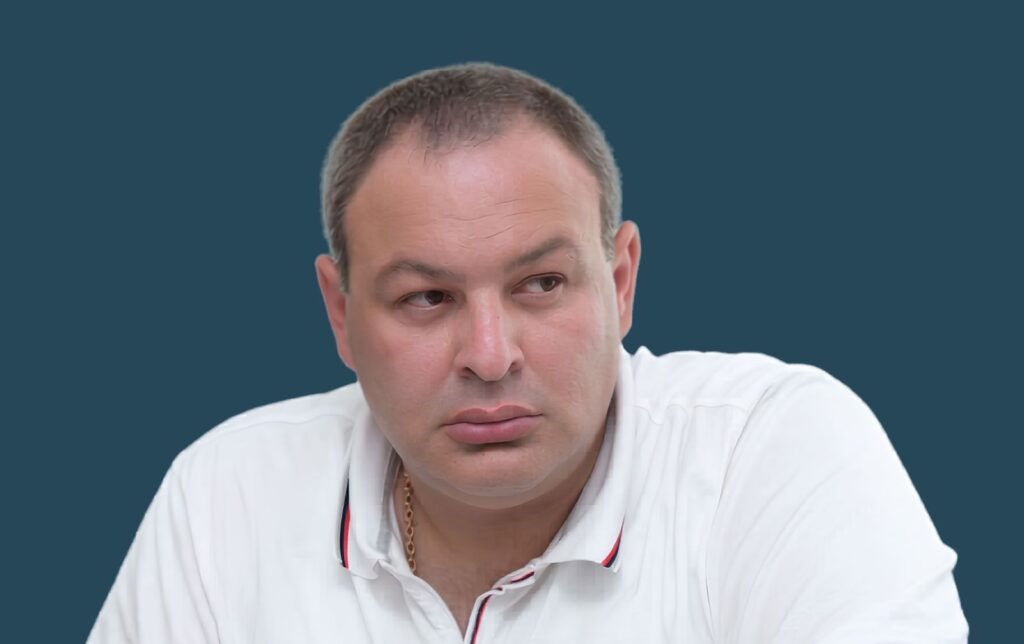
A Russian court has sentenced Kan Kvarchia, a member of the de facto parliament of Abkhazia, in absentia to 10 and a half years in a maximum-security penal colony on charges of robbery against citizens of the Russian Federation. The case is linked to a scandal involving Russian political strategists whom the local opposition accused of interfering in the 2025 elections. Moscow hopes that the harsh sentence will have a “sobering” effect on those who have “played too far.”
Kan Kvarchia is one of the prominent representatives of the Abkhaz opposition. He is a member of the de facto parliament, previously served as acting head of the Sukhumi administration, participated in the war of the early 1990s, and heads the socio-political organization "Aydgylara." In 2020, Kvarchia registered an initiative group to run in the "presidential" elections but withdrew from the campaign shortly after. In Abkhaz politics, Kvarchia is known as a public critic of the current de facto authorities.
The sentence against Kan Kvarchia was handed down by the Central District Court of Sochi. According to the Russian version of events, in November 2025, he, along with other accomplices, attacked three Russian citizens in Sukhumi, used physical force and weapons-like objects against them, and stole money and personal belongings.
The case was prosecuted under the article on robbery on an especially large scale. The court sentenced Kvarchia to 10 years and 6 months in a maximum-security penal colony. In addition, it upheld the victims’ civil lawsuits for 1.78 million rubles (about $24,000). The sentence was handed down in absentia, as the Russian side considers Kvarchia a fugitive from justice.
The politician remains in the occupied region. However, should he appear on Russian territory, he will be immediately arrested. According to media reports, Moscow does not rule out using international search and extradition mechanisms. But given the region’s specific circumstances and Kvarchia’s “parliamentary immunity,” such a scenario is currently difficult to implement.
Pro-Kremlin social media channels, calling the opposition figure a “radical” and a “Russophobe,” note that no one in the region currently intends to hand him over to Russian law enforcement: “However, travel outside Abkhazia is off-limits for this comedian. Except to Georgia, of course.”
The incident that triggered the criminal case occurred on November 5, 2025, in Sukhumi, at the office of the “Abkhazsky Vestnik” (Abkhaz Herald) newspaper. The opposition claims that the Russians who were there were covertly working for the pro-presidential coalition “Team Abkhazia” ahead of the elections. The consultants from the Russian Federation were involved in publishing the newspaper, preparing campaign materials, and coordinating support for pro-government candidates.
Kvarchia and several activists went to the office, after which the Russian citizens were handed over to the de facto State Security Service of Abkhazia. However, as local media reported, no full investigation into their activities followed at the time: the political strategists were escorted out of the region.
Later, the individuals in question approached Russian law enforcement. A criminal case for robbery was opened in the Russian Federation. A similar track emerged in Abkhazia: the de facto prosecutor’s office opened a case under several articles, including death threats, obstructing the exercise of electoral rights, grand larceny, and robbery.
According to Kvarchia and his supporters, there was no robbery—only an attempt to stop illegal interference by foreign citizens in the local electoral process. At a session of the de facto parliament, the opposition politician argued that Abkhazia should not be dictated “whom to vote for and how to vote,” explaining his actions as being in the country’s interests.
“We, the Abkhaz society, will decide for ourselves what to do, where to march, and in which direction to go.”
According to the politician, the Abkhazians were the real “injured” party in this case. Their personal data “was handed over to foreign political consultants, and none of the law enforcement agencies did anything to prevent this.” Moreover, the local authorities only facilitated the illegal actions of the political strategists.
“These people arrived, behaved however they pleased, and all documents were handed to them. Why did the prosecutor’s office believe these swindlers and not me? Why did the prosecutor not believe the testimony of a patriot and war veteran?”
The “Aydgylara” movement, led by Kvarchia, called the criminal case fabricated:
“We are deeply outraged by the politically motivated sentencing of Kan Valeryevich Kvarchia to 10.5 years in prison based on a fabricated allegation of a robbery attack on three citizens of a foreign state who violated the legislation of the Republic of Abkhazia and all conceivable moral and ethical norms of Abkhaz society.
We declare with full responsibility that such a practice of fabricating criminal cases at the interstate level will inevitably cause irreparable damage to mutual respect and trust between our countries.”
Notably, even before the criminal case, Kvarchia faced restrictive measures from Moscow. In early 2025, he was stripped of his Russian citizenship. In Sukhumi, this decision was discussed not only as a personal measure against a single politician but also as part of a broader conflict involving those representatives of the local political and civic sphere who criticized the actions of Moscow and the de facto authorities.
“Certain negative manifestations regarding political and public figures of Abkhazia” were also mentioned in a joint statement by the region’s civil society organizations published in early June, following the Sochi court’s verdict against Kan Kvarchia. Among the “reckless and hasty decisions,” it cited stripping certain residents of Abkhazia of their Russian citizenship and designating them as foreign agents “on fabricated political grounds.” They also called the verdict against the de facto MP “politically motivated and unjust.”
In this regard, the authors called on the Sukhumi authorities to “show principle and take comprehensive measures to protect the rights of citizens of the Republic of Abkhazia.”
Previously, to hold Kvarchia accountable, the local prosecutor’s office had to secure the lifting of his parliamentary immunity. In March 2026, a court found indications of death threats in the “MP’s” actions, after which the prosecutor submitted a formal request to parliament. The parliament, however, refused to strip Kvarchia of his immunity: only three MPs voted in favor of lifting it, while 23 voted against, and four abstained.
After this, the Abkhazian track of the case effectively hit a wall due to Kvarchia’s parliamentary status, but the Russian proceedings continued.
Oleg Matveychev, a member of the Russian State Duma (the lower house of parliament), explained: “We expected the Abkhaz side to punish the individual according to their own laws—that is, to punish the criminal. But since he had a parliamentary mandate, meaning immunity, and the parliament refused to lift it, the trial did not take place. If it had taken place, this person would definitely not have been tried in Russia.”
According to Matveychev, Moscow does not want to set a precedent where a crime against Russians goes unpunished simply because “someone somewhere has some local parliamentary mandate.”
A similar opinion was voiced by Konstantin Zatulin, deputy head of the State Duma Committee on CIS Affairs. In a comment to the “Vzglyad” publication, he stated that Russia did not try to bypass Abkhazia’s de facto judicial system, which is why it “waited.” However, after the de facto parliament’s refusal to lift Kvarchia’s immunity, “there was no other choice.” According to Zatulin, Moscow “does not abandon its citizens” and “cannot close its eyes when real harm has been done to them.”
“The Prosecutor’s Office and the Supreme Court of Abkhazia made their decisions, but the parliament refused to lift his parliamentary immunity. To my deep regret, Abkhaz justice turned out to be paralyzed.”
Zatulin admitted that the Sochi court’s decision was “harsh” but expressed hope that it would help other members of the de facto parliament draw the appropriate conclusions:
“I hope it will sober up those who, in a sense, have played too far in Abkhazia.”
However, veteran and socio-political figure Lasha Zukhba believes that such stories could become a “crack in the foundation” on which relations between Moscow and Sukhumi are built. Speaking to the “Okno” publication, he called the case against Kvarchia “politically motivated, with a fabricated accusation aimed at intimidating not only our society but perhaps also representatives of state authorities.”
“The sentence against Kan Kvarchia is a sentence against all those who fight for their country.”
According to Zukhba, residents of Abkhazia link the verdict to the opposition figure’s active civic stance, which is why they perceive the Sochi court’s ruling as external pressure.