


This article is part of a partnership with OC Media. You can read the original in English here.
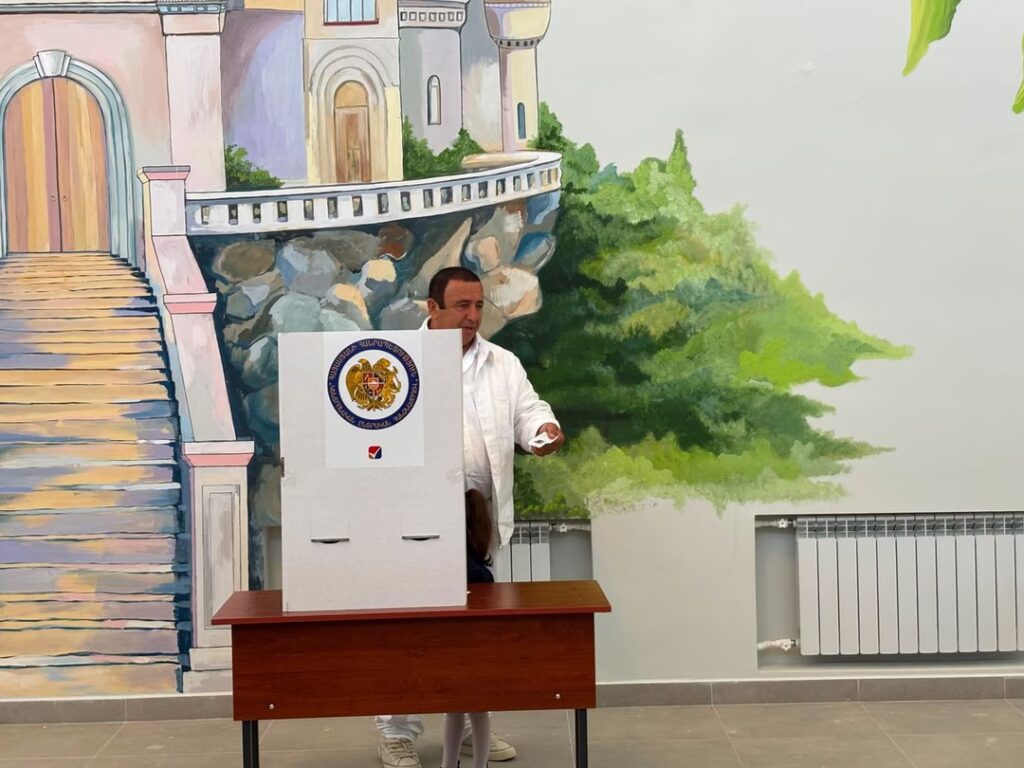
Businessman Gagik Tsarukyan has become the subject of an investigation into charges of large-scale tax evasion just two days after the parliamentary elections held on 7 June. His Prosperous Armenia party is currently awaiting the results of a recount, which will determine whether it can enter parliament.
On 9 June, the Prosecutor General’s Office of Armenia announced that a travel ban had also been imposed on Tsarukyan.
The prosecutor’s statement followed reports in media outlets close to the Armenian authorities that Tsarukyan had attempted to leave the country on 9 June via Zvartnots International Airport in Yerevan, but was prevented from doing so.
On the same day, Armenian law enforcement authorities placed under pre-trial detention two of the six wanted parliamentary candidates from the Strong Armenia party. They are suspected of money laundering and voter bribery.
These developments come amid a recount of votes at more than 550 polling stations in Armenia, initiated at the request of three opposition forces, including Prosperous Armenia. According to preliminary results, the party received 3.996% of the vote, falling just short of the 4% threshold required to enter parliament.
The recount will not only determine whether Prosperous Armenia gains representation in parliament, but could also influence the decision of two other opposition groups — the Strong Armenia alliance of Russian-Armenian businessman Samvel Karapetyan and the Armenia bloc of former President Robert Kocharyan — on whether they will take up their parliamentary seats.
Narek Karapetyan, who leads the Strong Armenia list, stated in a video posted on social media that the alliance would wait for the results regarding Prosperous Armenia before making a final decision.
“We will understand whether the opposition will have the opportunity to influence the election of the prosecutor general and other officials, as well as to convey its position,” Karapetyan said.
For its part, the Armenia bloc announced on Tuesday that it intends to appeal to the Constitutional Court to challenge the election results. Representatives of the bloc stated that once the final results are announced, they will present “substantial evidence” that the voting took place under “unfree and unfair conditions.”
“We are currently discussing further steps with our opposition partners,” Kocharyan said on Monday. He did not specify which opposition force he was referring to, adding only that a final decision would be announced after consultations are completed.
According to preliminary election results, the ruling Civil Contract party wins 64 seats in parliament, Strong Armenia gets 29, and the Armenia bloc receives 12.
Political analyst Narek Sukiasyan told OC Media that if Prosperous Armenia does enter parliament, the ruling party will lose the three-fifths majority required to appoint and dismiss key executive and judicial officials, as well as to amend constitutional-level legislation, including referendum rules and the electoral code.
According to him, this could prompt other opposition forces to abandon the idea of boycotting the new parliament and accept their seats.
However, Sukiasyan believes that participating in parliament also carries risks for the opposition.
“They could face a loss of loyalty from some of their MPs, potentially allowing Civil Contract to secure the majority it seeks,” the political analyst noted.
Russia reportedly instructed media to frame elections as defeat for Pashinyan
Armenian Prime Prime Minister Nikol Pashinyan continues to receive congratulations on the victory of the Civil Contract party in the parliamentary elections. However, Russian President Vladimir Putin has not yet publicly congratulated him.
Instead, Kremlin spokesperson Dmitry Peskov stated on 8 June that the Kremlin was taking note of all reports of violations during the elections.
Even before the vote, Putin had stated Russia’s interest in the participation of “pro-Russian” political forces in the elections. At the same time, Moscow introduced a series of restrictions on imports of Armenian products, which many viewed as economic pressure aimed at influencing the outcome of the elections.
Separately, the independent Russian media outlet Meduza, citing an employee of a major pro-Kremlin media organization, reported that the Russian Presidential Administration had recommended that state-run and government-loyal media cover the election results as a “defeat” for Pashinyan, using that exact phrasing.
According to the publication, officials were also recommended to focus on alleged voting violations in order to “sow doubts about Pashinyan’s legitimacy.”
Meduza also analyzed Russian media coverage and stated that these recommendations were indeed reflected in the reporting on the parliamentary elections in Armenia.