


This article is part of a partnership with OC Media. You can read the original in English here.
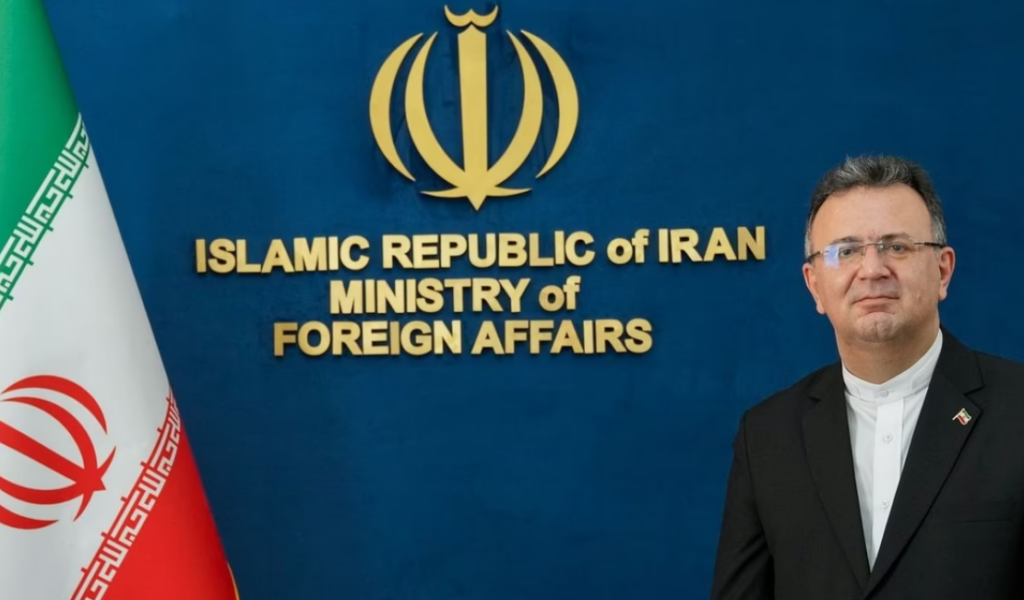
Iran’s Ambassador to Georgia, Ali Mojani, published a report on his first six months in office, touching on relations between Georgia and Iran, as well as the US–Israel war against Iran. In the document, he made a number of controversial statements, including the claim that Iran had allegedly never attacked neighboring countries “throughout its centuries-old history.” Following criticism, he later backtracked on this phrasing, accusing the media of distorting his words.
According to Mojani, the report was presented to the media at the Iranian Embassy in Tbilisi on 11 June. The text was later published in Georgian on the ambassador’s official Facebook page. Condemning Israel and the US, as well as the countries that provided them with their airspace, Mojani wrote:
“Today’s Iran relies on its national strength. Throughout its centuries-old history, Iran has never committed aggression against the territory of neighboring countries. The Islamic Republic of Iran has not had and does not have the desire to become an empire.”
A number of local media outlets, including Tabula, quoted the text published by Mojani, sparking a wave of negative and mocking reactions. Following this, the ambassador claimed that Tabula was spreading “false information” and asserted that its journalist was not present at the press conference where the statement was allegedly made.
“What was actually said was this: Iran has not attacked any state in the last 200 years; Iran ended a 2,500-year period of monarchical despotism 47 years ago and replaced it with a republic through direct elections,” Mojani wrote in a Facebook post on 12 June, reposting Tabula’s quote card.
OC Media, for its part, notes that it was not present at the press conference and cannot independently verify its content. However, the written text published by the ambassador and quoted by the media remains available on his Facebook page and does not specify a particular time period. The post had not been deleted or edited at the time of publication.
Commenting on the 2026 war, which began on 28 February, Mojani stated that “Georgian public opinion”—both at the political and societal levels—allegedly “openly expressed outrage at the injustice committed against Iran.”
He also added that during this period, “Georgian media and their information activities played an important and constructive role in raising public awareness,” while simultaneously criticizing those outlets that, in his words, “created unrealistic narratives, ignoring reality.”
Mojani also stated that “during the defense of the homeland and the period of US attacks, many people of Georgian descent from the Iranian community died as martyrs.”
In March, the embassy reported that 10 people from the predominantly Georgian-populated town of Fereydunshahr in Isfahan province had died during the US–Israel war against Iran, and announced a book of condolences in Tbilisi. Neither the embassy nor Mojani himself commented on reports from Fereydan Georgians—as ethnic Georgians in Iran are often called—that several Iranian Georgian-Armenian citizens may have died during the harsh crackdown on anti-government protests in January 2026.
The report also states that over the past six months, the embassy sought to present the “policies of modern Iran” to the Georgian public “without misleading propaganda,” including through direct meetings “both in villages and cities.”
Since his appointment, Mojani has actively used social media to comment on events in Iran and beyond, including historical ties between Georgia and Iran.
In February, a scandal erupted over the wording of an invitation distributed by the Iranian embassy for an event dedicated to the anniversary of the 1979 Islamic Revolution. In addition to the revolution, the text also mentioned the “410th anniversary of the arrival of Georgians in Iran,” which corresponds to 1616—a period of military campaigns (1614–1617) and the mass forced deportation of Georgians from the Kingdom of Kakheti to Persia under Shah Abbas I.
Many social media users perceived this as an attempt to soften or distort the historical context of the events.
Mojani later met with Georgian activists who delivered a letter of protest to the embassy. According to him, the discussion touched upon historical ties, including the “pain of deportations” and the role of Georgians in various spheres of life in Iran.