


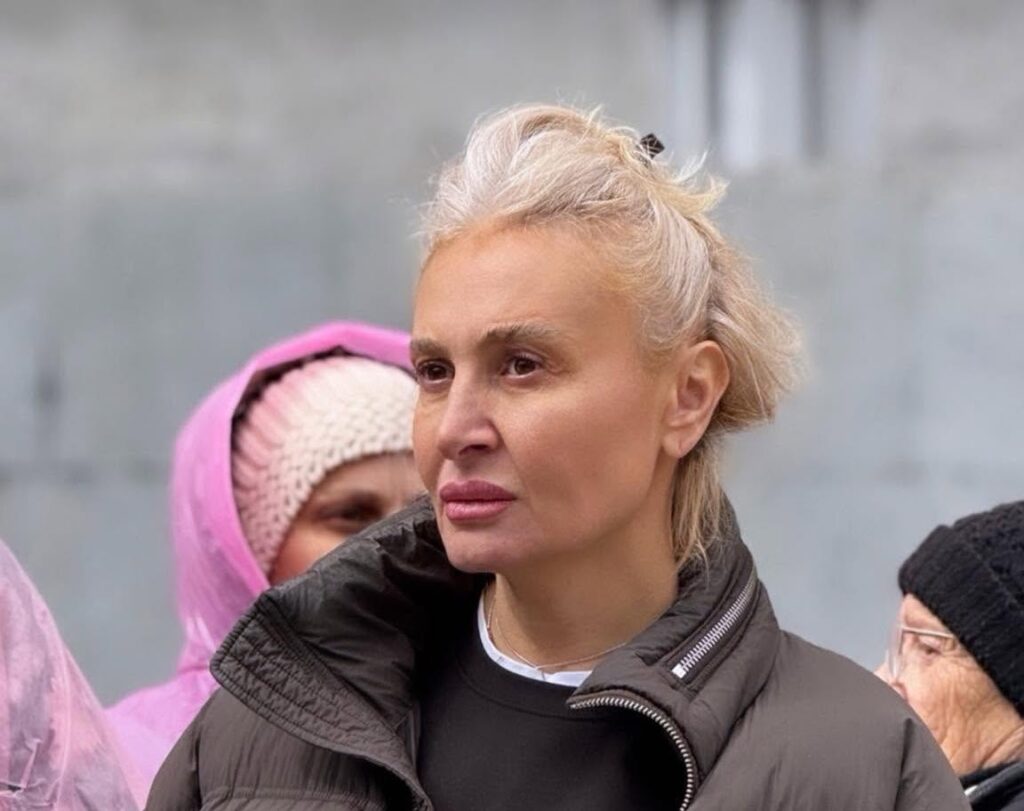
The United National Movement (UNM)—Georgia’s largest opposition party, founded by Mikheil Saakashvili—is once again talking about a radical renewal. The catalyst was a statement by Saakashvili himself: the imprisoned third president of Georgia wrote on social media that the party must undergo “fundamental changes.” He named journalist and civil activist Nanuka Zhorzholiani as a key figure in this process.
Mikheil Saakashvili offered Nanuka Zhorzholiani a position he once held himself. In his view, the TV host could lead the party, which previously governed Georgia. Initially, it was assumed that Zhorzholiani and her team might join the efforts to reform the political organization. However, Saakashvili later clarified that he specifically sees Nanuka as his candidate for the post of UNM chair.
The current chair of the “National Movement,” Tina Bokuchava, who was elected in July 2024 for a two-year term, initially welcomed the idea of “healthy changes” within the party. However, after Saakashvili publicly named Zhorzholiani as his favorite in the internal party race, Bokuchava stated that the announcement came as a surprise and was regrettable. According to her, it is precisely “impulsive and inconsistent decisions” in the past that have brought the party to its current state.
Who is Nanuka Zhorzholiani
Nanuka Zhorzholiani is one of Georgia’s most recognizable journalists and TV presenters, who in recent years has become not only a media personality but also a civic and political figure. Zhorzholiani has been in politics before. In 2020, she joined Mikheil Saakashvili’s team and ran as a majoritarian candidate for the United National Movement in the Samtredia-Tskaltubo-Vani-Khoni constituency in the Imereti region. She lost to the candidate from the ruling Georgian Dream party and failed to enter parliament. After the elections, Zhorzholiani did not remain within the party structure and publicly returned to journalism and civic activism.
The primary vehicle for her public work became the “Nanuka Foundation.” Initially, it focused on humanitarian aid and fundraising, including medical treatment for children. However, after the start of mass pro-European protests in late 2024, the foundation became part of the protest infrastructure: it was used to raise funds to pay fines for detained demonstrators and support people who suffered due to their participation in the rallies.
It was this activity that brought Zhorzholiani into direct conflict with the authorities. In 2025, the bank accounts of the “Nanuka Foundation” were frozen as part of an investigation into “sabotage” cases. Hundreds of thousands of lari were blocked. Zhorzholiani herself called this politically motivated pressure and demanded the unblocking of at least the portion of the funds intended for the treatment of sick children.
In May 2026, Nanuka Zhorzholiani was also placed under administrative arrest for three days for artificially obstructing pedestrian traffic on a sidewalk. This episode further solidified her image not just as a journalist or philanthropist, but as a participant in the protest movement who herself faces pressure from the authorities.
A Party of Reforms and Crises
The United National Movement was founded in 2001, during the presidency of Eduard Shevardnadze. Just a year later, the UNM became one of the key forces behind the Rose Revolution, which brought Mikheil Saakashvili to power and turned the party into the ruling political force.
From 2004 to 2012, the UNM governed the country. This period remains one of the most controversial in Georgia’s modern history. Supporters of the party associate it with rapid and effective reforms, the fight against corruption, the modernization of state institutions, the building of a new police force, and a pro-European and pro-NATO course. For them, the “National Movement” is the party that attempted to build a modern state out of the chaos of the 1990s.
Critics, conversely, remember this period through a different set of themes: an authoritarian style of governance, the usurpation of power, the persecution of opponents, pressure on businesses, systemic issues in the judicial and penitentiary systems, and the trauma of 2012, when prison abuse videos leaked shortly before the parliamentary elections became a symbol of the end of the UNM’s rule. In subsequent years, Georgian Dream turned the term “Natsis” (a colloquial shorthand for UNM members) into a derogatory label used to discredit all of its opponents. The term “collective National Movement” also entered the political lexicon, currently used to refer to liberal and pro-European parties.
Since moving into opposition, the United National Movement itself has remained one of the most recognizable and organizationally strong political structures in the country. At the same time, it has constantly faced internal crises. In recent years, the UNM has experienced splits, leadership changes, the departure of prominent figures, and debates over whether the party should maintain its tight alignment with Saakashvili or attempt to build a broader opposition model.
At the same time, despite his imprisonment, Mikheil Saakashvili continues to be the party’s main symbolic center. Formally, the UNM has an active leadership, a political council, a chairperson, and party bodies, but the former president’s political weight within the structure remains so significant that his public statements effectively set the party’s agenda—even when they conflict with the position of the current leadership.
A Risky Chairmanship
Nanuka Zhorzholiani tries to describe her potential entry into the UNM not as a struggle for office, but as an attempt at crisis management. She says she sees herself in the party more as a manager than a traditional political leader. According to the journalist, the ideal scenario would be her collaboration with Tina Bokuchava: the current chair would retain her political experience and knowledge of the party, while Zhorzholiani would help restore the structure’s momentum, energy, and connection with new supporters.
The final decision is to be made not through social media posts, but through internal party elections. In July, the “National Movement” congress will take place, where delegates will determine who will lead Georgia’s largest opposition force.
However, the struggle for leadership in the political association is taking place at a time when the very existence of the UNM has been called into question. The authorities intend to ban several opposition parties at the legislative level, primarily the United National Movement. The ruling Georgian Dream has already filed a corresponding lawsuit with the country’s Constitutional Court.
Furthermore, three of the five former chairs of the “National Movement”—Mikheil Saakashvili, Nika Melia (who has since left the party), and Levan Khabeishvili—are currently behind bars. Therefore, whoever leads the UNM during such a difficult period may face not only issues of mistrust within the party but also the risk of criminal prosecution.