


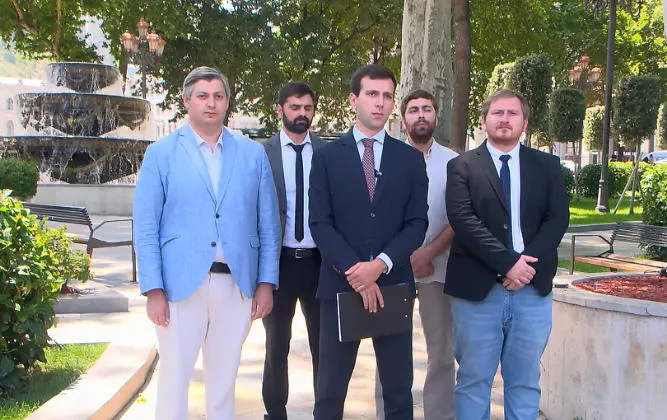
Representatives of the “Georgian Republic” political movement have issued a statement in response to comments by Russian Foreign Ministry spokesperson Maria Zakharova regarding the celebration of Russian Language Day in Tbilisi and the actions of the movement’s activists. Movement members gathered in Pushkin Square, where they emphasized that they consider the participation of Russian officials in public events dedicated to the Russian language unacceptable as long as Russia continues to control part of Georgia’s territory and restrict the use of the Georgian language in Abkhazia and the Tskhinvali region.
The statement notes that Dmitry Olisov, head of the Russian Interests Section at the Swiss Embassy, attended the event held on June 6 in central Tbilisi to mark Russian Language Day. According to the movement’s representatives, the participation of Russian diplomats gave the event a political character.
“Georgian Republic” claims that the situation regarding the Georgian language in Abkhazia and the Tskhinvali region continues to deteriorate. Activists point to the closure of Georgian schools, reductions in the teaching of the Georgian language, and restrictions imposed on the Georgian Orthodox Church in these territories.
Commenting on Maria Zakharova’s statement, the movement noted that accusations of radicalism are an attempt to discredit the civic stance of those who oppose Russian policy toward Georgia. They also criticized calls for the Georgian authorities to punish the protesters, describing such demands as a manifestation of “colonial thinking” and interference in the country’s internal affairs.
Representatives of the movement emphasized that they advocate for the peaceful restoration of Georgia’s territorial integrity, but believe this process must be based on defending national dignity and state interests.
“Despite the Georgian authorities’ attempts to accommodate Moscow’s interests, the only response has been further manifestations of injustice. In the occupied regions, the situation continues to deteriorate, and Russia bears responsibility for this,” the statement reads.
In conclusion, representatives of the “Georgian Republic” declared that they will continue to stand up for the country’s national interests and oppose any political actions by Russian officials in the Georgian public space as long as the issue of the occupied territories remains unresolved.