


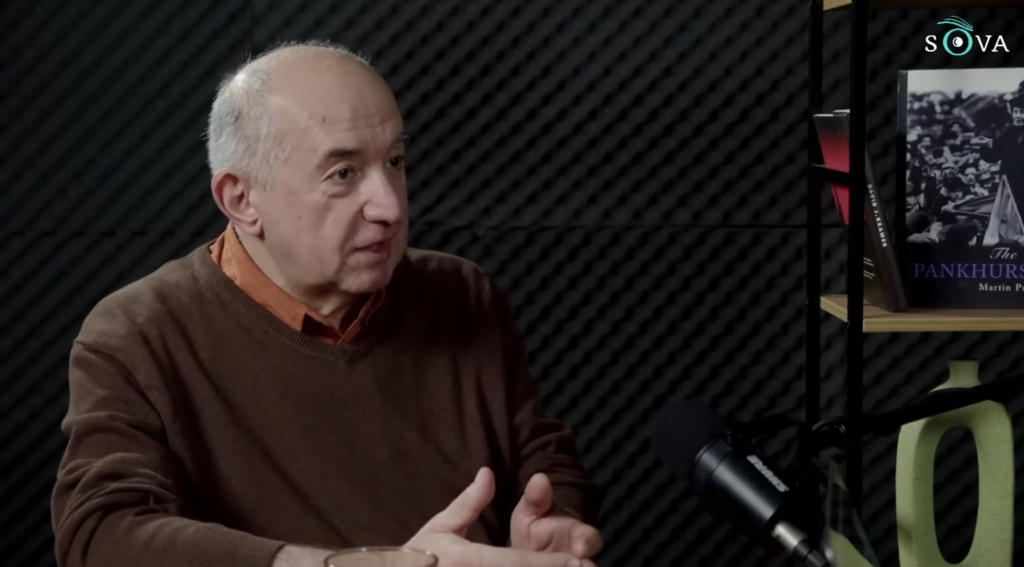
The de facto Ministry of Foreign Affairs of Abkhazia has reacted sensitively to the “When I Return to Abkhazia” contest held in Tbilisi. Such projects allegedly foster a “distorted perception of historical events” and are part of a “revanchist policy.” Earlier, Timur Gulia, leader of the veteran organization Aruaa (an influential Abkhaz socio-political group of war veterans), threatened that Abkhazia could attack Georgia with a thousand drones a day. Meanwhile, the de facto leader of Tskhinvali, Alan Gagloev, traveled to Moscow to meet with Vladimir Putin. All of this is unfolding against the backdrop of Russia’s weakening positions in the South Caucasus. SOVA spoke about the situation in the occupied regions and the Kremlin’s role with Paata Zakareishvili, former Georgian State Minister for Reconciliation and Civic Equality.
— To what extent does the statement by the de facto Abkhaz MFA reflect real anxiety in Sukhumi regarding such events in Georgia?
— The Abkhaz side is always happy to seize the moment to interpret things in its own favor. Of course, I believe that as long as the Georgian-Abkhaz conflict remains unresolved, the Georgian authorities should carefully consider various events to minimize such interpretations.
The title of this event, “When I Return to Abkhazia,” was read by the Abkhaz side exactly as they saw fit—in their own favor. They assessed it as proof that Georgians are not thinking about resolving the conflict or taking the interests of the Abkhaz side into account, but are simply convinced that they will return sooner or later, no matter how.
In other words, according to their interpretation, the Georgian side is planning not the creation of conditions for return, but rather what it will do after returning. Of course, an event with such a name allows for that kind of interpretation.
In general, if the sides want to improve relations, transform the conflict, move forward, and reduce tension, neither the Abkhaz nor the Georgian side behaves this way.
Unfortunately, the Georgian side tends to be confrontational, and the Abkhaz side supports it in this. This is a very notable example of how ready the sides are for reconciliation. The sides are not ready for reconciliation. This is a very important conclusion.
And it is very sad that 30 years have passed, yet the sides are still ready to continue in such a harsh manner, forgiving each other nothing and exploiting each other’s weaknesses.
— The Georgian media space is actively discussing Timur Gulia’s statement that Abkhazia could attack Georgia with a thousand drones a day. To what extent do such veteran organizations influence public opinion in Abkhazia today?
— This statement was not made after the statement by the de facto MFA. It was made much earlier, in May. Moreover, I can say that people in Abkhazia immediately started laughing at it: “What thousands of drones are we talking about? We don’t have a single drone, we don’t have operators,” and so on. That is, in Abkhazia, this man was mocked and essentially marginalized.
Therefore, what is important to me is not his statement itself, but how long it takes for information from Abkhazia to reach Georgia. This is an indicator of how little the Georgian public now cares about what is happening on the territory of Abkhazia.
The next such stunt will probably be assessed in three or four months, and then in a few years. Clearly, Georgian society is distancing itself from the Abkhazians, from the problems and the situation unfolding in Abkhazia. It is closing itself off more and more in its own shell.
For me, the reaction of Georgian society is more important than what this man said. This man talked nonsense. The Abkhazians themselves managed to respond and closed the topic.
Now, apparently, someone had planned for Georgians to react negatively back then. But since that didn’t work, they took additional measures to ensure the Georgian public would finally get outraged.
As a result, both sides ended up in an even more ridiculous situation: Gulia, because he says foolish things that his own fellow citizens laugh at, and Georgian society, because it showed that Abkhazia is far away for them. If someone doesn’t chew something up and put it in their mouth, they are no longer ready to swallow it.
— Against this backdrop, Russia seems to be ramping up its rhetoric on the need to resume relations with Georgia. Could the current activity around Sukhumi and Tskhinvali be part of Russian pressure on Tbilisi?
— Such flare-ups from the Russian side happen all the time, just to remind Georgia that it should take proactive steps to improve relations with Abkhazia. This is neither the first nor the last time. The Georgian side lets this slide, ignores it, and it has been this way for many years.
And this time is no different. Russia is reminding Georgia that it needs to find a common language with such a Russia. Russia is nervous because Georgia is pursuing a pro-Russian line on its own but is not institutionalizing it.
If anything happens to Ivanishvili, Georgia has no institutional ties to Russia. Armenia has many ties: the economy, property in Russian hands, diplomatic relations, the CIS (Commonwealth of Independent States), CSTO (Collective Security Treaty Organization), EAEU (Eurasian Economic Union), and so on.
Armenia is very tightly bound to Russia. But Georgia is not connected at all. The link is Bidzina Ivanishvili, nothing more. If something happens to him, or if he gets tired of being this link, Russia will have nothing to bind Georgia to itself with.
We have no diplomatic relations, no alliances. Therefore, Russia is naturally nervous about what comes next.
This is why it carries out such measures—for example, the appointment of Kambolov (Konstantin Kambolov, a Russian official appointed as de facto prime minister) as Prime Minister of South Ossetia—to somehow present Georgia with more costly conditions. If things take a turn in Ukraine or in the global community, and if Russia completely loses control over the South Caucasus, Abkhazia and South Ossetia will cost Georgia dearly.
Russia is nervous and wriggling. But, thank God, even Georgian Dream (the ruling party in Georgia) is not capable of or ready for any greater movement than what we are seeing now. Georgia is not going to restore diplomatic relations with Russia. Georgia does not even participate in such a pathetic format as “3+3.”
— Do you also link this to broader processes in the South Caucasus—Armenia’s distancing, Azerbaijan’s stance, and the weakening of Russian influence?
— Of course. Against this backdrop, Russia faces very significant challenges in the South Caucasus. Azerbaijan, with Turkey’s support, clearly demonstrates its distance from Russia and equal relations.
Armenia, through elections, gives its authorities more of a mandate to continue distancing themselves. Not against Russia as such, although Russia constantly portrays it that way, but Armenian citizens want to see the European Union, they want to improve relations with Turkey and Azerbaijan. The Armenian people place very serious hopes and demands on their authorities, voting the way they do.
Meanwhile, against this backdrop, Georgia is in no way tied to Russia. Therefore, Russia is squandering its power and administrative structures in the South Caucasus. This is striking.
And such pathetic statements—like, “remember Russia”—only worsen the situation. What kind of protection of the Russian language can we talk about in Georgia when no one in Georgia is ready to take to the streets with a Russian flag or a St. George’s ribbon? In Armenia, such people still come out, and in Moldova they do, but in Georgia, this is out of the question. In Georgia, Russia is considered an occupier.
It is very sad to watch Russia trying to remind people of itself using such methods.
— Today, the de facto leader of Tskhinvali, Alan Gagloev, arrived at the Kremlin and met with Vladimir Putin. Is this a preventive talk or an effort to pull the region even closer to Russia?
— And how much closer can Tskhinvali be pulled? How many liters of water fit in a three-liter jar? Three liters, no more. Tskhinvali has long been filled with Russia. It is impossible to overfill it, and it is impossible to make it even more pro-Russian.
This is simply a policy adjustment. Now that Kambolov has been appointed de facto Prime Minister, they probably want to understand the new parameters of South Ossetia’s actions.
There is corruption there, the public is dissatisfied, and Russia is unhappy that its money is disappearing, dissolving. I think Kambolov was primarily appointed as a crisis manager—to stop this bottomless pit where money is poured in and then lost.
He must first of all turn off the tap of corruption and see how society reacts to this. And then other superstructures can be built.
But in any case, Russia does not want to irritate the current Georgian government. Russia is unlikely to take any institutional actions—for example, formalizing annexation.
Most likely, they will do what they are doing today: informal annexation. Increasingly taking over South Ossetia, all its institutions of power and governance.
So that if something changes in Ukraine or in Georgian politics, and the issues of Abkhazia and South Ossetia return to the agenda, it will be harder to resolve Georgian-Abkhaz and Georgian-Ossetian relations.