


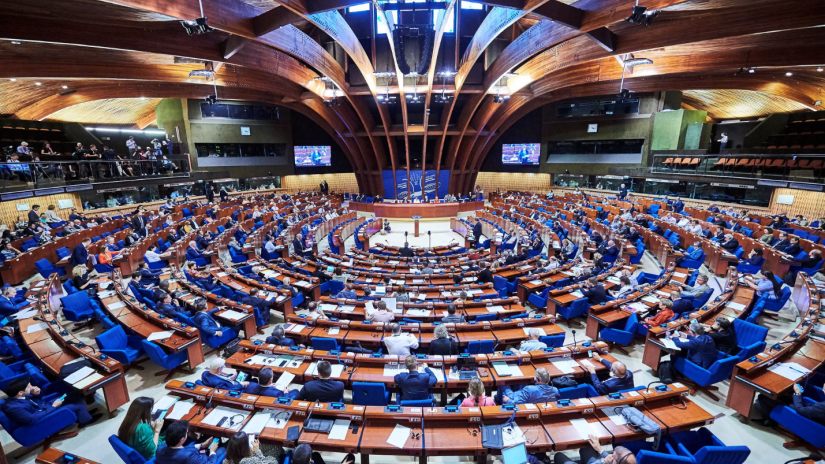
The Parliamentary Assembly of the Council of Europe (PACE) has adopted a resolution on Georgia — 83 MPs voted in favor of the document, 5 voted against, and 4 abstained.
The document emphasizes that democratic backsliding in Georgia continues, as does the pressure on civil society, the political opposition, and dissidents. It notes that none of the Assembly’s recommendations requiring urgent implementation have been fulfilled.
It points out that the Assembly remains committed to an open and result-oriented dialogue with both the Georgian authorities and all other political and civic forces in the country.
It notes that “the initiative to ban virtually all democratic opposition parties in Georgia and to criminally prosecute their leaders on politically motivated and fabricated charges is unacceptable.”
“The Assembly reiterates that continuing this course would effectively lead to the establishment of a one-party dictatorship in Georgia, which violates the fundamental principles of democracy and is incompatible with membership in the Council of Europe.
It demands that the Georgian authorities immediately withdraw their appeal to the Constitutional Court to ban democratic opposition parties, and cease the unfair and politically motivated criminal prosecution of their leaders,” the document reads.
PACE states that due to the “ruthless suppression” of the democratic opposition, civil society, and independent media, as well as extremely high social and political polarization, the conditions for holding truly democratic elections are currently lacking in Georgia.
The Assembly calls on the Georgian authorities to initiate “an open and inclusive political process involving all political forces and civil society representatives to restore a genuinely free and democratic political environment in the country, in line with the clearly expressed expectations and aspirations of Georgian society.”
The resolution also addresses the restriction of freedom of expression and freedom of assembly, including through “repressive legislation and the abuse of politically motivated prosecution” against NGOs, independent media, the opposition, and individual participants in pro-European processes. It mentions Elene Khoshtaria, leader of “Droa!”, and Nika Melia, one of the leaders of “Ahali”.
PACE calls on the Georgian authorities to fully repeal recently adopted repressive legislation, in particular the controversial amendments to the Criminal Code, the Law on Political Associations of Citizens, and the Code of Administrative Offenses, as well as to replace the current Code of Administrative Offenses with a new law developed in close cooperation with the Council of Europe to ensure its compliance with European norms and standards, including the European Convention on Human Rights.
The Assembly emphasizes that a diverse civil society is a prerequisite for a fully functioning democracy and plays a key role in the country’s democratic development.
PACE expresses concern over the impact of recent educational reforms on academic freedom and stresses the need to ensure the independence of the academic community.
“Furthermore, to address well-founded concerns regarding corruption, the Assembly calls on the authorities to establish a transparent and independent mechanism for managing the privatization of university assets that may become redundant as a result of the new ‘One City — One Faculty’ reform,” the document states.
The resolution states that “despite numerous calls, no credible investigation has been conducted into cases of police violence and other human rights violations during demonstrations, as well as instances of torture and ill-treatment of detained protesters.”
It also mentions the use of “banned chemical substances to disperse a protest rally in Tbilisi.”
“An independent, effective, and credible investigation must be launched immediately into these allegations,” PACE notes.
The Assembly calls on the Georgian authorities to fully implement the general measures prescribed by the ECHR judgments in the cases of “Tsaava and Others v. Georgia”, “Mekvabishvili v. Georgia”, and “Makharashvili and Others v. Georgia”, as well as to execute the remaining 77 judgments of the court currently pending execution.
PACE took note of the report by the expert of the OSCE’s “Moscow Mechanism”, which was invoked by 24 participating States of the organization.
“It fully shares the findings contained therein, which align with the conclusions of this and previous resolutions regarding democratic backsliding in Georgia. The Assembly calls on the Georgian authorities to fully implement the recommendations set out in this report,” the resolution states.