


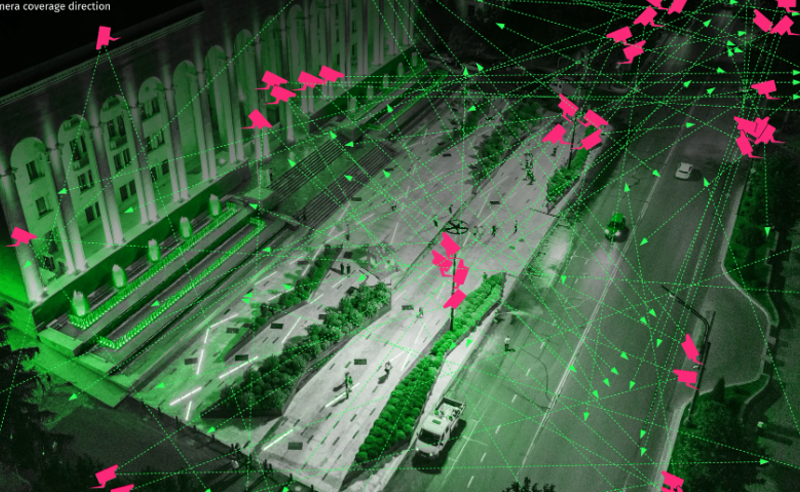
AlgorithmWatch, an organization that researches algorithms and artificial intelligence technologies from the perspective of human rights, democracy, and sustainable development, has published an investigation titled “How Russian Surveillance Software Suppresses the Rights of Peaceful Georgian Citizens.” According to the investigation, over the past two years, the Georgian government purchased cameras with facial recognition capabilities from a Moscow-based company with ties to Russia’s Federal Security Service (FSB).
According to the authors of the study, the faces of Georgian citizens could end up in the possession of the FSB, as the Russian company is legally obligated to cooperate with Russian state authorities. The investigation also revealed that the state acquired the Russian facial recognition system back in 2013, a year after the Georgian Dream party came to power.
According to AlgorithmWatch, in 2018—prior to the events of “Gavrilov’s Night” and the mass anti-Russian protests—Russian engineers arrived in Georgia to train Ministry of Internal Affairs (MIA) staff on how to operate the system.
Following the 2019 protests, the contract with the Russian company was renewed in 2020, and in 2024, version Polyface 3.7.0 was implemented. As the authors of the investigation note, this version potentially allows the personal data of citizens to fall into the hands of Russian security services.
“In other words, since 2013, a sanctioned Russian company has been providing the state with technology to identify people. The personal data of these citizens could at any moment end up in the possession of a foreign state and its agents of influence. This is precisely why thousands of citizens have been fined today, requiring public funds and fundraising campaigns to pay them,” the investigation states.
At the same time, AlgorithmWatch emphasizes that facial recognition systems themselves are not a hallmark of authoritarian regimes—similar technologies are also used in European countries. According to the authors, the fundamental difference lies in political will: in Georgia, the investigation claims, these technologies were used to suppress protests.
The organization also warns that using software developed in a foreign country poses a serious risk of transferring its citizens’ personal data to a third party.
The investigation was prepared as part of the AlgorithmWatch Algorithmic Accountability Reporting Fellowship program.
The article also states that police used water cannons and rubber bullets against protesters, and documented cases of demonstrators being beaten by law enforcement officers and government-linked groups of so-called “titushky” (state-sponsored hired thugs).
A separate section of the study is titled “From EU Candidate Country to Authoritarian Repression.”
The authors recall that in 2023, Georgia obtained candidate status for European Union membership. In their view, for the majority of the country’s citizens, this status was not merely a diplomatic step, but a hope for institutional reforms, the strengthening of the rule of law, economic integration, and protection from the influence of a more powerful and hostile neighbor.
The investigation claims that after the parliamentary elections on October 26, 2024, which the authors describe as “presumably rigged,” mass protests began in the country, lasting for 580 consecutive days. It notes that the European Parliament called for repeat elections, while Prime Minister Irakli Kobakhidze announced the suspension of Georgia’s EU accession process until 2028.
The authors believe that many viewed this decision as contradicting the Constitution of Georgia, since the Basic Law obligates state bodies to facilitate European integration. It also cites data from a 2023 poll, according to which 86% of the population supported the country’s entry into the EU.
According to the investigation, in the subsequent years, the authorities gradually restricted the rights of protesters. While in 2023 holding assemblies did not require permission, by 2024 covering one’s face became an administrative offense, and the fine for blocking roads increased from 500 to 5,000 lari. In 2025, the authors claim, both of these actions were criminalized, and state registration became required to hold assemblies even on sidewalks. In 2026, the publication states, publicly calling the government illegitimate and criticizing it online using expressions deemed offensive also became criminally punishable.
The investigation concludes with a finding by Transparency International, according to which the legislative changes adopted under the ruling Georgian Dream party have effectively nullified the freedom of assembly guaranteed by the Constitution of Georgia.