


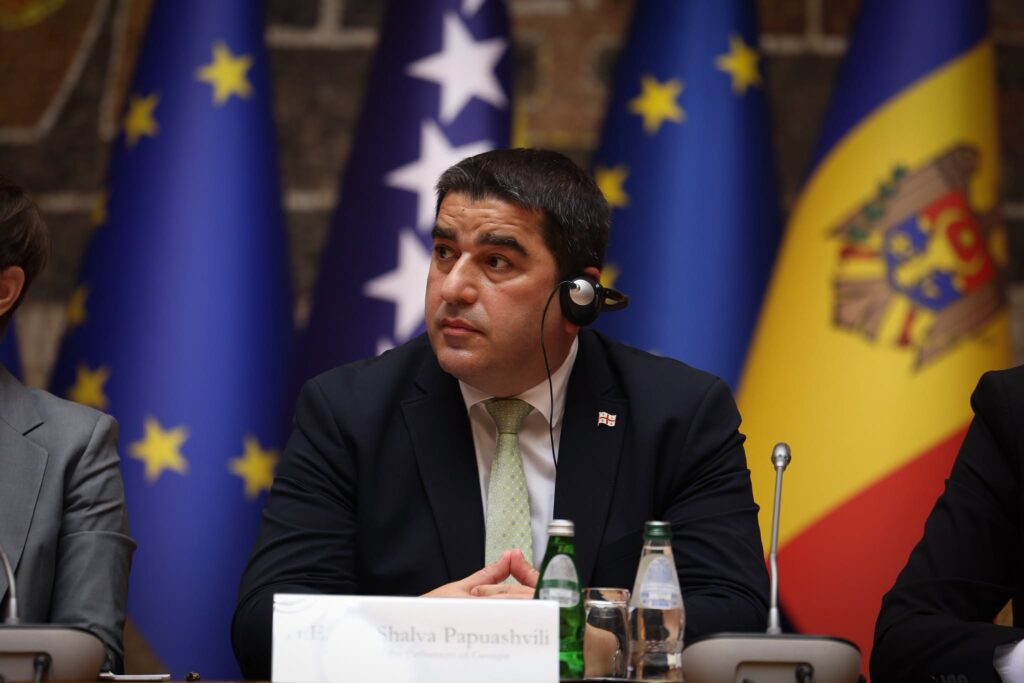
Georgian Parliament Speaker Shalva Papuashvili stated that some EU countries are attempting to reconsider promises made in 2022 regarding EU enlargement, or are putting forward new conditions for candidate countries.
Speaking at the first conference of parliamentary speakers of EU candidate countries in Belgrade, Serbia, Papuashvili noted that since the start of the Russian aggression against Ukraine in 2022, the EU had announced a rethinking of its geopolitical role and a shift toward an enlargement policy. Today, however, in his view, a number of states consider these statements to have been hasty and are trying either to back away from previous promises or to supplement the accession process with new requirements that could prove unacceptable to certain candidate countries.
Papuashvili pointed out that the challenges Georgia faces on its path to European integration are no exception, with virtually every candidate country experiencing similar difficulties. The Speaker noted that this is driven either by individual EU member states pursuing their own political agendas, or by additional requirements from Brussels that, according to Papuashvili, are not stipulated by either the accession procedure or the Copenhagen criteria.
The head of the Georgian parliament stressed that under these conditions, it is crucial for candidate countries to coordinate their actions, share information, and present a united front to European Union institutions, as each EU member state holds veto power and can block the enlargement process.
“For example, Serbia is awaiting a decision on opening the third cluster of EU accession negotiations. The European Commission has issued a positive assessment for the sixth consecutive time. However, according to media reports, the Netherlands opposes opening this stage of negotiations, despite the European Commission’s confirmation that, thanks to implemented reforms, Serbia deserves to advance to the next stage.
“In addition, some Baltic states are blocking the opening of this cluster because Serbia has not joined the sanctions against Russia.
“The EU accession process is full of such examples. That is why it is vital for candidate countries to share information, support one another, and stand together,” Papuashvili concluded.