


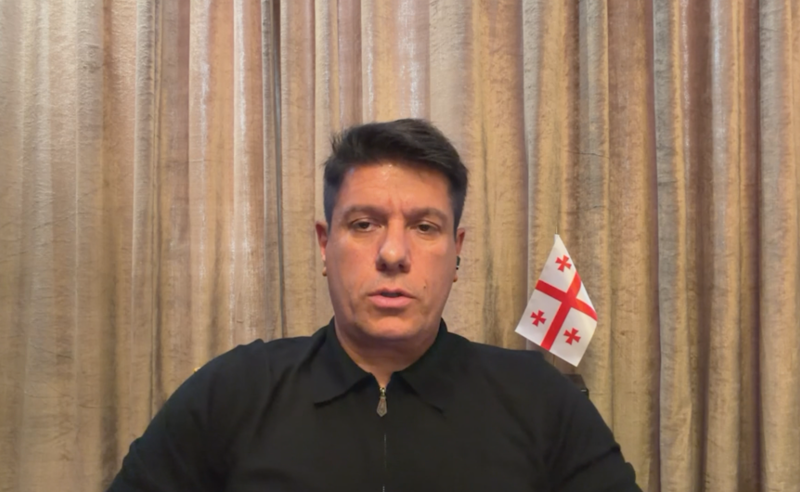
According to Mamuka Pipia, leader of the pro-Kremlin party “Solidarity for Peace” (Solidarnost vo Imya Mira), a statement regarding “Georgievsk-2” will soon be issued from Moscow.
Speaking to the TV Pirveli channel, he also noted that he agrees with Georgian Prime Minister Irakli Kobakhidze that the 1783 Treaty of Georgievsk “saved our statehood and Christianity,” but disagrees with the assertion “that this step was taken as a path toward Europe.”
“As the leader of ‘Solidarity for Peace,’ I want to openly state: we are working in this direction, and very soon an announcement regarding ‘Georgievsk’ will be made from Moscow. Today, the time has come to see to the country’s genuine salvation and to a new ‘Georgievsk-2.’ This time—on equal terms.”
As a reminder, on August 18, Prime Minister Irakli Kobakhidze once again stated that the signing of the Treaty of Georgievsk nearly 250 years ago was vital to the preservation of Georgian statehood. About a week earlier, the Prime Minister had already remarked that the agreement concluded between King Irakli II of Kartli-Kakheti and Russia played a crucial role in saving Georgia.
The Treaty of Georgievsk was concluded in the fortress of Georgievsk in the North Caucasus in 1783. Under the treaty, Moscow pledged to protect the Kingdom of Kartli-Kakheti; however, when the need arose in 1795, it left King Irakli II and his army to face the forces of Agha Mohammad Khan alone.
In 1801, Russia issued a manifesto on the annexation of Kartli-Kakheti—an outcome the agreement never provided for. Furthermore, in 1811, in direct violation of the treaty, Russia abolished the autocephaly of the Georgian Orthodox Church, which was supposed to remain inviolable under the terms of the document. The Treaty of Georgievsk ultimately led to the annexation of Eastern Georgia, the subsequent subjugation of other Georgian principalities by the Russian Empire, and the overall elimination of Georgian statehood.