


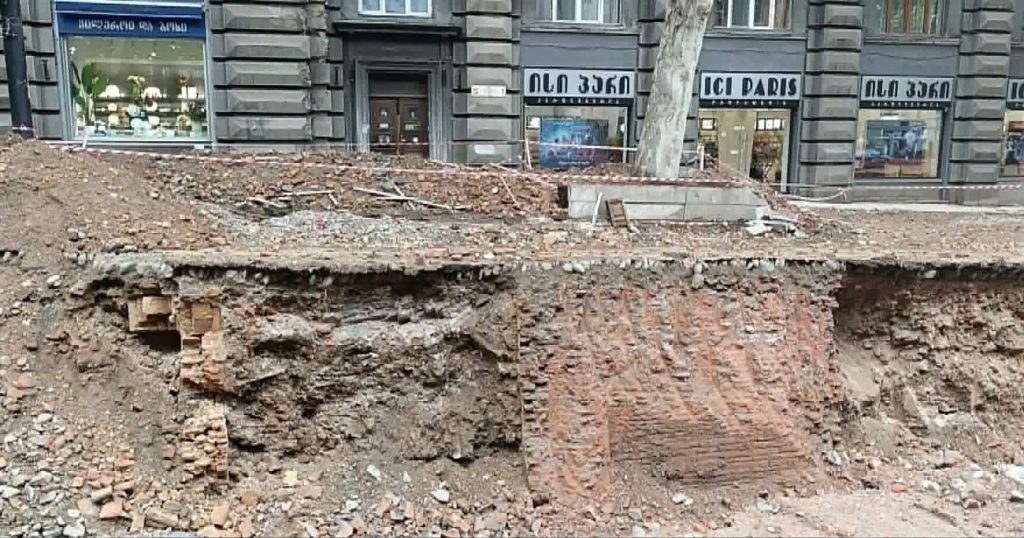
The “Movement for Cultural Heritage” organization has issued a statement reporting that during works on Rustaveli Avenue, along the section between the Freedom Square metro station and the Georgian National Museum, brick masonry was discovered—presumably part of a 19th-century drainage collector system from the historic Garetubani district (an outer quarter of the city).
In addition, the movement noted that numerous ceramic vessels, presumably dating back to the 10th–11th centuries, were also found.
“We wish to address the ongoing work on Rustaveli Avenue. As is well known, the rehabilitation of the capital’s main thoroughfare began on July 23 (with the company Smart Solutions serving as the contractor).
During the works on the section between the Freedom Square metro station and the Georgian National Museum, brick masonry was uncovered—presumably a 19th-century collector system of old ‘Garetubani’—along with, according to our information, numerous ceramic vessels, presumably dating from the 10th–11th centuries. Work on this section has already been suspended; however, it remains unknown whether an investigation of the exposed layers is planned and what fate awaits them going forward.
Furthermore, to this day, the identity of the specialist or team of specialists (if any exist) who, in accordance with the law, must provide archaeological supervision over the rehabilitation works remains undisclosed.
The ‘Movement for Cultural Heritage’ welcomes all projects aimed at improving the capital’s urban landscape; however, it is equally critical that the Law ‘On Cultural Heritage’ (Chapter III, Article 10) be strictly observed throughout the process.
The ‘Movement for Cultural Heritage’ calls on the Ministry of Culture, the National Agency for Cultural Heritage Preservation of Georgia, and the Tbilisi City Hall to initiate consultations in order to examine the archaeological layers and artifacts discovered on Rustaveli Avenue within the statutory timeframe, as well as to ensure the proper coordination of archaeological supervision during the project’s implementation,” the organization’s statement reads.
Meanwhile, Tbilisi City Hall has already stated that following the discovery of the archaeological layers and artifacts, the relevant data was handed over to the National Agency for Cultural Heritage Preservation. Work will now proceed in strict compliance with the recommendations issued by the agency.
“Whenever archaeological layers and artifacts are uncovered during completed or ongoing infrastructure projects in the capital, Tbilisi City Hall collaborates closely with the National Agency for Cultural Heritage Preservation and makes further decisions strictly based on its recommendations.
Naturally, information regarding the artifacts discovered during the rehabilitation of Rustaveli Avenue was also immediately conveyed to the National Agency for Cultural Heritage Preservation. Based on the notification, the agency’s specialists responded without delay, conducting an on-site inspection of the discovered objects and issuing appropriate recommendations. Work on the designated section will be carried out in strict accordance with the issued recommendations,” the official statement said.