


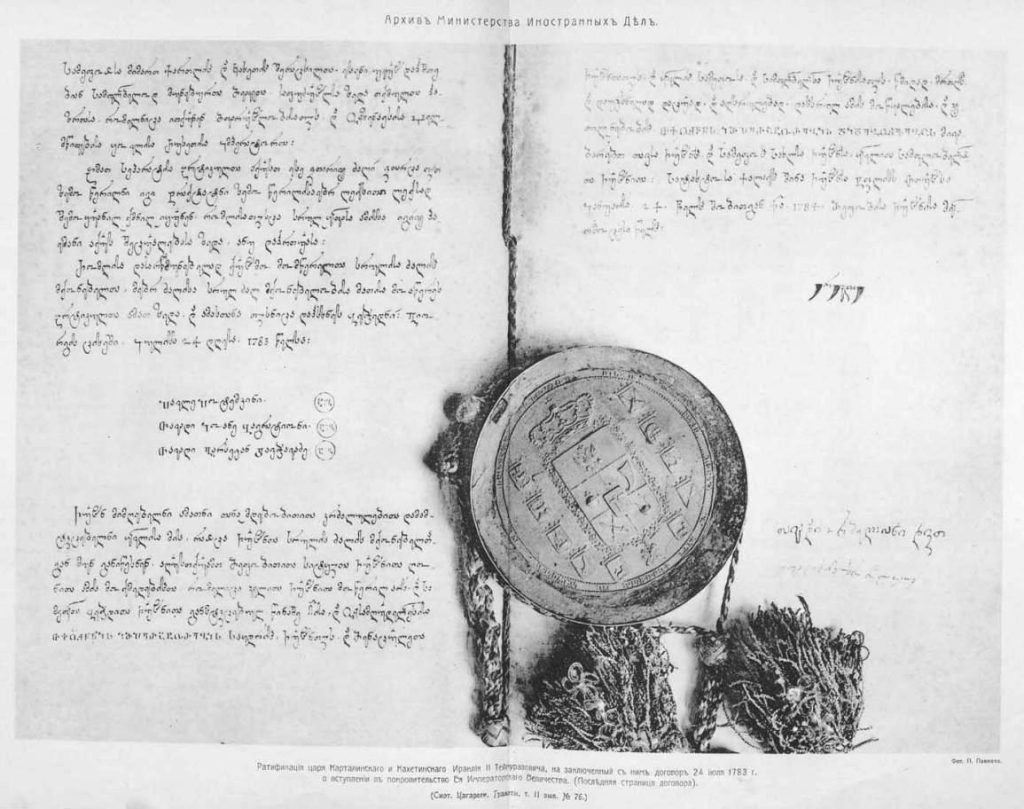
Following Prime Minister Irakli Kobakhidze, members of the ruling Georgian Dream party are highlighting the benefits that the Treaty of Georgievsk brought to Georgia.
“With a coreligionist state—an empire, of course, but in the absence of any other reality—with a country that remained the only path to the West, Irakli II concluded that very smart and wise treaty, thanks to which, ultimately, despite numerous extremely negative consequences, Georgia and the Georgian people were able to physically survive. Here, King Irakli’s genius is obvious,” stated MP David Matikashvili.
Parliament member Gia Volski also told reporters that although Russia failed to fulfill the terms of the treaty, Georgia ultimately avoided disappearing as a nation:
“Following the signing of the Treaty of Georgievsk in 1783, Georgia suffered a series of severe blows, with Russia failing to fulfill the terms of the agreement—this only began later, when it became advantageous to Russia. For a certain period, Georgia went through very difficult times… Ultimately, this helped ensure that Georgia would not become, let’s say, a vassal to any Muslim culture and a rather aggressive neighbor, or completely disappear as a nation and a people.”
Akaki Aladashvili of Georgian Dream, for his part, stated that in signing the Treaty of Georgievsk, King Irakli II was guided by the national interests of his country.
“Every existing state primarily looks after its own interests and acts accordingly. This is precisely what we see in Irakli II’s decision. It [the treaty] was determined exclusively and entirely by Georgia’s interests. A starkly opposite example was the step taken by Saakashvili when the war started in 2008, a step he took based on the interests of another state.”
According to another lawmaker, Irakli Kadagishvili, the signing of the Treaty of Georgievsk was decisive in aligning Georgia with European civilization.
“Today, Georgia is the type of country, the type of state, the type of society that wants to be part of Christian, European civilization and follow this path. Today, Georgia is a country under the sway of European civilization, and that decision [by Irakli II] made a tremendous contribution to this.”
As a reminder, on August 12, Prime Minister Irakli Kobakhidze stated that the Treaty of Georgievsk played a crucial role in saving Georgia. Later, on the 18th, the head of government noted that the country derived “fundamental benefits” from the agreement: “at a time when we stood on the brink of existence and non-existence, thanks to this step by Irakli II, we not only survived as a nation, but ultimately triumphed, which is best demonstrated by the fact that today Georgia is an authentic country rooted in Christian values, national origins, and traditional European culture.”
These statements have drawn criticism from pro-Western opposition figures, experts, and civil society activists.
Lasha Parulava, a member of the United National Movement party, stated that Prime Minister Kobakhidze is attempting to rewrite history. He noted, in particular, that after the signing of the Treaty of Georgievsk, Russia abolished the autocephaly of the Georgian Orthodox Church and altered the appearance of ancient churches by erecting Russian-style domes on them.
“If anyone wants to rewrite history and sign a new treaty with Russia, we say once again that this will not work! Georgia will not become Russian. Ivanishvili is offering our country the impossible; he does not know the Georgian people, and yes, he will receive an answer from the Georgian people, and that answer will be quite harsh for the entire Georgian Dream regime,” the opposition figure stated.
Diplomat Gia Japaridze also criticized the Prime Minister’s remarks. He called Kobakhidze’s statements regarding the Treaty of Georgievsk an “immoral lie,” emphasizing that Russia violated the agreement immediately after signing it—”just as it violated and continues to violate all other agreements concluded subsequently.”
“The Treaty of Georgievsk was not concluded between Georgia and Russia. This treaty was signed between the Kingdom of Kartli-Kakheti and the Russian Empire. Imereti, Samegrelo, Abkhazia, and the rest of Georgia were conquered by Russia later. Conquered after Russia had used the Treaty of Georgievsk to complete the subjugation of Kartli-Kakheti.”
Japaridze believes that “there are plans to surrender Georgia to Russia,” and that by using the topic of the treaty, the current authorities are “justifying their pro-Russian policy, the shift in Georgia’s foreign policy course, betrayal, and the desecration of the historical choice made by Rustaveli and Ilia Chavchavadze.”
Meanwhile, the leader of the pro-Kremlin “Solidarity for Peace” party, Mamuka Pipia, on the contrary, welcomed Kobakhidze’s remarks, announcing that a statement regarding a “Georgievsk-2” would soon come from Moscow. He noted that he agreed with the Prime Minister that the treaty “saved our statehood and Christianity,” but disagreed with the notion “that this step was taken as a path toward Europe.”
“As the leader of Solidarity for Peace, I want to state openly: we are working in this direction, and very soon a statement regarding ‘Georgievsk’ will be issued from Moscow. Today, the time has come to see to the real salvation of the country and a new ‘Georgievsk-2.’ This time—on equal terms.”