


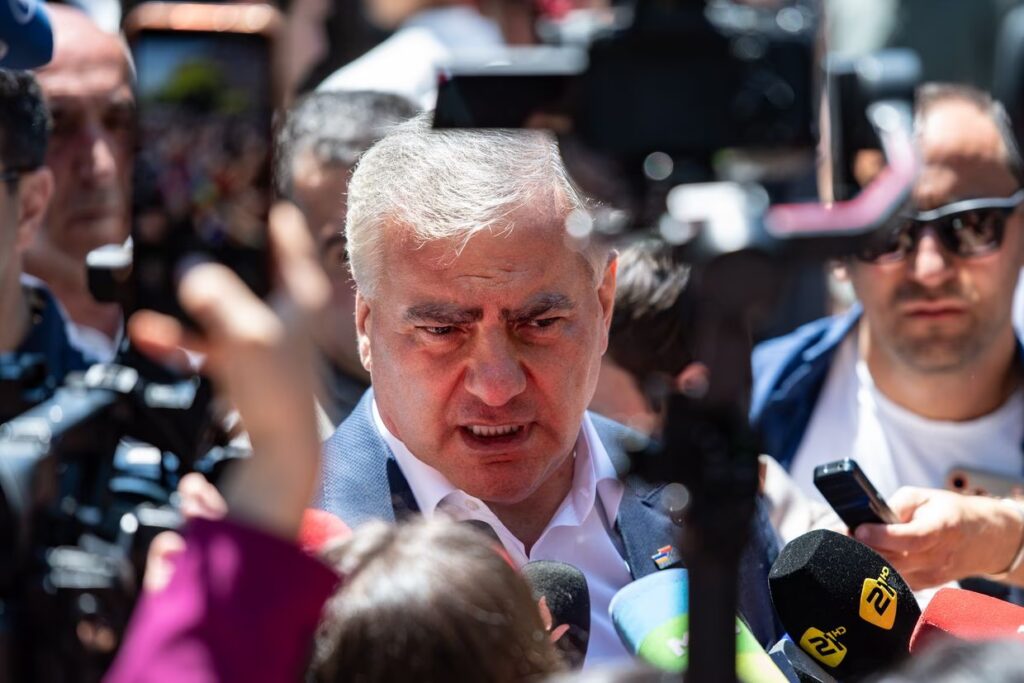
- Samvel Karapetyan speaks to reporters on election day. Photo: Mariam Nikuradze/OC Media.
This article is part of a partnership with OC Media. You can read the original English version here.
Russian-Armenian tycoon and opposition leader Samvel Karapetyan has claimed that Armenia will be left ‘without an owner in the region’ if Russia withdraws its military base from Gyumri. Russia has signaled its readiness to withdraw the base, which has been stationed in Armenia since the 1940s; in response, Yerevan stated that it had never requested such a move, but does not consider the Gyumri facility a ‘vital necessity’.
Karapetyan built his fortune in Russia and entered politics in 2025, founding the Strong Armenia party, which is currently the largest opposition faction in parliament. He made the remarks on 11 September while speaking to journalists outside a courthouse where criminal proceedings against him—involving charges of public calls for a coup d’état and money laundering—were underway.
‘Well, put a Turkish base there instead. A base has to be there; a base exists now: it is either the Russians or the Turks. Make up your minds,’ Karapetyan said, answering a reporter who asked why Armenia should be considered ‘without an owner’ if there is no foreign military base in the country.
‘We have Armenian bases,’ Karapetyan said after being asked why foreign troops should be stationed there instead of an Armenian base.
These comments followed a meeting between Prime Minister Nikol Pashinyan and Russian President Vladimir Putin on 1 September, after which Putin said Russia was prepared to withdraw ‘if Armenia believes that the Russian military base in Armenia is not needed.’
The issue emerged amid strained relations between Yerevan and Moscow, which escalated ahead of Armenia’s June elections. Several matters between the two nations remain unresolved, particularly regarding Yerevan’s push toward EU membership and Moscow’s imposition of trade restrictions. Both sides agreed to continue negotiations in the near future.
Following Putin’s 2 September statement, Pashinyan remarked that Armenia does not consider the presence of the Russian base a ‘vital necessity’, adding that Yerevan would not object if Moscow decided to withdraw it, and noting that Armenia itself had never raised the issue.
The Russian 102nd Military Base in Gyumri was established in the 1940s and is believed to host over 3,000 Russian service personnel. It has served as a cornerstone of Russia’s military presence in the South Caucasus.
Over the years, the base has repeatedly been mired in controversies, including allegations linked to the detention and abduction of Russian military deserters, as well as crimes committed by Russian soldiers outside the installation. The most high-profile incident occurred in 2015, when a Russian soldier murdered seven members of a local family.
Following Pashinyan’s remarks, Civil Contract MP Vilen Gabrielyan, chairman of the Armenian parliament’s Standing Committee on Defense and Security, stated that the base’s departure would not adversely affect Armenia’s security, arguing that Moscow had failed to honor its commitments during the Azerbaijani attacks on Armenia in 2021 and 2022.
Gabrielyan did not rule out that Armenia might eventually request Russia to withdraw the base or pay rent. Moscow currently pays nothing to maintain the facility; however, Pashinyan previously noted that if Russian gas prices increase, Armenia ‘will also look at what we can raise in price or what has been free until now, after which a price may emerge proportionally.’
‘My personal view is that, yes, such a financial recalculation—as you phrased it—could also apply to the base, since, as we know, the premises and upkeep [of the base] are largely covered by the Republic of Armenia,’ the Armenian leader said.
‘ENA is not for sale’
During his remarks to the press, Karapetyan also addressed the ongoing dispute surrounding the Electric Networks of Armenia (ENA), owned by his Tashir Group.
Yerevan moved to seize control of the utility shortly after Karapetyan’s arrest in June 2025, which came after he publicly supported the Armenian Apostolic Church during its standoff with Pashinyan—a dispute that escalated in May 2025.
‘As for ENA, don’t worry, ENA will return to its rightful owner, and there is nothing they can do,’ Karapetyan said.
Asked whether ENA could be sold to foreign investors, he replied that the Armenian authorities would first have to ‘take it away before they can sell it.’
‘We can sell it, but we are not going to sell it,’ Karapetyan insisted.
Karapetyan declined to disclose the amount offered to his company, reiterating that ‘ENA is not for sale.’
The government has not publicly disclosed the buyout offer made to Karapetyan. According to documents obtained by Radio Free Europe/Radio Liberty (RFE/RL), the proposal stood at 23.3 billion drams ($59 million), conditioned on Karapetyan returning more than 23 billion drams ($60 million) in dividends he had drawn from the company over the preceding 10 years.
RFE/RL calculated that this would result in an effective net buyout offer of just 142 million drams ($360,000) for ENA’s shares once the company dividends were reimbursed.
In early September, Armenian authorities drafted legislation declaring an overriding public interest in ENA, clearing the legal path for state expropriation with compensation.
Under legislative amendments expedited through parliament in the summer of 2025 shortly after Karapetyan’s detention in June, if ENA is stripped of its license, the power grid must be recognized as an ‘overriding public interest’ subject to an asset valuation. The current owner, Tashir Group, would subsequently receive expropriation compensation.
In November 2025, Armenia’s Public Services Regulatory Commission voted to revoke ENA’s power distribution license, citing gross violations, and installed a temporary state administrator.
In response, Tashir Group launched international arbitration proceedings, seeking hundreds of millions of dollars in damages over what it characterizes as unlawful interference with its investments in Armenia’s energy sector.