


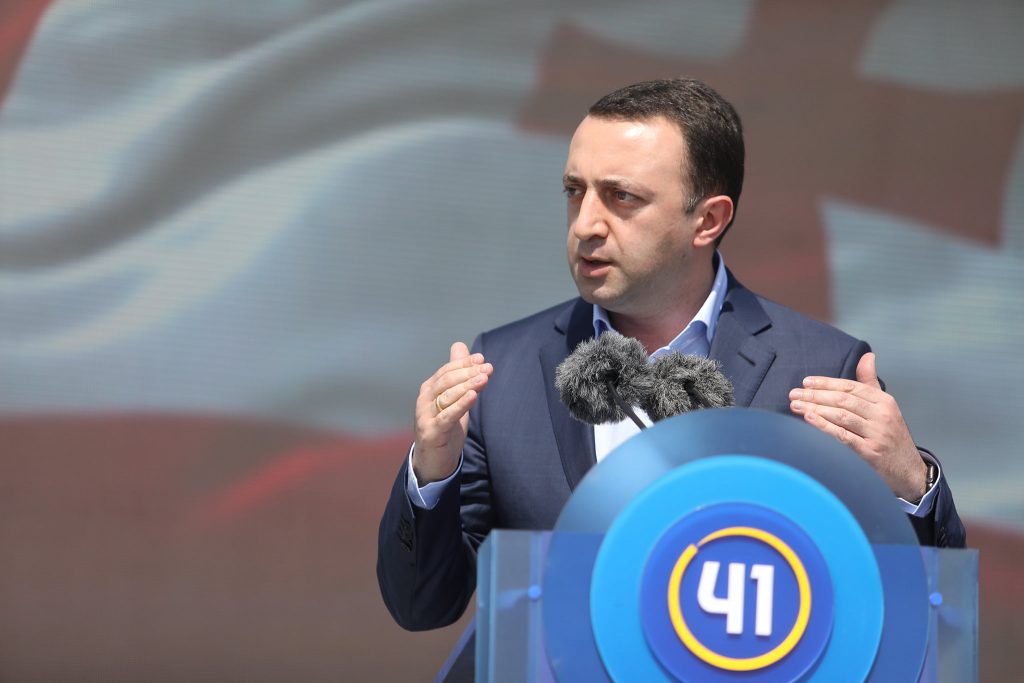
Former Prime Minister Irakli Garibashvili has released another letter from prison, offering explanations regarding his arrest. According to Garibashvili, he was promised that if he pleaded guilty, a plea agreement would be reached, resulting in a lengthy suspended sentence and a fine without any prison time. However, the former prime minister claims he was “double-crossed.”
The former prime minister stated that the primary goal and motive behind his arrest was his political neutralization.
“Questions are emerging in society regarding my arrest, and numerous murky theories and speculations are circulating. In my previous letters, I partially explained and outlined the main motive; however, I decided to address this matter in greater detail and explain to the public the real reason I was put in prison.
The primary goal and motive behind my detention was and remains my political neutralization, damaging my name and reputation, discrediting me in the eyes of the people, and, ultimately, destroying my political future.
After they committed an act of incredible vile treachery, set a dirty trap for me, broke their word, tore up our agreements, and stormed into my home, a message was delivered to me that very day: ‘You won’t walk away clean; you’ll have to forget about politics,’ accompanied by a promise: ‘Not a single day in prison, a lengthy suspended sentence, and a fine.’ I was ‘double-crossed’ once again. On January 4, I was unexpectedly informed that the terms had changed and that I had to go to prison for five years. By that point, I had already confessed, was out on bail, and was awaiting the finalization of the plea agreement on the promised terms.
As I have already explained to the public in my letters, owing to my 20-year relationship with Bidzina Ivanishvili and my attitude toward him, I meekly walked to the political slaughterhouse and went to prison, as I did not wish to enter into an open confrontation. By doing so, I made a sacrifice and spared the team and the country. In return, I received a third betrayal.”
At the same time, Garibashvili notes that following his detention, he maintained contact with the authorities through an intermediary, who told him that the government had suffered far more from his arrest than he had.
“In February, when contact was established through an intermediary, apart from the press, the authorities’ main message was essentially that the government had suffered more from my arrest than I had… I realized that they were looking for pretexts to target me and were preparing a new, dirty provocation. The reason was obvious: the authorities had failed to properly discredit me in the eyes of the public and achieve the outcome they had counted on through the arrest and the accompanying propaganda.
After that, there was no contact at all until July, when, as the public already knows, I unexpectedly received a letter with new conditions, while an oral message delivered through an intermediary conveyed that the authorities had suffered greatly from my arrest, whereas my reputation had not sustained any substantial damage. Public sympathy toward me—especially among Georgian Dream voters—had only grown, all the more so against the backdrop of dozens of individuals convicted in the coup case being released with suspended sentences.
People found it baffling and inexplicable why I was kept in prison for five years, given that I had confessed, compensated for the damages, there were no victims in the case, and the fine had been paid. Consequently, my imprisonment turned into an intolerable burden for the authorities.
Compounding this were senseless suspicions and fears that I would return to politics after being released from prison. Because of this, they demanded that I plead guilty to new, fabricated corruption charges—on the one hand, to destroy my good name once and for all, and on the other, to further insure themselves against the risks of my return to politics,” Garibashvili writes.
According to the former prime minister, his imprisonment was purely political from start to finish, from the very first day, and all actions taken against him were driven by political motives and had nothing to do with justice.
Garibashvili emphasizes that he remains behind bars because of “absurd suspicions, fears, and envy,” calling it an egregious injustice and act of cruelty toward him and his family.
“Over the past two weeks, the authorities’ deceitful and dirty propaganda has continued its smear campaign against me using laughable and desperate methods driven solely by fear. I have also heard hypocritical and deceitful statements from government representatives, to which I want to respond: I see you have gotten carried away and too absorbed in your roles. Enough hypocrisy! Take the log out of your own eye first before lecturing on corruption. The people understand perfectly well that all of this is an outright farce and an insult to our society.”
In his letter, Garibashvili also argues that Georgian Dream is reviving the governing methods of the United National Movement (UNM). According to him, the ruling party has ruined lives, brought grief to families, and bred a sense of despair among the people.
“Through these absurd and malicious spectacles, you have insulted state institutions and made them a laughingstock both domestically and abroad; you have provided fodder for criticism to internal and external adversaries; and, above all, you have inflicted colossal, irreparable harm on your own country, the authorities, and the ruling party itself. Through your reckless policies and actions, you have plunged the country into perpetual chaos and an endless crisis, bewildered even your own voters, embittered citizens and entire families, and sown despair, instability, and fear of an unpredictable future among the people. You are already walking the path of Saakashvili and bringing back the governance methods of the National Movement… You are committing evil—come to your senses!” Garibashvili wrote.
As a reminder, on August 24, the former leader of Georgian Dream and ex-prime minister was hit with new charges: accepting a bribe on an especially large scale by a group of individuals by prior agreement. According to his lawyer, he denies the allegations and intends to prove his innocence in court. According to the prosecution’s case, Garibashvili received 750,000 GEL as a bribe. The money was allegedly handed over to him directly by Juansher Burchuladze. The criminal code article under which the charge was brought carries a penalty of 11 to 15 years in prison.
Since August 17, Garibashvili has been regularly releasing letters on social media. He maintains that he is being “forced” into an open confrontation.
In his first public statement, the former prime minister wrote that, acting on instructions from Bidzina Ivanishvili, he received a letter in prison urging him to take the blame in a new corruption case. In that same statement, Garibashvili stressed that full responsibility for his safety and the safety of his family members rests squarely on Bidzina Ivanishvili and the current government.
In his August 18 post, he omits any mention of Ivanishvili, clarifying that the letter published on Facebook the day before had been delivered to him in July by Mamuka Mdinaradze, one of the leaders of Georgian Dream.
Garibashvili notes that on the very same day, he communicated his position to Mdinaradze and “once again reiterated” that he had no intention of returning to politics. According to the text, in response, “they” conveyed that “a 1-percent risk still remains” of his re-entry into public politics. The politician claims that the new corruption charge was leveled against him specifically to neutralize that hypothetical risk.
In his letter of August 20, Garibashvili addressed Georgian Dream, accusing his former comrades-in-arms of orchestrating a “dirty provocation” and a “vile trap.” The former prime minister claimed he was deceived and abandoned to his fate, his relatives faced intimidation, and security personnel raided the homes of his parents and his father-in-law’s family. In the same message, he pointed out that he had received a thinly veiled hint threatening his father’s arrest for the second time.