


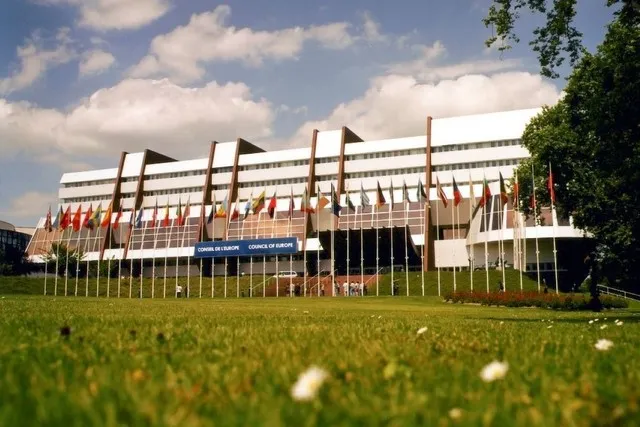
Council of Europe
This article is part of a partnership with OC Media. You can read the original English version here.
Five exiled Azerbaijani NGOs have urged the Council of Europe to take concerted action against Azerbaijan, including measures to secure the release of political prisoners and investigate allegations of torture.
Azerbaijan’s relations with the Council of Europe, as well as its agencies and bodies, have remained strained for years. The Council has frequently criticised the human rights situation in Azerbaijan, regularly issuing statements condemning Baku’s treatment of politicians, journalists, and members of civil society.
The NGOs’ statement asserts that Azerbaijan has one of the highest rates of non-implementation of ECtHR rulings: according to calculations cited in the document, 68% of the court’s judgments concerning Azerbaijan have not been enforced.
The groups called on the Council of Europe to take action over human rights violations in Azerbaijan and the country’s failure to fulfil its obligations as a member of the Council.
The statement—reportedly the first appeal of its kind addressed to the Council of Europe—was signed by the Independent Lawyers Network, the Caspian Research and Analysis Centre, the Open Azerbaijan Initiative, the Free Voice Collective, and the Institute for Democratic Initiatives.
“The European Convention on Human Rights establishes the collective protection of human rights, democracy, and the rule of law as the shared responsibility of the organisation’s member states,” the statement said.
“It is on the basis of this shared commitment and responsibility that we urge the member states of the Council of Europe to take joint and consistent steps within the organisation’s institutions to ensure that Azerbaijan complies with its membership obligations.”
The group noted that Azerbaijan joined the Council of Europe in 2001 and ratified the European Convention on Human Rights in 2002, granting Azerbaijani citizens access to international legal protection. According to the signatories, the European Court of Human Rights (ECtHR) became the only effective avenue for pursuing justice when domestic legal remedies proved ineffective.
The organisations noted, however, that Azerbaijani authorities have sought to frame the Council of Europe’s monitoring mechanisms as an infringement on national sovereignty and have pursued policies questioning the legitimacy of the organisation’s institutions.
A human rights crisis has been mounting in Azerbaijan since 2022, with independent media outlets and the political opposition facing increasingly stringent restrictions.
“According to reports by independent organisations, there are at least 328 political prisoners in the country,” the statement read. “Civil society representatives, journalists, and political activists are being sentenced to lengthy prison terms of up to 10–15 years.”
The organisations also accused Azerbaijani authorities of torture and ill-treatment of these detainees, citing reports of sexual harassment against female prisoners that reportedly intensified in the first half of 2026.
They also stated that existing channels of engagement, including the Council of Europe Office in Baku and visits by the European Committee for the Prevention of Torture (CPT), must not serve to legitimise the current situation in Azerbaijan.
“Permitting the erosion of the organisation’s founding principles simply to preserve the membership of a particular state could carry far more severe and lasting consequences for the Council of Europe and all of its member states,” the group said.
The organisations acknowledged that a principled response might accelerate the Azerbaijani government’s exit from the Council of Europe; however, they insisted that the responsibility for such an outcome would lie squarely with Baku, rather than the organisation itself.
They urged the Council to respond to Azerbaijan’s suspension of cooperation with the body and its refusal to implement judgments in the case of Anar Mammadli, who was sentenced to 13 years’ imprisonment in September.
They also called on the Secretary General to request an official explanation from the Azerbaijani government concerning the human rights situation in the country and its disregard for ECtHR decisions.
Furthermore, the organisations appealed to the Parliamentary Assembly of the Council of Europe (PACE), the Committee of Ministers, and the Secretary General to keep the situation in Azerbaijan on their agendas and take coordinated steps to secure the release of prisoners in the country.
Relations between Azerbaijan and PACE have deteriorated markedly in recent years amid clashes over human rights, political prisoners, and the state of democratic institutions. Azerbaijan suspended its participation in PACE in January 2024 after the assembly voted against ratifying the credentials of its delegation.
PACE President Petra Bayr has since stated that Azerbaijan’s return to the assembly would depend on whether Baku removes at least 70 PACE members—including Bayr herself—from its blacklist.
Bayr also noted that if Baku were genuinely serious about returning to PACE, it should, at a minimum, release several prominent political prisoners.
Shortly thereafter, however, Azerbaijani President Ilham Aliyev declared that if Azerbaijan were to leave the Council of Europe entirely, “no one in our country would even notice.”
Azerbaijan became a full member of the Council of Europe in 2001, committing to human rights obligations and a range of other standards. Nevertheless, the country remains subject to the Council of Europe’s monitoring procedure.