


The school was shut down as unsafe, an expert assessment recommended its demolition, and just days later authorities decided to reopen the building for 1,200 children. In the span of a single week, the story of Tbilisi School No. 21 swung from an “unsafe structure” to the “temporary return of students.” Why did the decision change so rapidly—and what does the published expert report actually say?
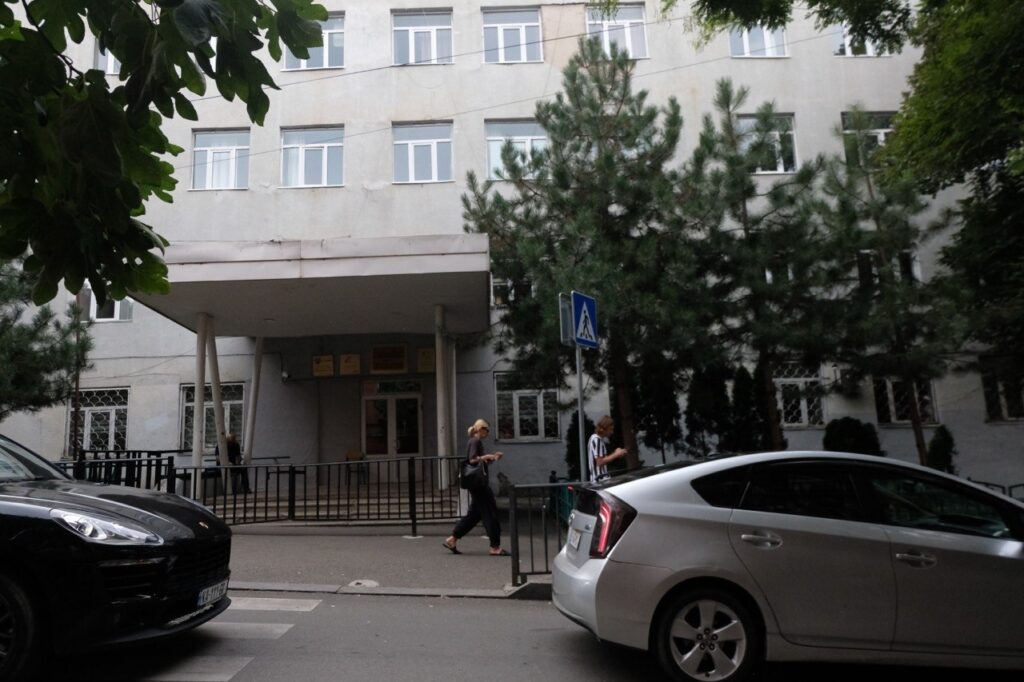
Classes at School No. 21 in Tbilisi’s Vera district began on September 15, as they did across Georgia’s other public schools. But by 10:00 PM on September 17, parents received a message: in-person classes in the building were being suspended starting the following day. Its structurally compromised condition was cited as the official reason.
“Last academic year, we were notified about planned renovations to the school building, but no information was provided regarding problems with its structural integrity. As it turned out, teachers hadn’t been informed either,” says Khatuna Saginidze, the mother of a student at the school.
Revaz Apkhazava, an education policy expert, is also intimately familiar with School No. 21, and not only in a professional capacity.
“I have two reasons for caring deeply about this school. My connection to it is as a former student—I grew up here, spent some of the best years of my life here, and made friends who have stayed with me for a lifetime. Later, I became a teacher at this school myself, and my former teachers became my colleagues. We were all deeply immersed in its life and built so much here with our own hands,” Apkhazava recounts.
On September 19, the online outlet Netgazeti published the full assessment report from the Levan Samkharauli National Forensics Bureau. The document reveals that the inspection of the school’s condition began long before the start of the new school year.
The Municipal Development Fund approached the bureau exactly one year earlier, on September 16, 2025. Experts were tasked with determining the building’s seismic resistance and whether its rehabilitation was viable. The on-site structural inspection took place as early as December 10, 2025. However, the final report was only issued on September 10, 2026—just five days before the start of the academic year. The school’s closure was announced shortly thereafter.
Minister of Education Givi Mikanadze attributed this discrepancy in dates to the fact that the Ministry itself did not receive the report until the afternoon of September 17. According to him, the agency made the decision to suspend classes immediately after reviewing the document.
Yet the published assessment leaves unexplained what transpired with the document between September 10 and September 17: when the Municipal Development Fund—which commissioned the study—received it, how long it took to transfer the findings between agencies, and whether any responsible body knew about the expert’s conclusions before the school opened its doors.
There is also a broader question regarding the timeframe of the assessment itself. About nine months elapsed between the physical inspection of the school and the formalization of the findings, with the entire process taking a full year. The published document offers no explanation for such a delay.
What the Report States
Meanwhile, the expert’s conclusion proved more nuanced than simply declaring that “the building is unsafe.” The report first independently assesses the nature of the school’s actual damage. Based on the severity of the damage, the building was assigned to Category III suitability. The expert recorded cracks and damage to individual structural components, though noting that some defects were localized. The document also states that following previously conducted structural reinforcement work, deformations had stabilized, and no further progression was observed at the time of inspection.
Had the building remained in Category III, this alone would not have necessitated evacuation and demolition. Under the temporary procedure approved by Georgian Government Decree No. 161 of April 22, 2026, Category III indicates that a building has suffered less than 30% damage, its operational stability is compromised, and it requires timely reinforcement in accordance with an appropriate design plan.
Revaz Apkhazava believes the published assessment provides insufficient grounds for a definitive decision on the building’s fate.
“When we read the expert findings, the reasoning struck us as very superficial. As far as we can see from the document, no comprehensive study of the building was conducted. This is the conclusion of a single expert who inspected the building and pointed out, among other things, that it was not designed to withstand an eight-magnitude earthquake. To understand the true condition of the school, an additional, more thorough assessment is essential.”
The building’s final safety category, however, was determined not solely by the state of its damaged structural elements. The expert separately evaluated the school’s compliance with seismic resistance standards and concluded that its structural framework failed to meet these requirements.
Specifically, the report notes that the building violates regulatory requirements regarding the spacing between transverse load-bearing walls under calculated seismic conditions, and that the number of above-ground stories exceeds the limit permitted for school buildings. Based on these non-compliances and Government Decree No. 161 of April 22, 2026, the expert downgraded the school to Category IV suitability.
The Issue of Stories
Another noteworthy point in the Samkharauli Bureau’s report is the violation regarding the number of above-ground stories exceeding the allowable limit for a school facility. Technical regulations on earthquake-resistant construction explicitly stipulate that childcare and school facilities must not exceed three above-ground stories. This provision has been part of the regulations in force since 2009 and was subsequently incorporated into state building codes.
In comments to TV Pirveli, the school’s former principal, Tamar Amzashvili, stated that the educational institution had previously successfully passed the authorization and accreditation process. According to her, the building’s structural stability was verified by a Samkharauli Bureau report as part of that review, after which the school received its authorization and continued operating. That decision indeed dates back to September 2023, following which the school operated without restrictions.
It was precisely the Category IV classification that served as the basis for the final verdict: rehabilitation was deemed economically unviable, and complete demolition of the school was recommended instead.
The expert does not claim that the extent of the directly observed damage on its own corresponds to Category IV. On the contrary, the text indicates that the physical damage aligns with Category III, while the reclassification to Category IV stems from the failure of the building’s overall structural layout to meet modern seismic safety standards.
What Was Offered to the Children
According to Khatuna, neither teachers nor parents trusted the findings of the assessment. At the time operations were halted, approximately 1,200 children were enrolled in the school, and around 100 educators were employed there.
“It was decided that students would transition to online learning for one week, after which they would be split up among different schools across different shifts. This decision sparked protests; teachers have also joined in,” Khatuna explains.
Apkhazava likewise opposed dispersing students and staff across multiple schools. In his view, if a temporary relocation is indeed required, the school must be preserved as a unified community:
“If a decision is made to relocate, the students and teachers must be transferred together—into a single building. This is vital given the specific character of the school.”
Reversing the Decision
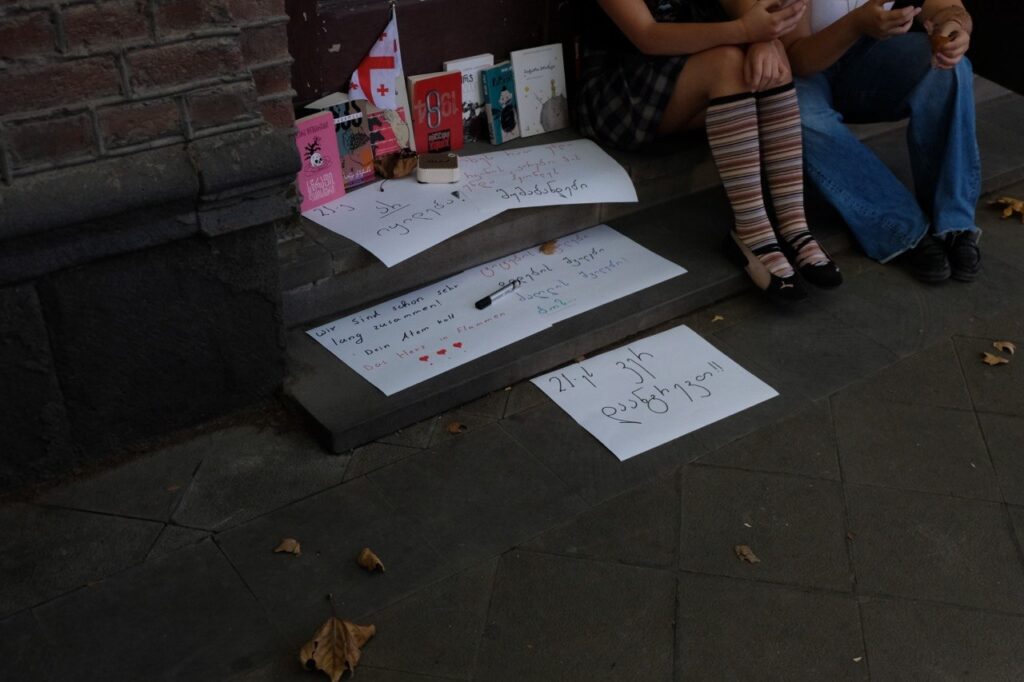
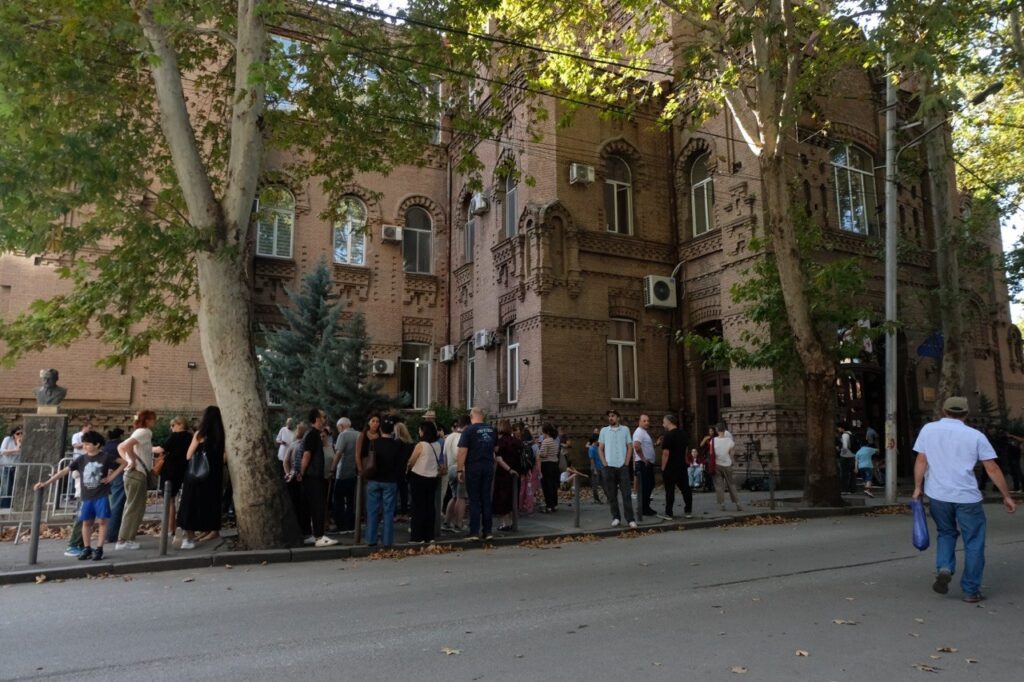
During the shutdown of School No. 21, several protest rallies were held outside the premises, demanding a more detailed justification of the expert findings, as well as an appropriate venue where students and teachers could continue classes together.
“We demand what we need most at this stage: complete information, an independent and objective assessment, a safe and fully functional educational environment, and the preservation of School No. 21’s educational role and integrity,” read one of the rally announcements.
On the morning of September 24, the Ministry of Education of Georgia announced that following a clarifying assessment of the building’s condition, a decision was made to carry out several weeks of rehabilitation work on the school. Once completed, students will be able to return to the building and continue their studies through the end of the 2026–2027 academic year under continuous monitoring of structural conditions. The Ministry plans to launch full-scale reconstruction work in the summer, during which classes are to be temporarily shifted to an alternative facility.
Later that day, Education Ministry officials met with roughly 35 teachers and parents. The parties agreed to conduct a joint site visit with the Municipal Development Fund to inspect the building. Parents and educators emphasized that they are insisting on a comprehensive study to establish whether the existing building can be reinforced and reconstructed or whether demolition will be inevitable.
According to attendees of the meeting, no definitive decision has been reached regarding the long-term fate of the building. At this stage, efforts are focused on carrying out minimal necessary work to resume classes, including facade repairs. Once completed, the educational process is expected to resume as soon as possible.
Minister Mikanadze stated that after receiving the initial assessment, the agency submitted follow-up inquiries to the Samkharauli Bureau. Responses were received on September 23, prompting the convening of an interagency commission comprising representatives from the Ministry of Infrastructure, the Municipal Development Fund, Tbilisi City Hall, the Parliamentary Education Committee, and the Samkharauli Bureau. According to the Minister, the commission concluded that following specific repairs and subject to constant monitoring, in-person instruction in the building could be temporarily resumed.
Prior to this, the Ministry of Education had presented the school community with two options: transferring students to second-shift schedules at Schools No. 49 and No. 51, or continuing online learning. According to Mikanadze, both options were rejected by parents and teachers, who insisted on maintaining the school as a unified educational space and preserving first-shift instruction. The Ministry had previously reported its proposal to transfer students to other schools.
Revaz Apkhazava argues that the situation surrounding School No. 21 should not be viewed in isolation:
“It is crucial that this issue is not discussed only by the students and teachers of our school. There are other schools in even worse condition, but their problems receive far less publicity. Therefore, the discussion should not focus exclusively on School No. 21, but on the challenges facing school infrastructure as a whole.”