


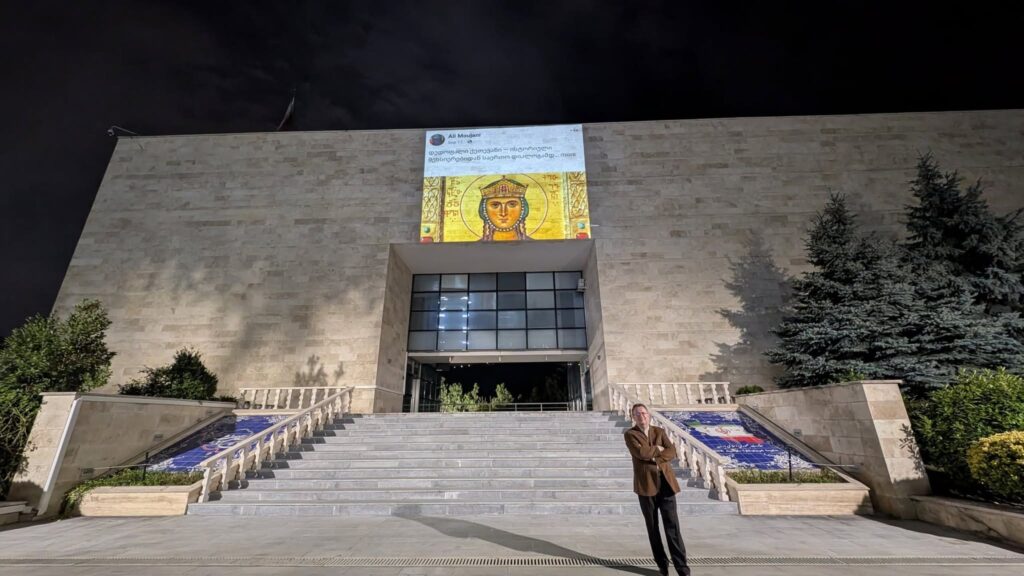
The facade of the Iranian Embassy in Tbilisi was illuminated with an image of Queen Ketevan of Kakheti, sparking yet another controversy surrounding the Iranian diplomatic mission.
Ambassador Ali Mojani posted a photograph of the building on his social media accounts. He noted that the image itself is a symbol of historical memory, “about which many different narratives still exist to this day.”
Mojani also announced that he plans to soon publish preliminary findings from his own research into Queen Ketevan and Iran.
However, as Ali Mojani noted, the document “will be neither an official version nor an attempt to put the final period on the history of Ketevan.” He also emphasized that “perhaps re-evaluating such stories is not so much a return to the past as an opportunity to gain a better, deeper understanding of one another today.”
Queen Ketevan the Martyr was the queen of the eastern Georgian kingdom of Kakheti and remains one of the most venerated saints of the Georgian Orthodox Church. She was the consort of King David I and the mother of future Kakhetian King Teimuraz I.
In the early 17th century, Ketevan was taken captive by Iran’s Shah Abbas I, who demanded that she convert to Islam. The queen refused, after which she was subjected to torture and executed in Shiraz.
The Iranian ambassador’s post sparked widespread outrage across Georgian society. Many viewed Ali Mojani’s comments as an attempt to reinterpret Ketevan’s story to suit his own narrative.
In particular, Georgian historians pointed out that by pursuing academic research alongside his diplomatic posting, the ambassador breached diplomatic protocol. Representatives of the ruling party have already stated that they expect a response from Georgia’s Ministry of Foreign Affairs.
The incident involving the projection of Ketevan’s image is not the first scandal to hit the Iranian embassy. In February, the diplomatic mission hosted a reception marking the anniversary of the Islamic Revolution. Outrage ensued over invitations that read: “The 410th Anniversary of the Arrival of Georgians in Iran”—a reference to the forced resettlement of tens of thousands of residents of eastern Georgia to Iran in the early 17th century under the orders of Shah Abbas I.
At the time, Ambassador Ali Mojani stated that Tehran views the episode primarily through the lens of the formation of the Georgian community in Iran and its contribution to the country’s development.
Ali Mojani was back in the spotlight of Georgian media in June after making a series of controversial statements against the backdrop of heightened tensions with the United States and Israel. In particular, the ambassador claimed that Iran had never attacked neighboring countries “throughout its centuries-long history.”
Facing mounting criticism, the diplomat walked back his wording, accusing the media of distorting his remarks. On his Facebook page, Mojani wrote:
“What was actually stated was the following: Iran has not attacked a single state in the past 200 years. Iran brought an end to a 2,500-year era of monarchical despotism 47 years ago, replacing it with a republic through direct elections.”