


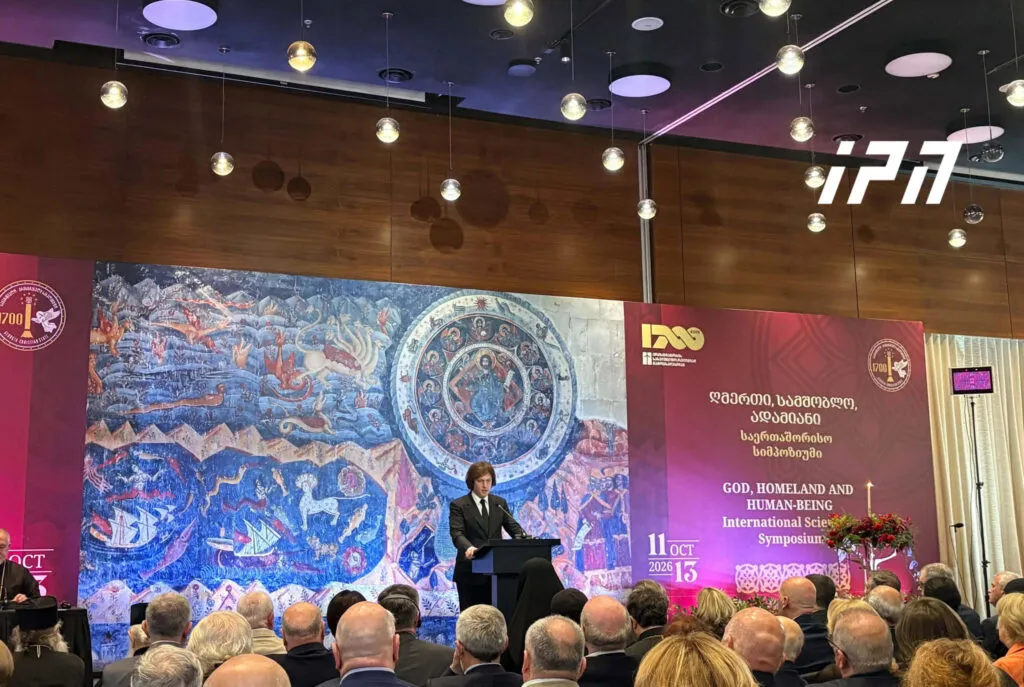
Georgia is among those rare nations where the Gospel arrived as early as the first century through the preaching of Christ’s apostles, and the historic decision made 17 centuries ago to declare Christianity the state religion defined our nation’s path of development and identity. Prime Minister Irakli Kobakhidze stated this during his address at the international symposium “God, Homeland, Man,” according to the IPN news agency.
As the head of government noted, the Mother Church has served as the nation’s spiritual pillar for centuries.
“For centuries, the efforts of our greatest secular and spiritual figures have been aimed at strengthening this solid foundation. The contribution of our great Patriarch Ilia II is exceptional in ensuring that supreme Christian values formed the foundation for building a modern independent state and the nation’s spiritual unity during this process. The state treats these eternal values with special reverence. In close cooperation with the Church, we will steadfastly defend the heritage upon which our national unity and development rest.
‘God, Homeland, Man’ are the very values that Patriarch Ilia II bequeathed to us to cherish. It is gratifying that the international symposium is dedicated specifically to this theme and aims to comprehend the interconnectedness of these values and their significance in modern life. I thank the symposium’s organizers, scholars, clergy, and all guests. I believe that today’s dialogue and future cooperation will make a significant contribution to strengthening universal human values. I extend my congratulations on the 1,700th anniversary of the proclamation of Christianity as the state religion. I wish the international symposium fruitful work,” Kobakhidze stated.
President Mikheil Kavelashvili spoke about seven eternal values that “can still be clearly traced today in our state thinking.” Addressing the symposium, the head of state noted that it is precisely these symbols that form the bedrock of defining an individual’s identity.
“Today, as the modern world faces a crisis of values and geopolitical upheaval, our duty is to ask a fundamental question: on what foundation must the Georgian state, society, and the individual stand?
In our state mindset today, seven eternal values are harmoniously united: God, Homeland, Man, Fatherland, Language, Faith, and Family.
This unique seven-component formula, based on the 19th-century national triad of Saint Ilia the Righteous (Ilia Chavchavadze) and the spiritual heritage of His Holiness Ilia II, transcends time and space, seamlessly uniting centuries of Georgian national thought—including such supreme summits of the Georgian mind and spirit as the immortal legacy of Shota Rustaveli and Vazha-Pshavela.
It is these seven symbols that serve as the basis for defining an individual’s identity. And today, when the era of globalization and artificial intelligence attempts to devalue human identity, these eternal values act as our primary, existential shield.
Georgian youth raised on these ideals are a guarantee that our society will be significantly more protected, progressive, morally resilient, and empathetic,” the president said.
In turn, Parliament Speaker Shalva Papuashvili described the event commemorated today in Georgia as one that “defined its development path, shaped its cultural identity, and determined its civilizational affiliation.”
As the speaker noted, Georgia stood at the crossroads of empires for centuries, and while many circumstances changed, the choice the Georgian people made by adopting Christianity remained steadfast.
“Seventeen hundred years ago, Kartli did not merely embrace a new religion. It embraced a system of values, chose a civilizational sphere, a cultural path, and the identity that became one of Georgia’s main pillars for centuries. For Georgia, Christianity was not merely a religious choice. It was the choice of our historical path and state mindset.
For centuries, our country stood at the crossroads of empires. The geopolitical landscape changed. Neighbors changed. The balance of power shifted. But the choice made by the Georgian people by embracing Christianity remained unchanged.
This is precisely why understanding Georgia’s history is impossible without Christianity. In the same way, it is impossible to fully comprehend Georgian culture, literature, architecture, legal thought, and national identity without the spiritual foundation that gave shape to it all.
Christianity built more than just churches. It established schools and monastic educational centers. It bound literary culture to statecraft. It forged that understanding of moral responsibility, justice, and human dignity that has served as the pillar of Georgian society for centuries,” Papuashvili said.
According to him, the history of Georgia is a story not only of survival, but also of fidelity to its faith, language, culture, and the very idea of statehood.
“Today, the world is once again going through an era of sweeping transformation. Technology, economic ties, and the international order are changing rapidly. But, as history has proven time and again, in times of change, the societies that stand firmest are those that do not lose their own identity,” the parliament speaker added.