


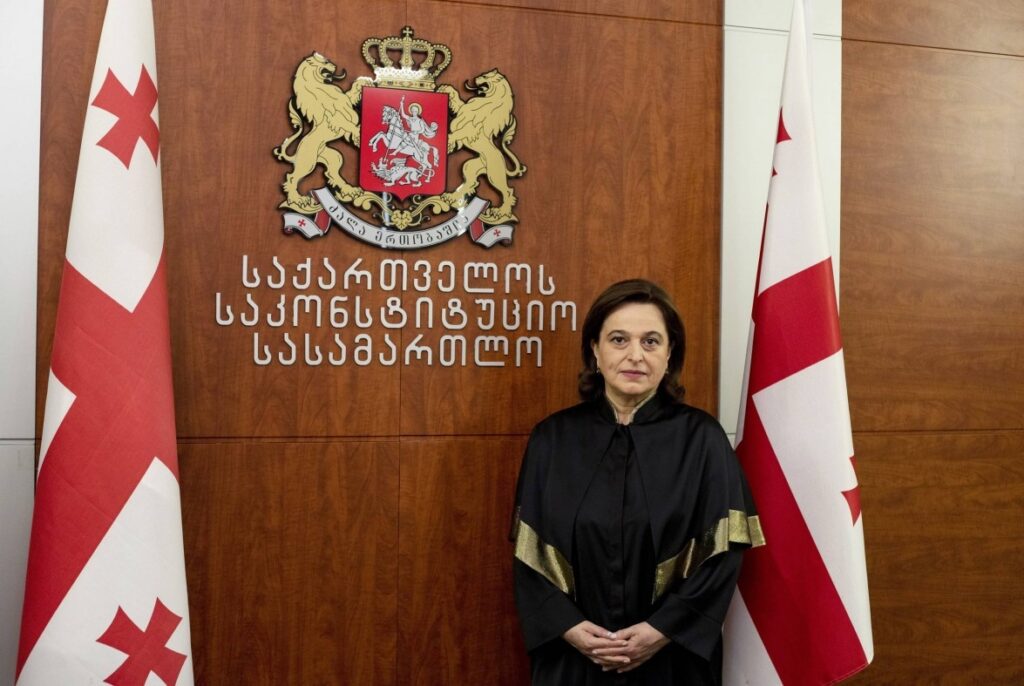
Judge Manana Kobakhidze of the Constitutional Court of Georgia filed a motion to recuse herself from considering a lawsuit seeking to ban opposition parties; however, the court declined to grant her request.
Kobakhidze sought recusal on the grounds that her past political activities and public criticism of the United National Movement could give rise to reasonable public doubts regarding her impartiality in conducting an objective review of the case.
As the judge pointed out, the public is well aware that she previously served as a co-founder and chairperson of the ruling Georgian Dream party, as well as a member of parliament. Furthermore, even prior to launching her political career, she publicly criticized the National Movement and several of its individual figures, who are currently affiliated with other parties targeted in the lawsuit. Kobakhidze had demanded that they be held accountable for actions cited in the constitutional lawsuit as key arguments for declaring these organizations unconstitutional and subsequently banning them.
“Moreover, during a plenary session of parliament that was publicly broadcast, she explicitly called on members of the Unity – National Movement coalition to dissolve the party and permanently withdraw from the political arena,” reads the document released by the court.
Manana Kobakhidze emphasized that since being elected as a judge, she has acted strictly in accordance with the Constitution and bears high judicial responsibility, meaning there are no objective reasons to question her integrity. Nevertheless, she noted that these circumstances could raise public questions about her independence and impartiality, potentially undermining trust in the court.
The plenum rejected Kobakhidze’s motion. The court explained that her past political statements constituted general criticism; therefore, there were insufficient grounds to presume bias on the judge’s part when rendering a decision. The court also concluded that Kobakhidze’s earlier statements did not, in essence, coincide with the claims raised in the lawsuit.
“The criticism voiced by Judge Manana Kobakhidze directly against Unity – National Movement was made in the course of her political activities quite some time ago. It stemmed from the logic of inter-party confrontation and, in substance, constituted harsh yet generalized critical assessments. Such rhetoric at that time was characteristic of the entire political team represented by Manana Kobakhidze and was repeatedly expressed by other party members.
The Constitutional Court does not agree with the arguments presented by Judge Manana Kobakhidze and believes that her participation in hearing the lawsuit and addressing related legal or procedural matters cannot provide the parties to the constitutional proceedings, the public, or an objective observer with compelling reasons to doubt the judge’s impartiality.”
“Taking into account the substance, form, and context of the public statements made during her membership in the Georgian Dream – Democratic Georgia party and the tenure of her parliamentary mandate, as well as the absence of a direct link between these statements and the subject matter of the current lawsuit, neither the participants in the proceedings nor the public should have reason to believe that Judge Manana Kobakhidze would violate the Constitution of Georgia, breach her judicial oath, or deliver an unjust ruling,” the plenum stated in its ruling.
The ruling further emphasized that recognizing political statements made by an individual prior to assuming judicial office as an absolute ground for recusal would paralyze the operations of the Constitutional Court and undermine the objectivity of the institution as a whole.
As a reminder, on October 6, 2026, the Constitutional Court of Georgia accepted for consideration a lawsuit filed by Georgian Dream seeking to ban the activities of five pro-Western opposition parties. These include the United National Movement, the Coalition for Change, Lelo – Strong Georgia, the Federalists, and Gakharia For Georgia.
In the lawsuit, the ruling party contends that since 2016, these political entities have consistently denied the legitimacy of the incumbent authorities and the country’s constitutional order. Georgian Dream initially sought to ban three political forces, including the party of former President Mikheil Saakashvili, but the list was subsequently expanded.