


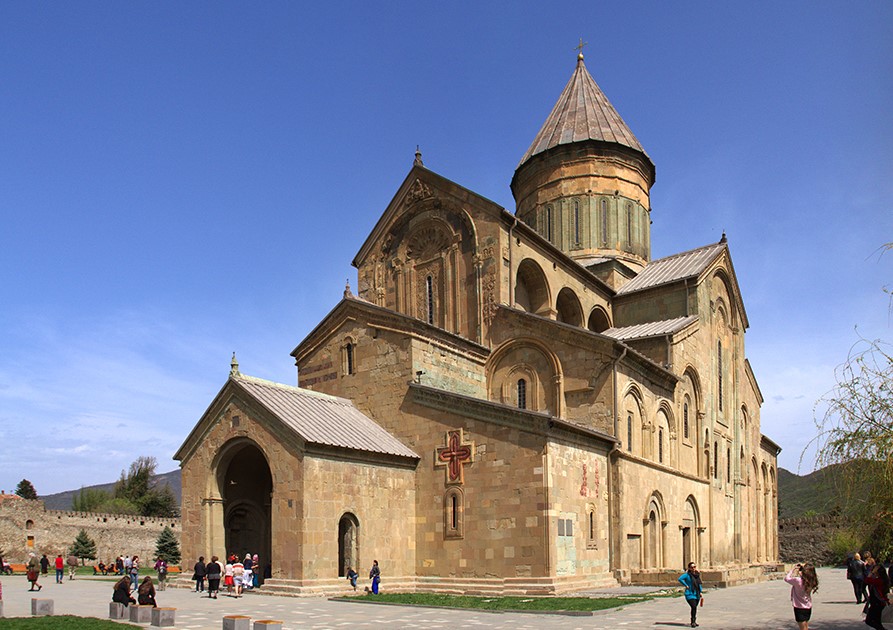
Georgia is celebrating the religious feast of Svetitskhovloba. It is also known as Mtskhetoba, as Svetitskhoveli Cathedral is located in the ancient Georgian capital of Mtskheta.
This year, Svetitskhovloba coincided with the commemoration of the 1,700th anniversary of Christianity being declared the state religion in Georgia. On this occasion, Catholicos-Patriarch Shio III, together with members of the Holy Synod, celebrated a solemn liturgy at the patriarchal cathedral.
The public holiday is also known as the Feast of the Tunic of the Lord and was instituted by the Georgian Orthodox Church on October 14 in honor of the “Myrrh-Streaming Pillar of the Lord and the Robe of the Lord.” On this day, King Mirian and his wife, Queen Nana—both canonized as saints—are also commemorated.
According to legend, the robe of Jesus Christ was brought to Georgia by Georgian Jews Elioz and Longinoz, who had been present at the crucifixion. They handed the robe to their sister, Sidonia, who died instantly upon pressing the garment to her heart. The brothers buried their sister, placing the robe in the grave with her. Sometime later, a cedar tree grew upon the grave.
In the 4th century, King Mirian decided to build a church on the site of the burial. According to legend, Mirian ordered the tree to be felled and fashioned into a pillar for the new sanctuary. Of the church’s seven pillars, no one was able to raise the pillar carved from the tree that stood where the robe was buried. Its erection succeeded only after Saint Nino prayed. In subsequent years, Svetitskhoveli Cathedral was built on the site of the church originally established by Saint Nino and King Mirian.
The present-day cathedral is a comparatively newer structure. After the dismantling of the first wooden church built on the counsel of Saint Nino, the holy King Vakhtang Gorgasali erected a basilica-style church in the second half of the 5th century. In the 11th century, Catholicos Melchizedek of Kartli commissioned a new cathedral, Svetitskhoveli, designed by the architect Arsukidze.
Following the restoration of Georgia’s independence in 1991, Mtskhetoba became an official public holiday in Georgia and a non-working day.