


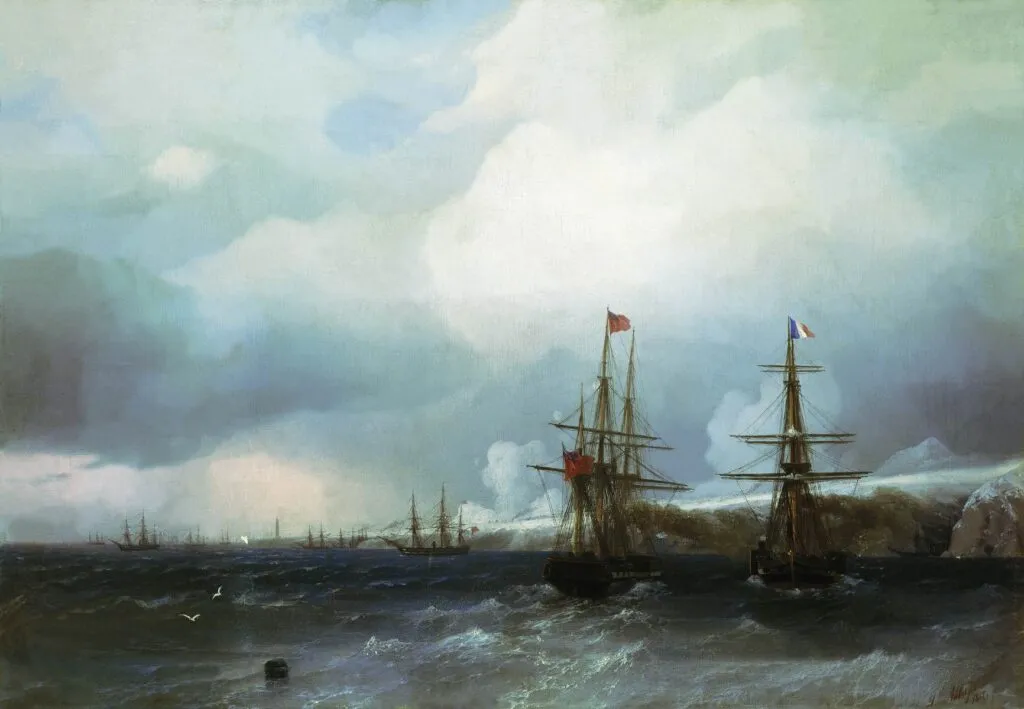
On the night of July 28, 1991, a burglary occurred in central Tbilisi that would remain unsolved for decades. An unidentified individual entered a restoration workshop through a window of an unfinished wing of the State Art Museum of Georgia, and from there broke into the Russian art exhibition gallery. Several canvases were stolen that night, including Ivan Aivazovsky’s painting The Capture of Sevastopol.
Dark Times for Art
Preserving cultural property in 1990s Georgia was a daunting task. Between the declaration of independence and 2004, 128 items were lost from galleries across the country. During the civil war, multiple works were destroyed, while others went missing or perished during collection transfers; some pieces were reallocated to other institutions, after which their trail went cold.
Thefts presented another major threat to the country’s cultural heritage, surging against a backdrop of economic crisis and rising crime. According to Georgia’s Ministry of Internal Affairs, at least seven burglaries were recorded at the State Art Museum alone.
The thefts varied widely in scale and sophistication. In the autumn of 1992, thieves stole a canvas by Niko Pirosmani from the house-museum of writer Demna Shengelaia—a crime swiftly solved when the perpetrators turned out to be three students from the Georgian Technical University. Far more serious was the heist at the Tbilisi house-museum of theatrical artist Irakli Gamrekeli that same year, where criminals made off with Lado Gudiashvili’s Lovers on a Bull, works by Gamrekeli himself, and a canvas by Jacopo Tintoretto. In that instance, the burglars clearly understood art and targeted only the most valuable pieces.
The most brazen heist in the country’s history struck the State Art Museum of Georgia exactly three years after the theft of the Aivazovsky piece. More than ten armed men overpowered and bound three guards, disabled the alarm system, and stripped the galleries of paintings by Lucas Cranach the Elder, Jacob van Ruisdael, and Jean-Siméon Chardin. Investigators suspected the crime had been carried out based on an inside tip from museum staff.
Other works reported missing from state collections over the years included canvases by Angelica Kauffman, Alexandre Benois, Filipp Malyavin, Vasily Perov, and Ivan Aivazovsky.
How Aivazovsky Came to Georgia
The Aivazovsky painting, originally recorded under the title The Capture of Sevastopol, entered the collection of the Georgian State Museum of Art in 1939, as corroborated by several historical records.
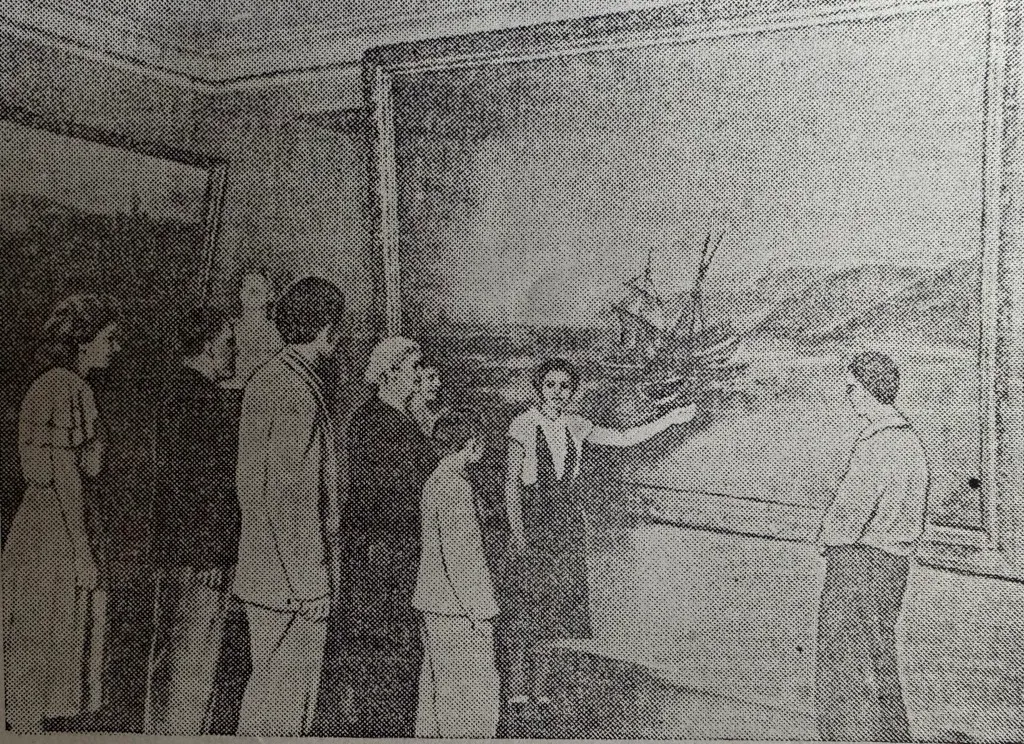
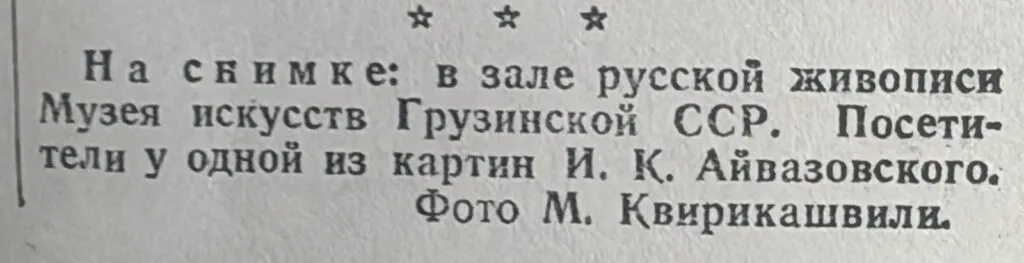
As early as September 18, 1955, the newspaper Zarya Vostoka (“Dawn of the East”), in an article titled “Aivazovsky in Georgia,” detailed the artist’s works held at the Art Museum of the Georgian SSR. Among the pieces listed, the author specifically noted The Capture of Sevastopol, Ayu-Dag, Venice, and The Sea.
Five years later, The Capture of Sevastopol was included in the official catalog State Museum of Art of the Georgian SSR: Painting, compiled by museum director and art historian Shalva Amiranashvili and published in Moscow by the State Publishing House of Fine Art (Izogiz) in 1960.
Another independent record appeared in 1962. In art historian Nikolai Barsamov’s monograph Ivan Konstantinovich Aivazovsky, The Capture of Sevastopol was listed as held in the “Metekhi Museum, in Tbilisi.” “Metekhi” was the earlier name of the State Art Museum of the Georgian SSR, in use until the early 1950s.
Subsequent reference works likewise list The Capture of Sevastopol—oil on canvas, measuring 59 × 84 cm—as belonging to the permanent collection of the Art Museum of Georgia.
A Suspicious Resemblance
Following the 1991 theft of the master’s work in Tbilisi, 22 years of silence followed. What happened to the canvas during those intervening decades remains unknown.
The first lead emerged unexpectedly in 2013, when a canvas featuring a strikingly similar composition surfaced in Moscow at the Grabar All-Russian Scientific Restoration Center—one of Russia’s premier institutions for scientific art conservation and technical expertise.
A source speaking to SOVA on condition of anonymity stated that on January 7, 2013, a representative of the painting’s owner entered into a contract with the Center for an expert evaluation. Specialists never completed the examination: on November 12 of that year, officers from the Main Investigation Directorate of the Russian Ministry of Internal Affairs (MVD) for the City of Moscow seized the painting directly from the premises.
The seizure was executed on the basis of a request from Georgian law enforcement authorities under an active criminal inquiry—the very case opened after the Aivazovsky was stolen from the Georgian State Art Museum in 1991.
Mysterious Calls
The Georgian press, notably the publication Kviris Palitra, later offered its own account of how the painting had resurfaced: in January 2013, an unidentified woman phoned the Art Museum of Georgia from Moscow, stating that The Capture of Sevastopol had been brought to the Grabar Center for examination. She asked for documentation regarding the canvas, to which museum staff replied that the work was officially registered as stolen.
According to SOVA’s source, it was later established that the work in question was indeed the stolen canvas. However, this account appears nowhere in the accessible files of the Russian criminal investigation.
The same article in Kviris Palitra noted that in February 2015, museum conservator Gia Marsagishvili received a call from the painting’s holder, an individual identified as Vadim. The caller claimed to be a collector who had acquired the canvas in Germany in 1993, restored it at his own expense, and submitted it to the Grabar Center for authentication. He promised to return the painting to Georgia himself.
The Georgian Side of the Case
On September 11, 2014, responding to a mutual legal assistance request from the Russian MVD, an investigator from a Tbilisi district police department inspected the museum’s inventory files—specifically, three registration ledgers. The examination took place in the presence of the chief registrar responsible for collection records. One ledger recorded Ivan Aivazovsky’s painting The Capture of Sevastopol, oil on canvas, 59 × 84 cm. Two other ledgers showed that the painting had entered the museum on December 17, 1939, and that its condition was assessed as satisfactory.
The inspection was documented in an official protocol, accompanied by two low-resolution photographs of the painting. These materials were subsequently transmitted to the Main Investigation Directorate of the Russian MVD’s Moscow headquarters.
Notably, despite the vivid verbal description of the composition in the protocol, precise technical details—such as the nature of the brushwork or the state of conservation of individual paint layers—were absent. Combined with the poor quality of the accompanying photographs, this created significant obstacles to conclusively matching the canvas found in Moscow with the work historically held by the National Museum of Georgia.
Weeks later, Russia’s Ministry of Culture instructed the State Tretyakov Gallery to accept the canvas into secure temporary custody as material evidence. According to information obtained by SOVA, the painting remains in storage at the Tretyakov Gallery to this day, where it has been held for roughly ten years.
Confusion Over Titles
The holder of the canvas insisted that the painting in his possession was not the work stolen from Tbilisi. In his version, the painting was titled The Naval Battle of Chesma and represented an entirely different composition by Ivan Aivazovsky.
Title discrepancies are common in Aivazovsky’s vast oeuvre. In the 1960s, the level of academic research on the Georgian collection was evidently insufficient to link the scene definitively to a specific historical engagement—the Siege of Sevastopol during the Crimean War. The title The Capture of Sevastopol, by which the work is widely known today, particularly online, appears to have become established later.
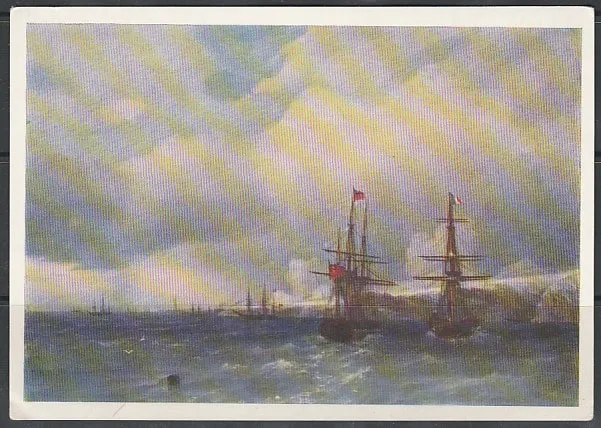
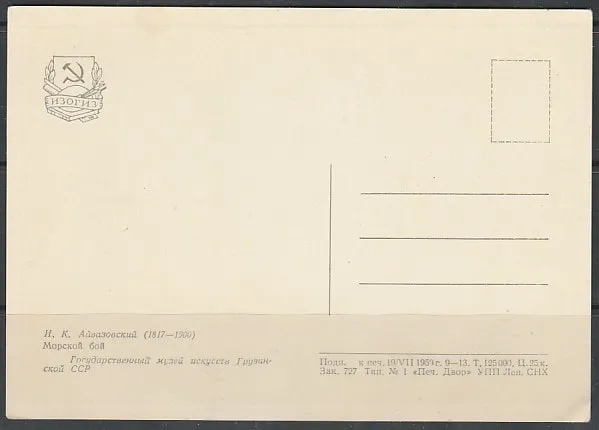
This is further evidenced by the fact that later analyses found three separate Georgian sources referring to the same work by three different titles. In the catalog State Museum of Art of the Georgian SSR: Painting (Tbilisi, 1960, p. 60), the piece—matching in medium, technique, and dimensions—was reproduced under the title Sea Battle. In 1959, the publishing house Izogiz issued an art postcard of the same painting, also titled Sea Battle and crediting the Museum of Art of the Georgian SSR. Meanwhile, the authoritative monograph by Nikolai Barsamov, one of the painter’s primary biographers—Ivan Konstantinovich Aivazovsky: 1817–1900 (Moscow, 1960, p. 267)—reproduced the same canvas under a third title, Ships off the Coast, likewise citing the Georgian museum collection and listing identical dimensions.
However, as experts from the Grabar Center noted during the investigation, a title alone cannot serve as a reliable basis for identifying historical paintings.
Coverage of the Case in Georgia
After the painting presumed to be The Capture of Sevastopol surfaced in Moscow, Georgian media reported that the inquiry had gained official traction. However, specific details regarding legal steps being taken to secure the work’s repatriation were never released.
It was not until September 22, 2022, that Georgian Minister of Culture Thea Tsulukiani publicly mentioned the lost Aivazovsky work. Addressing parliament, she presented the findings of a comprehensive inventory across several branches of the Georgian National Museum network.
The results of the audit covering the Open Air Museum of Ethnography, the Shalva Amiranashvili Museum of Fine Arts, the Dimitri Shevardnadze National Gallery, and the Sighnaghi Museum of History and Ethnography were staggering.
“The inventory results <…> demonstrate that 2,640 exhibits are considered lost. That is an established fact,” Tsulukiani declared.
Before parliament, the minister listed only a fraction of the missing works, which included pieces by Gigo Gabashvili, Elene Akhvlediani, Shalva Kikodze, Lado Gudiashvili, Angelica Kauffman, Alexandre Benois, Vasily Perov, and other prominent artists. Tsulukiani specifically named several works by Aivazovsky, among them The Capture of Sevastopol.
This statement came nearly nine years after the canvas had been seized by Russian investigators at the Grabar Center and transferred to the Tretyakov Gallery. Yet in Tsulukiani’s address, the painting was still listed merely as a lost cultural asset, with no mention of progress in the case or acknowledgment of the ongoing proceedings in Russia.
Reopening the Investigation
The Russian MVD asked the Grabar Center to conduct a definitive authentication only in 2023. In response, experts explained that the initial 2013 examination had never been completed due to the canvas’s impoundment by law enforcement. It was subsequently decided to order a new forensic art examination, this time conducted through the State Tretyakov Gallery.
In June 2023, an investigator from the Russian MVD’s Main Investigation Directorate commissioned the examination in execution of an international letter of request from the Georgian authorities. Experts were asked to address several questions, including whether the canvas could be identified as the work stolen from the museum in Tbilisi in 1991.
SOVA sent official inquiries regarding the status of the painting attributed to Aivazovsky to both the Russian Ministry of Internal Affairs and the Tretyakov Gallery. As of publication, neither institution has provided a response.
Identification Challenges
The Grabar Center had previously encountered similar authentication hurdles with another work by Aivazovsky, Evening in Cairo. In 2015, a painting surfaced at a Sotheby’s auction in London that the heirs of Moscow collector Ivan Nosenko identified as the work stolen from their apartment in 1997. The title, subject matter, dimensions, and even parts of the provenance aligned; however, investigators lacked high-resolution photographs, X-ray radiograms, or detailed conservation records of the stolen piece. The Russian MVD stated in its formal reply that the case file lacked sufficient documentation to draw a conclusive comparison with the auction lot.
Natalia Ignatova, a senior researcher at the Grabar Center, noted at the time that visual similarity alone is insufficient: without X-ray imaging and macro-photographic surface analysis, proving the identity of two canvases is nearly impossible. Relying purely on outward appearance invites “endless debate,” she observed, particularly with Aivazovsky, who produced thousands of paintings and frequently returned to identical themes. Identification therefore requires not only compositional analysis and titles, but also established provenance, vintage photographs, documented surface damage, technical brushwork analysis, and material testing.
Furthermore, even when technical examination confirms that a recovered canvas is an authentic Aivazovsky and corresponds closely to a stolen museum piece, restitution is never automatic. A requesting state must legally demonstrate the provenance of the work, establish its ownership as part of a specific public collection, document the exact circumstances of its loss, and—most critically—establish absolute physical identity between the seized item and the stolen object.
This is why accession registers, archival photography, exhibition catalogs, exact measurements, conservation stamps, provenance documentation, and technical imaging are pivotal. In the case of The Capture of Sevastopol, the absence of high-resolution archival photographs and detailed condition reports has severely complicated the identification process.
Once physical identity is established, the legal phase begins: the state of origin submits a formal restitution request, while the holding state must determine the object’s procedural status and adjudicate the rights of the current possessor. In Georgia’s case, an added legal barrier exists: the 1970 UNESCO Convention on the Means of Prohibiting and Preventing the Illicit Import, Export and Transfer of Ownership of Cultural Property came into force for Georgia on November 4, 1992—after the Aivazovsky theft occurred.
While both Georgia and Russia signed the 1995 UNIDROIT Convention on Stolen or Illegally Exported Cultural Objects, which governs the restitution of stolen cultural property and the rights of bona fide purchasers in greater detail, neither state ratified it; thus, it cannot be invoked directly in this dispute. Consequently, the repatriation of the canvas rests primarily on domestic legislation, bilateral mutual legal assistance treaties, criminal procedure, and intergovernmental negotiations.
Precedents and Parallels
The story of the Aivazovsky canvas is only one chapter in Georgia’s ongoing, decades-long effort to recover looted cultural heritage. Of the three major masterpieces stolen from the same museum in 1994, a portrait by Lucas Cranach the Elder was eventually traced and spent six months between 2004 and 2006 undergoing conservation at the Hamburger Kunsthalle laboratory, where Georgian restorers worked alongside German specialists before the painting was returned to public display in Tbilisi.
Jacob van Ruisdael’s landscape The Waterfall was returned severely damaged in May 2004, while a Chardin still life was presumed lost for nearly three decades until November 2023, when an individual surrendered it to the Georgian Ministry of Culture anonymously in exchange for immunity from prosecution.
The Chardin piece became the 132nd cultural artifact returned to the National Gallery and the National Museum over the past five and a half years. In total, between 2012 and 2021, more than 550 previously lost items were returned to Georgian state museum collections.
Nevertheless, consensus remains elusive within the museum community regarding the full extent of the losses. In December 2021, Culture Minister Thea Tsulukiani asserted that of 117 artworks loaned at various times to Georgian diplomatic missions abroad, the fate of 53 remains unaccounted for. In response, the National Museum issued a statement insisting that since its consolidation in 2004, not a single accessioned piece from its member institutions had gone missing.
Although ironclad documentary identification of the Aivazovsky canvas has not yet been finalized, the case retains viable prospects for resolution. The recovery of the Chardin still life—presumed lost for nearly thirty years before resurfacing in 2023—proves that even the oldest and seemingly intractable art restitution cases can reach a successful conclusion.