


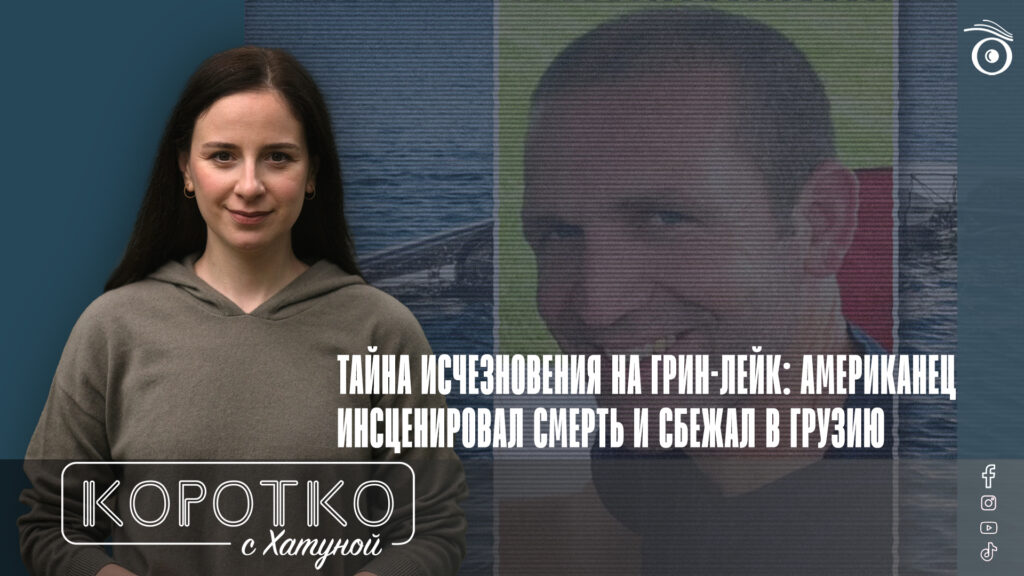
He staged a tragedy and fled to Georgia to build a new life with an online love interest. The story of an American who faked his own death made headlines worldwide back in 2025, but right now, following an article in Kholod (an independent Russian media outlet), it is experiencing a true renaissance.
On the evening of August 11, 2024, Wisconsin resident Ryan Borgwardt went fishing on Green Lake—the state’s deepest inland body of water. Late that night, he texted his wife of 22 years, with whom he had three children, saying he would be home soon, and then vanished off the radar.
The next morning, his family filed a missing person report with the police. On the shoreline, officers found his vehicle and trailer; in the water was his overturned kayak; and a passing fisherman retrieved fishing gear from the lake bed containing Borgwardt’s keys, wallet, and driver’s license. Everything pointed to a fatal accident. For nearly two months, law enforcement officers, rescue teams, and volunteers combed the lake, but no body was ever found.
A breakthrough came when law enforcement checked international border registries. It turned out that the day after his “disappearance,” Borgwardt’s name had been checked by Canadian border officials. After seizing his home laptop, investigators discovered that the man had spent seven full months plotting his escape.
First, the American had taken out a substantial life insurance policy in favor of his family, reported his passport lost, and obtained a duplicate. At the time of his “disappearance,” he left the old passport at home to avoid arousing suspicion. In addition, he opened a foreign bank account where he routinely deposited funds, and on the day he executed the scheme, he wiped his hard drive. It was also discovered that he had been exchanging emails from a covert account with a Russian-speaking woman from Uzbekistan.
The escape plan read like a detective thriller. Borgwardt brought a children’s inflatable raft to the lake, using it to reach shore after overturning his kayak. Near the pier, he had stashed an electric bicycle. Riding it through the night, he covered 112 kilometers to the state capital, caught a bus to Detroit, crossed into Canada, flew to Paris, and ultimately landed in Tbilisi, where his pen pal met him.
In the Georgian capital, the couple stayed briefly at a hotel before renting an apartment. Borgwardt followed news about himself via a Russian VPN. He later admitted he knew that finding his location was only a matter of time.
By November, American investigators tracked down the fugitive’s online flame using contacts retrieved from his hard drive, and through her, established contact with Borgwardt himself.
Because the law did not allow for Borgwardt’s extradition, police persuaded him to return voluntarily. A month later, he flew back to the United States and surrendered to the authorities. A court sentenced him to 89 days in jail—reportedly matching the exact number of days law enforcement had spent searching for a nonexistent drowning victim. Borgwardt was also ordered to pay $30,000 in restitution. His wife ultimately divorced him. What became of his online companion remains unknown.
Nevertheless, the story produced an unexpected benefit: Wisconsin authorities used approximately $9,000 of the restitution to purchase sonar equipment to survey lake bottoms. Using this device, search teams in the state have already located two genuinely missing individuals.