


- Forcible eviction of internally displaced persons from an occupied building in Tbilisi’s Varketili district. Photo – SOVA
The Georgian government has offered internally displaced persons (IDPs) from Abkhazia and the Tskhinvali region 10,000 GEL (around $3,800) per person as an alternative to state-provided housing. On the first day of applications, October 19, more than four thousand families applied for the payout. SOVA spoke with displaced individuals who have spent decades waiting for their own homes, as well as former State Minister for Reconciliation Paata Zakareishvili, to examine whether a cash lump sum can truly resolve their housing crisis.
Prime Minister Irakli Kobakhidze announced the government’s new initiative on October 12. According to him, the program is designed to speed up the resolution of the housing issue for internally displaced persons, many of whom remain without permanent shelter decades after the armed conflicts.
Kobakhidze noted that once the construction of new residential blocks is completed, another 2,600 families will receive apartments. However, according to government estimates, maintaining current rates of delivery would mean that providing housing to all qualifying displaced persons would take at least another ten years.
How the Current Program Works
In Georgia, state housing for internally displaced persons is allocated through a priority system based on assessments of a family’s living conditions and social standing. The procedure is governed by Order No. 01-30/n of the Ministry of Health, dated April 8, 2021. Each criterion corresponds to a specific number of points, which are tallied during application reviews. The higher the final score, the greater a family’s chances of receiving housing ahead of others.
Scoring factors take into account, among other things, whether a family lives in an owned property or rents, the number of minor children, whether family members have disabilities, and the household’s overall socio-economic situation. For instance, living in rented accommodation adds 1.5 points, having two minor children adds 1 point, and being a single parent adds another 1.5 points.
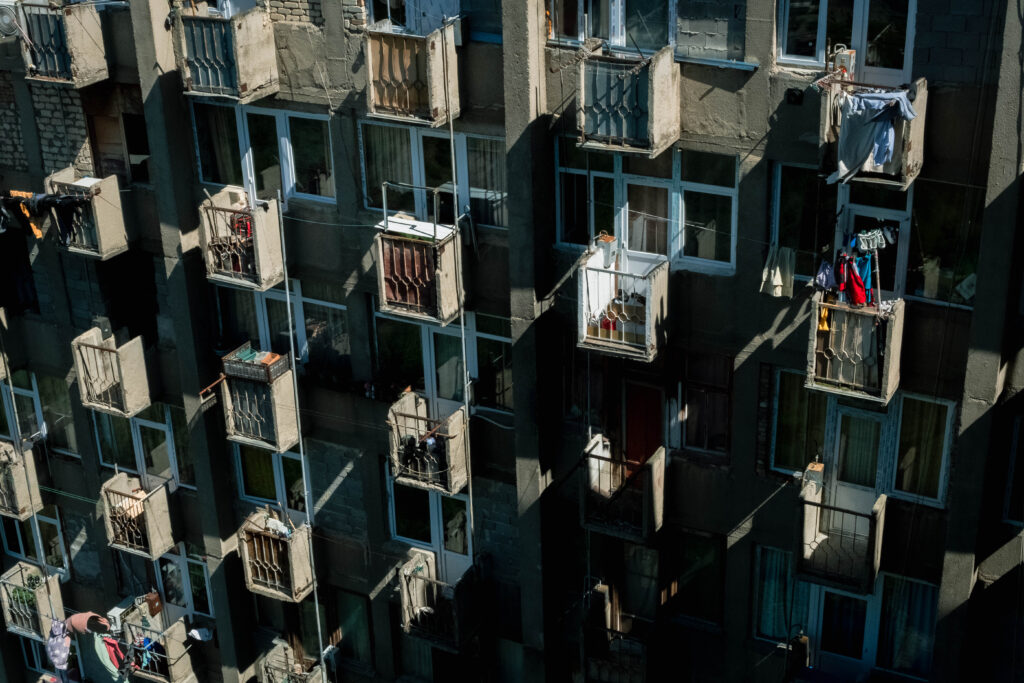
The size of the allocated apartment depends on family size: one or two people qualify for a one-room apartment, three to four people for a two-room apartment, and five to six people for a three-room apartment. Available housing stock, however, remains severely limited. According to data from the Agency for Internally Displaced Persons as of April 2026, approximately 40,000 families were still waiting for long-term housing.
The agency itself attributes the prolonged waiting times to the varying levels of need among specific families and the state’s limited housing resources. At the same time, the law sets no statutory deadline by which the state is obligated to provide an apartment. Consequently, even after an application is approved, the wait can stretch out for years, depending on family needs assessments and the volume of available state-owned property.
The Reality on the Ground
Nino’s family has experienced this decades-long wait firsthand. Her grandparents were forced to flee Gudauta during the war in Abkhazia. They initially relocated to Sochi, living in rented quarters, before eventually moving to Tbilisi.
In 2015, shortly after relocating, the couple learned they were eligible to apply for state housing as internally displaced persons and submitted an application.
“Instead of their two-story house in Gudauta, they were hoping for even a one-room apartment anywhere in Georgia. But they never lived to see it and passed away,” Nino says.
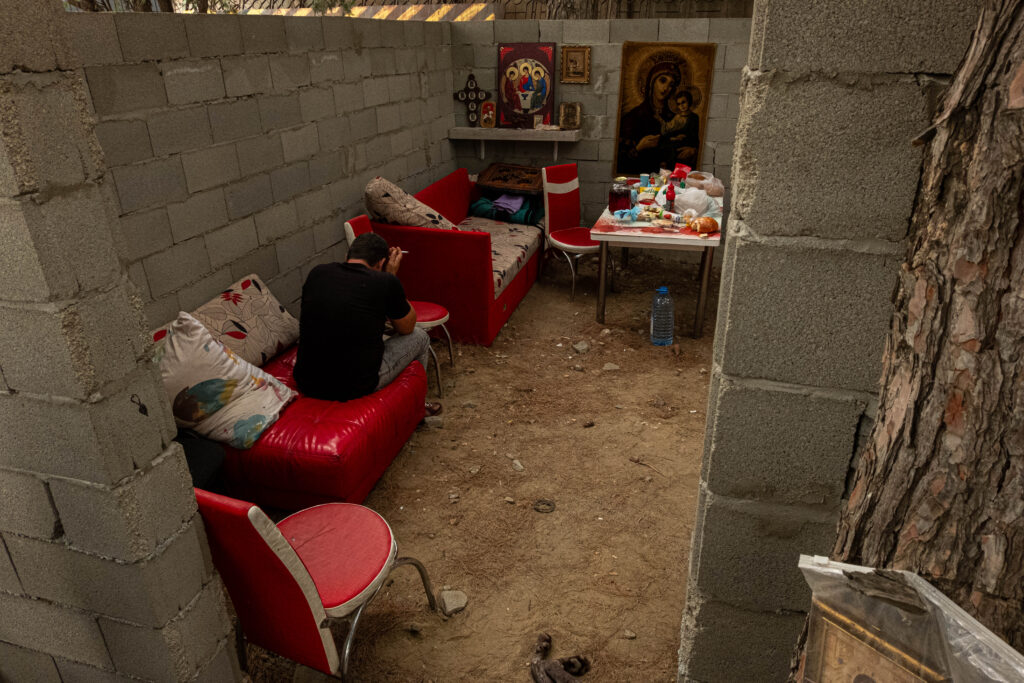
Inga is an IDP from Gagra who settled in the former Megobroba Hotel in Tbilisi’s Gldani district following the war in Abkhazia. Thirty-four years later, she says she is still living there in an 18-square-meter room without private bathroom facilities.
“We live in unbearable conditions. I refused the cash compensation. I want an apartment. How much longer must we live like this?” she asks.
According to Inga, despite repeated appeals to the Agency for Internally Displaced Persons, she has never been granted state housing. During the assessment of her living conditions, her family was awarded two points—insufficient to qualify for an apartment.
“Every time I went to the agency, they kept telling me that I needed to raise my score. They gave me two points. What do I need these points for? My main argument is that I am a displaced person,” she says.
She now plans to take her case to court in an effort to have her status reviewed and secure state-allocated housing.
Another displaced resident, Anna, now in her eighties, fled Sukhumi on September 27, 1993. She had lived in the city since the 1960s, first studying at the Institute of Subtropical Agriculture before settling down there with her family. Following the war, she ended up in Tbilisi, where relatives took her in along with her children, who were university students at the time.
Anna says that over the ensuing decades she repeatedly submitted applications for a state apartment, only to receive empty promises each time. She insists she has received no real support from the state throughout all these years.
“We belong to the generation that lost everything firsthand. Housing should have been provided to us first, and only then to subsequent generations. They promised us every single time. And it is still going on.”
Maya (name changed), an IDP from Gagra, has faced similar housing struggles, waiting 34 years for a state apartment. Battling an oncological condition, she has a disability and is bedridden for most of the day. According to her, state agencies awarded her six points during assessments, yet she still has not received a home.
“I have nothing, and I live with my daughter. She has her own family. I cannot burden her with caring for me, especially since I spend most of my time lying down,” she explains.
Who Qualifies for the Compensation
The program offering a 10,000 GEL payout in lieu of housing is aimed at IDP families who have not previously received housing or corresponding monetary compensation under state long-term housing programs.
The payout is calculated based on the number of family members who hold official IDP status. For example, a three-person household can claim 30,000 GEL, a four-person family 40,000 GEL, and a five-person family 50,000 GEL.
However, belonging to a displaced family is not in itself sufficient grounds to receive the funds. The critical requirements are having officially recognized IDP status and having no record of receiving long-term housing through relevant state programs.
The procedure for granting this status is governed by Georgia’s Law “On Internally Displaced Persons from the Occupied Territories of Georgia – IDPs,” dated February 6, 2014. Under Article 6 of the law, status may be granted not only to individuals who directly fled Abkhazia or the Tskhinvali region due to armed conflict, but also to their descendants.
Specifically, a minor child is entitled to IDP status if at least one parent holds or previously held it, subject to the consent of the parents or another legal guardian. If the status was not registered during childhood, an individual has the right to apply for it independently upon reaching the age of majority.
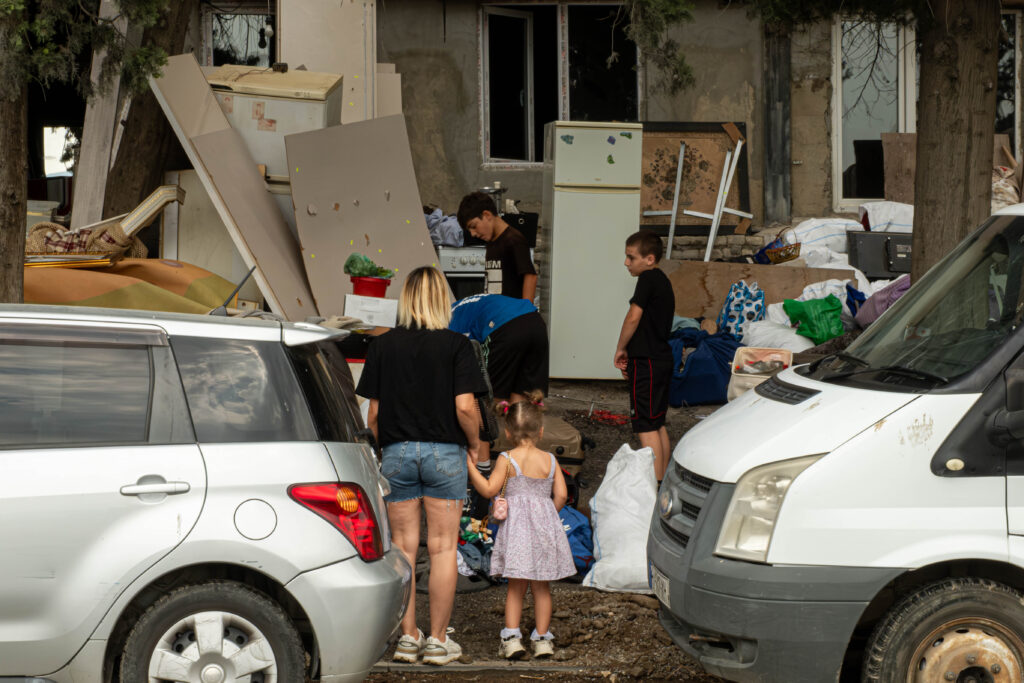
As a result, the legislation imposes no fixed limit on the number of generations eligible—such as restricting status solely to the children or grandchildren of those who fled Abkhazia in the 1990s. The status can be passed down to future generations, provided statutory conditions are met. It is not granted automatically by descent alone, however; formal status is mandatory to participate in the compensation program.
The law also defines an IDP family beyond strict blood relations. It can encompass a group of people living together and running a common household, even if they are not related. Such a household may include members without IDP status, but the compensation is calculated strictly for those members who officially hold it.
The legal framework for the new initiative was formalized by Order No. 47/n of Mikheil Sarjveladze, Minister of Internally Displaced Persons from the Occupied Territories, Labour, Health and Social Affairs, issued on October 13, 2026. Published on October 15, the decree took effect the same day.
The order amends the housing regulations for displaced persons that have been in place since April 2021. Most notably, financial compensation has now been formally added to the list of long-term housing solutions.
This means the state treats the new payout not as a supplementary social allowance, but as an outright substitute for providing an apartment or house.
How Affected Families Have Reacted
According to Nino, her family reacted negatively to the government’s latest initiative. The proposed 10,000 GEL per person, she argues, cannot substitute for the proper housing that displaced persons have been awaiting for decades.
“People are waiting for housing, not money that comes nowhere close to putting a roof over their heads,” Nino explains.
Inga shares this view. She turned down the offer because she remains determined to secure real estate from the state:
“I did not accept the financial compensation. I want an apartment. How much longer must we live like homeless people?”
Anna is equally critical: “Now they are offering us 10,000 for an apartment. They are laughing in our faces.”
Paata Zakareishvili, the former State Minister for Reconciliation and Civic Equality, also considers the offered amount insufficient. In his view, even the combined payout for a family of four would not cover the cost of a suitable home.
“Forty thousand GEL is just over $10,000—at most $15,000. For a family of four, that is simply not enough. They need at least 60 square meters of living space. And in the best-case scenario, a 60-square-meter apartment costs around $60,000,” Zakareishvili told SOVA.
At the same time, he does not rule out that the program could be helpful for certain households. For instance, the payout could be put toward paying down an existing mortgage or added to personal savings.
“If someone has already managed to save some money, or wants to close a gap on a mortgage, or qualify for one, it could provide a boost for some families.”
Do the Displaced Truly Have a Choice?
The government insists that participation in the compensation scheme is entirely voluntary: families may accept the cash or remain on the waiting list for state-provided housing. However, Paata Zakareishvili argues that after decades of waiting, such a choice can hardly be called free.
“They are putting pressure on the will of the public—specifically this segment of the population. It is unequivocally immoral behavior.”
Zakareishvili believes displaced persons might take the money out of fear that the government will eventually withdraw even this modest support.
“I think this will force everyone to think: ‘Things will only get worse. Let’s take these 10,000 now, because later we won’t even get that.’ Motivated by that logic, people might decide to take this handout,” he observes.
At the same time, the former minister doubts the authorities would strip displaced persons of their legal status or completely abandon their obligations to those who opt out. He points out that all IDPs hold the same legal status, regardless of whether they have received state housing.
“I doubt they could alter the status of refugees and displaced persons, because that would trigger an outcry. In fact, it would amount to unconstitutional activity, since some were granted apartments while others were not.”
Nevertheless, Zakareishvili notes that even if displaced persons attempted to challenge this coercion in court, winning would be difficult, “because the issue is so sensitive and can be approached from so many different angles.”
Why the Program Was Introduced Now
Paata Zakareishvili suggests that the new compensation scheme may serve political interests alongside social ones. He points out that the initiative coincided with the government’s decision to increase pensions.
“Such moves are typically made ahead of elections. Yet no elections are on the horizon right now. We are two years away—the vote isn’t until October 2028.”
One possibility, according to Zakareishvili, is that authorities are seeking to shore up support among vulnerable groups ahead of potential political shifts, including snap elections. However, he warns that the move could easily backfire on the government.
“The amount is so meager that it could actually prompt people to take to the streets instead. So there is no straightforward answer.”
Stripping Future Generations of Their Rights
Another issue raising alarms among human rights advocates is how accepting compensation affects the children and grandchildren of displaced persons.
In an interview with BMG, lawyer Nana Gogokhia argued that the new scheme could extinguish the right to state-provided housing not only for the recipients themselves, but for their descendants as well.
In her view, the initiative suffers from an inherent legal contradiction: if the payment is meant to replace housing, the sum is far too low; if the money can be used freely for other needs, it remains unclear why a family should permanently forfeit the right to a state-allocated home.
The debate centers specifically on the right to housing provision rather than the forfeiture of IDP status itself. The extent to which accepting compensation binds future generations remains in need of clear legal clarification.
Will There Be Enough Funds for Everyone?
The government allocated 58 million GEL (around $22 million) for the compensation scheme in 2026. At 10,000 GEL per person, that budget covers a maximum of 5,800 displaced individuals, or roughly 1,450 four-person families.
Yet on the very first day of applications, October 19, over four thousand families applied. Assuming an average family size of three, total claims could reach 120 million GEL—more than double the allocated funding.
Submitting an application does not guarantee approval, however; the state has yet to verify whether applicants satisfy program criteria. It also remains unclear how many individuals are represented in each application.
Consequently, it remains an open question whether allocated funds will cover all eligible applicants, and what fate awaits families who meet the criteria but are left empty-handed due to budgetary constraints. While authorities state that the program will run through 2027, dates for the next round of applications have yet to be announced.