


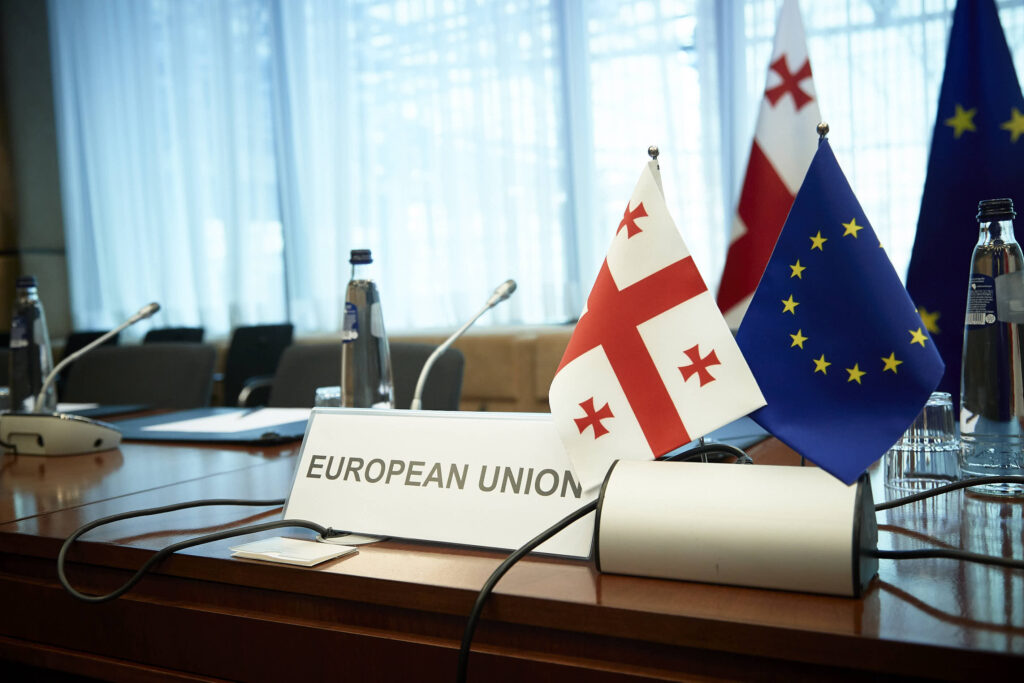
The European Commission presented its latest EU Enlargement Report today, on November 4. The section dedicated to Georgia highlights a series of critical and acute trends: a backsliding on democratic norms, the degradation of the rule of law, and a departure from the EU’s foreign policy course, which has “de facto suspended Georgia’s accession process to the European Union.”
Failure to Comply with Recommendations of the Visa Suspension Mechanism
According to the European Commission’s assessment, Georgia has failed to implement virtually all recommendations set out in the eighth report under the visa suspension mechanism. The Commission also points out that the country has regressed on key good governance and rule-of-law benchmarks that underpin visa-free travel.
Under the 2026 Enlargement Report—which separately assesses Georgia’s visa policy, the state of the visa-free dialogue with the EU, and migration management—the country’s visa policy continues to diverge significantly from EU standards.
Specifically, Georgia’s visa-free list includes 26 countries whose citizens require a visa to enter the European Union. According to the European Commission, no steps have been taken to further align with EU policy in this area.
Furthermore, Georgia allows citizens of 17 countries to enter on the basis of a visa or residence permit issued by the six member states of the Cooperation Council for the Arab States of the Gulf: the United Arab Emirates, Bahrain, Saudi Arabia, Qatar, Kuwait, and Oman. Meanwhile, citizens of these 17 states require an entry visa for both Georgia and EU member states.
The document notes that in 2025, 15,130 Georgian nationals applied for asylum in EU member states. Georgia consistently ranks among the top visa-free countries by number of asylum applications submitted in the EU.
Over the same period, 10,445 Georgian citizens were returned home following the issuance of return orders from the European Union. In 2024, this figure stood at 12,095. By total number of readmitted citizens, Georgia ranked second among all third countries.
The report states that in 2025, the Ministry of Internal Affairs of Georgia took part in 27 return operations organized by the European Border and Coast Guard Agency (Frontex).
The European Commission emphasizes Georgia’s failure to comply with baseline visa-free commitments: the report underlines that the visa dialogue held with Georgian authorities on June 11, 2026, brought no progress on the issues that raised Brussels’ concerns and led to the suspension of the agreement. As the European Commission notes, the very objective of the stepped-up dialogue in June 2026 was to address the circumstances that prompted the restriction of the visa-free regime.
At the current stage, the suspension of visa-free travel applies to holders of diplomatic, service, and official Georgian passports and is in force across all EU member states. This measure took effect on March 6, 2026, for a 12-month period. The European Commission stresses that visa-free travel for this category of persons was suspended because Georgia had “deliberately and systematically violated” its obligations.
The European Commission calls on Tbilisi to fulfill the visa liberalization benchmarks, address the recommendations of the seventh and eighth visa suspension mechanism reports, and tackle the issues of irregular stays by Georgian citizens in the EU as well as unfounded asylum applications.
Attempted Ban on the Opposition and Political Repression
The report mentions a constitutional lawsuit filed by the ruling Georgian Dream party seeking to ban five opposition parties, a case currently under review by the country’s Constitutional Court.
The document underscores that such processes further undermine political pluralism in Georgia and raise grave concerns regarding the instrumentalization of the judicial system for the benefit of the authorities.
“As a result of government actions targeting democratic institutions and fundamental freedoms, the state of democracy in the country continued to deteriorate. This was reflected in the introduction of severe new restrictions on citizens’ political activities and their participation in political processes,” the report states.
The document also acknowledges that while Georgia maintains a certain level of preparedness in the areas of justice, freedom, and security, no progress was recorded over the reporting period.
“Law enforcement operations continued to show signs of improper political interference. The lack of a comprehensive judicial response mechanism to instances of disproportionate use of force by security forces points to systemic shortcomings,” the authors of the report state.
Criminal Prosecution and Arrests of Opposition Leaders
The document notes that most opposition leaders face criminal charges (including high treason, punishable by up to 15 years’ imprisonment) and are either in exile or in custody. It is emphasized that 49 of the 150 parliamentary seats in Georgia currently remain vacant due to an opposition boycott and the early termination of lawmakers’ mandates.
Legitimacy of the Electoral Process and Restrictions on Citizen Participation
The 2026 report points out that the local government elections held in October 2025 took place amid severe polarization and a repressive environment, without the participation of reputable international missions (OSCE/ODIHR) or recognized domestic observation organizations. Out-of-country voting and gender quotas were abolished, resulting in the proportion of women in local sakrebulos (municipal assemblies) dropping to 16.8%.
Repressive Measures Against Civil Society
The report pays particular attention to the repressive legislative framework: the combined enforcement of the Law on Transparency of Foreign Influence, the Law on Registration of Foreign Agents, and amendments to the Law on Grants has created a coercive and stigmatizing environment for non-governmental organizations and human rights defenders.
The document also details pressure on civil society actors: the European Commission reports ongoing criminal investigations under broad and vague charges such as “sabotage,” “assisting foreign organizations in hostile activities,” and “damaging state interests,” carrying sentences of 6 to 12 years’ imprisonment. The document also highlights the freezing of bank accounts belonging to several leading NGOs.
The European Commission draws attention to censorship and unprecedented pressure on the media. Independent newsrooms and reporters face continuous online attacks, physical violence, unlawful detentions, bans on video recording, and strategic lawsuits against public participation (SLAPPs), while the perpetrators enjoy widespread impunity.
The report also points to regulatory overreach: “The National Communications Commission expanded its mandate and began monitoring broadcast content, subsequently issuing fines to critical media outlets. Parliament revoked the accreditation of independent journalists and representatives of media critical of the authorities,” the Commission states.
The report also highlights the so-called “scrolling and screenshot department”: a unit established within the Ministry of Internal Affairs tasked with combating hate speech that has in practice begun opening proceedings against citizens and journalists for social media posts, creating a direct threat of arbitrary censorship.
Judicial control and police impunity: according to the European Commission, the regression in judicial independence has continued for the third consecutive year. Power has been consolidated within the High Council of Justice, which has not undergone genuine reform.
At the same time, concern is expressed that the courts have become a punitive instrument against participants in peaceful protests. Meanwhile, numerous allegations of excessive force, torture, and ill-treatment by law enforcement officers during the dispersal of demonstrations remain without adequate investigation.
The report emphasizes the high rate of incarceration and the misuse of pre-trial detention: Georgia ranks fourth in Europe in terms of prison population (232 inmates per 100,000 residents). The European Commission adds that “in cases with an apparent political background, pre-trial detention is applied excessively and unjustifiably.”
Brussels expressed strong criticism of the abolition of the Anti-Corruption Bureau and the Personal Data Protection Service.
The challenge of de-oligarchization was also described as unresolved. “Oligarchic influence remains deeply entrenched, contributing to state capture and obstructing democratic consolidation,” the report stresses.
Divergence from the Common Foreign and Security Policy, Sanctions
According to the report, the alignment rate of Georgia’s foreign and security policy with that of the EU plummeted to 38%. Tbilisi refuses to join the vast majority of the European Union’s restrictive measures against Russia, Belarus, and Iran.
Additionally, the EU has imposed sanctions on entities operating in the energy and crypto-asset sectors: under the 21st package of anti-Russian sanctions, transactions with the Kulevi Oil Refinery in Georgia were prohibited for processing Russian crude oil. Three crypto-organizations registered in the country were also sanctioned. Against this backdrop, the number of direct flights between Georgia and Russia has surged.
Political dialogue with Brussels remains frozen, and funding under the European Peace Facility (EPF) as well as bilateral financial assistance programs totaling over €121 million have been fully suspended or frozen.
Restrictions on Fundamental Human Rights
The European Commission points to the “family values” legislative package, which introduced sweeping bans on the legal recognition of same-sex unions, child adoption, gender-affirming healthcare, public assemblies, and media coverage of LGBTQI+-related topics.
Higher education changes were not overlooked either: the document states that “higher education reforms led to the establishment of rigid centralized control mechanisms, posing a direct threat to university autonomy and academic freedom.”