


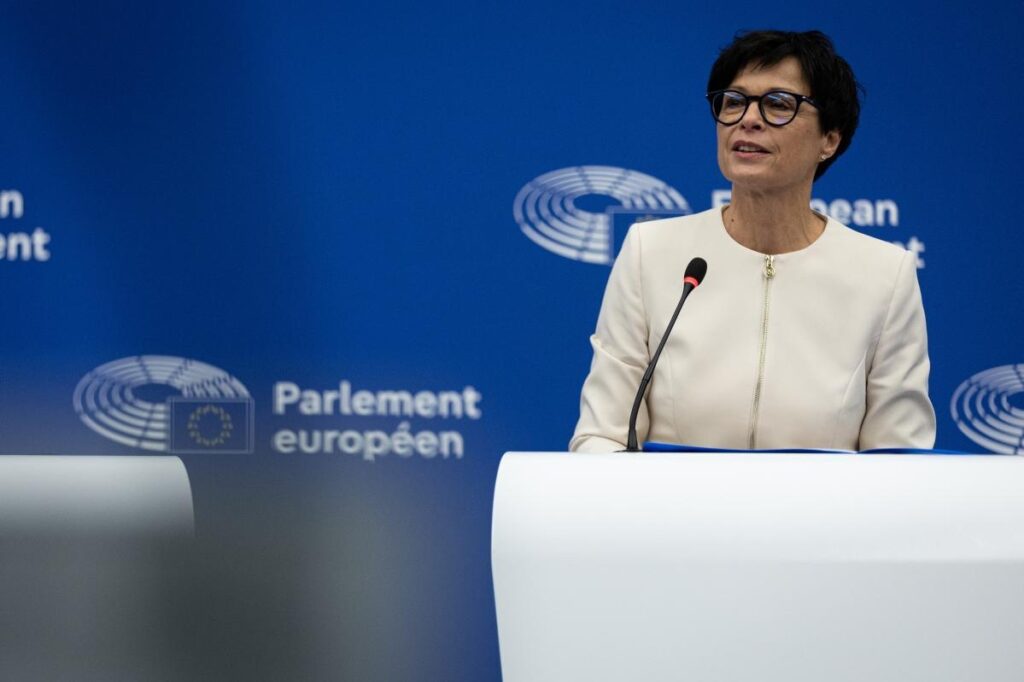
There is insufficient support among the 27 EU member states to impose sanctions against Bidzina Ivanishvili, Irakli Kobakhidze, Shalva Papuashvili, and other individuals, European Commissioner for Enlargement Marta Kos stated during a meeting of the European Parliament’s Committee on Foreign Affairs.
Kos presented the 2026 EU enlargement report. During the discussion, Polish Member of the European Parliament Krzysztof Brejza asked the Commissioner about introducing sanctions against representatives of the Georgian authorities.
According to Brejza, the European Parliament has repeatedly called on the EU to sanction those responsible for political repression and the undermining of democracy in Georgia.
“We know their names: Bidzina Ivanishvili, Irakli Kobakhidze, Shalva Papuashvili, and many others, including judges who sentenced people to prison on politically motivated charges,” Brejza stated.
He asked Kos when an EU sanctions package against these individuals could be expected, what is hindering this decision, and what steps are being taken to address the emerging obstacles.
The MEP also pointed out that Irakli Kobakhidze’s visit to Brussels was exploited for domestic political propaganda.
“Kobakhidze was in Brussels yesterday. They then exploit such visits for propaganda purposes, portraying even a brief trip to Europe as their political victory. This leads the citizens of Georgia to believe that our resolutions, actions, and criticism mean nothing.”
The MEP asked whether the EU plans to introduce individual visa restrictions against these figures.
In response, Marta Kos clarified that the European Commission does not have the authority to unilaterally adopt sanctions, as the matter falls under the jurisdiction of the EU member states and the Council of the European Union.
“I agree with you that steps must be taken in this direction. We tried, but among the 27 EU member states, there is no majority in favor of imposing sanctions, either against the individuals you mentioned or against many others,” Kos emphasized.
The Commissioner also addressed cooperation with Tbilisi. According to her, despite Georgia’s backsliding in the EU integration process, the country remains part of the regional agenda regarding European transport and infrastructure connectivity.
As Kos noted, the European Union has repeatedly invited the Georgian side to take part in various sector-specific events, but has not yet received a positive response.
“We expect the government will nonetheless take steps in the areas where civil society and citizens are suffering the most. Even one small step or move toward meeting the requirements we place on Georgia would truly help in this situation,” the Commissioner concluded.
At today’s press conference on the enlargement report, journalists repeatedly raised questions regarding sanctions against members of the Georgian Dream cabinet (Georgia’s ruling party). High Representative of the European Union for Foreign Affairs and Security Policy Kaja Kallas stated that discussions on this topic will continue, with a more detailed debate on the Georgian dossier scheduled for January.
“We discussed imposing sanctions on ministers who used violence against peaceful demonstrators… Back then, we did not have the support of all member states; several countries opposed it.
These discussions are certainly continuing. In January, we will examine this issue in detail: how to approach it and what path might be most effective to support the Georgian people on the one hand, and on the other, make it abundantly clear to the authorities that they are on the wrong track. At this stage, all options are on the table,” Kaja Kallas stated.
She also added that Georgia’s leadership is currently pursuing a path of escalation and open confrontation with the European Union due to democratic backsliding, and “this is completely, crystal clear.”