


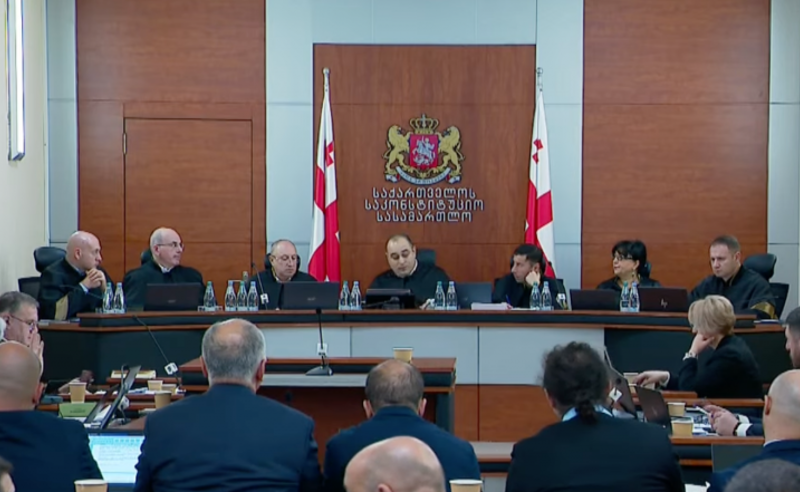
The Constitutional Court of Georgia continues hearing the lawsuit filed by the ruling Georgian Dream party seeking to ban five opposition parties. The court was scheduled to proceed to the question-and-answer stage; however, today’s session also began with the filing of a motion.
Levan Samushia, representing the “Lelo – Strong Georgia” coalition, demanded an examination of the evidence presented in the case materials.
Other parties also supported the motion to hold an evidence examination phase. Berdia Sichinava, representing the “Gakharia for Georgia” party, once again pointed out that it remains unclear which specific findings of the report by the so-called parliamentary commission led by Tea Tsulukiani, on which the lawsuit relies, apply to his political force.
The court’s plenum only partially granted the Lelo alliance’s motion regarding the examination of evidence.
“The request to display during the trial absolutely all web links cited in the constitutional lawsuit is denied. The court will also not examine during the hearing on the merits facts of common knowledge, as provided for in Article 31 of the Rules of Procedure of the Constitutional Court, nor judicial acts that have entered into legal force.
During the proceedings, the court will assess the relevance of individual pieces of evidence cited in the claim should they be contested—either upon a reasoned motion by a party or on its own initiative,” stated Revaz Nadaraia, the presiding judge.
When asked whether the parties must file a separate motion for each piece of evidence, the judge clarified:
“No. Only if their relevance becomes a matter of dispute. That is, the web links attached to the lawsuit, as well as the verdicts and other materials cited in the footnotes, have already been published, and the parties are aware of all of this. That said, both during the question-and-answer stage and in subsequent phases, the parties certainly retain this opportunity—and it is strange if anyone believes they are deprived of the right to ask questions about any piece of evidence or comment on it: a party has the right to request the information it requires. As for examining and displaying here rulings that have entered into legal force, there is practically no point in doing so.”
The Constitutional Court began hearing Georgian Dream’s constitutional lawsuit on October 21. To date, eight hearings have already been held.
In its lawsuit, Georgian Dream demands that the activities of the following political parties be declared unconstitutional and banned: the United National Movement, the Coalition for Change, Strong Georgia – Lelo, the Federalists, and Gakharia for Georgia.