


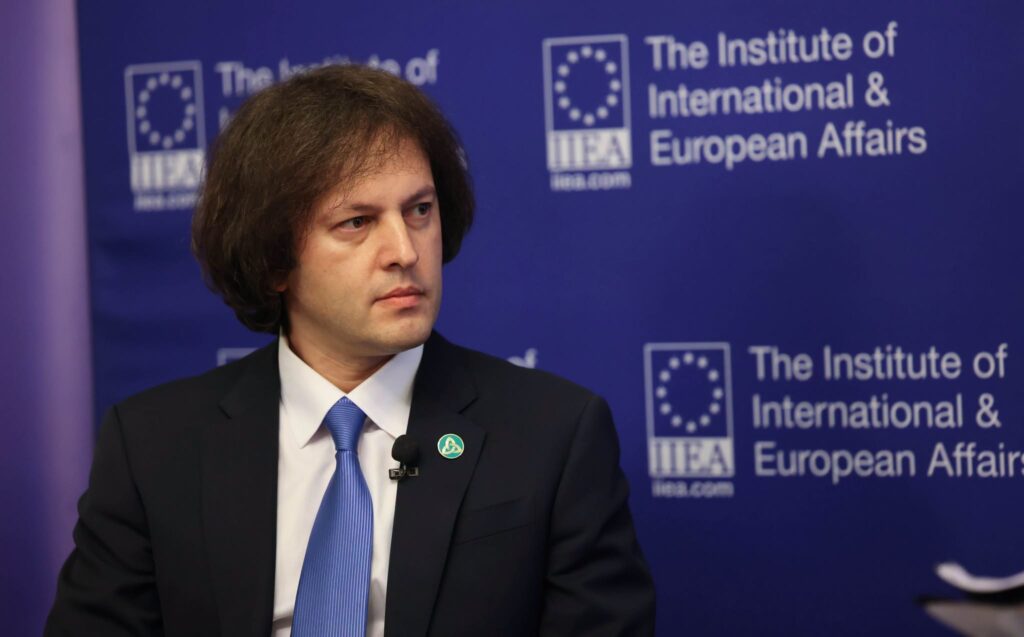
Russia has no levers of influence over Georgia. This was stated by the country’s Prime Minister, Irakli Kobakhidze, during an address at the Institute of International and European Affairs (IIEA) in Dublin. Responding to a question from the institute’s Director-General, Mark Redmond, Kobakhidze noted that there are still no diplomatic relations between Tbilisi and Moscow, and that Russian penetration into Georgia occurred exclusively under the previous administration.
“I can put it very simply: Russia is not in Georgia at all. If we consider the issue of Russian influence in Georgia, Russia has no levers of impact on Georgia—at least, no significant instruments.
Ultimately, when we discuss our government’s foreign policy, we frame the question in the simplest terms: let us judge by the results. Let us look at the record of the previous administration, which positioned itself as exceptionally ‘pro-Western’—which, by the way, is an outright lie—and now let us look at the record of Georgian Dream, our government.
The previous government’s record regarding Russia was characterized by economic expansion: between 2004 and 2012, the former authorities sold off an immense number of strategic economic assets to Russian companies. Let me give you one example: Georgia’s capital, Tbilisi, was supplied with gas, electricity, and water through Russian companies. This was done during the tenure of the previous administration. They sold these strategic economic assets to Russian companies, including strategic hydroelectric power stations and so on. In other words, Russian economic intervention was one of the primary outcomes of the previous government’s actions.”
According to Kobakhidze, the policies of Georgia’s former authorities led not only to Russia’s economic expansion but also to its territorial expansion—noting that it was during the rule of the United National Movement (UNM) that the Russian invasion of the country took place.
As for the current government, the Prime Minister stated that from 2012 to the present, there has been “zero territorial and zero economic expansion.” Kobakhidze also insisted that Georgian Dream maintains no ties or contacts with Moscow, citing “zero political meetings.”
“For instance, Moldovan politicians—say, deputy ministers—can travel to Russia for talks, return, and this is considered normal. They maintain diplomatic relations. Moldova has diplomatic relations with Russia. They remain members of the CIS [Commonwealth of Independent States] to this day, and no one criticizes Moldova for this—for preserving diplomatic ties, trade connections, and political communication with Russia.
Georgia, however, has no diplomatic relations, nor even communication at the political level with Russian politicians—since 2012, there have been zero meetings between Georgian and Russian officials. Moldovans can hold meetings. Georgians do not hold such meetings, yet Georgia is considered pro-Western.”
Kobakhidze also pointed out that among Moldova’s population, only 45% voted in favor of the European Union, whereas in Georgia, “largely thanks to the government’s efforts,” public support for the EU exceeds 70%.