


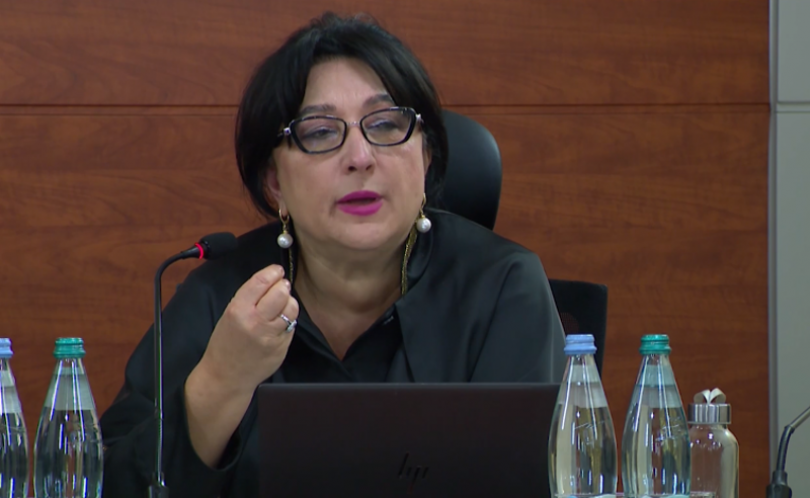
The opposition United National Movement (UNM) party has filed a motion to recuse Judge Eva Gotsiridze from proceedings regarding a ban on five political parties. According to UNM member Anna Tsitlidze, the challenge was prompted by the judge’s pre-existing, biased negative stance on a central matter of the trial—the criminal cases from the 2003–2012 period cited in the complaint against the United National Movement.
The motion was also based on Eva Gotsiridze’s assertion that Mikheil Saakashvili had partially “usurped” the judiciary and, during his presidency, held “unlimited powers.” Other opposition parties supported the UNM’s recusal motion.
The Plenum held deliberations on the spot and dismissed the motion on the grounds that it was “unsubstantiated.” Presiding Judge Revaz Nadaraya stated that the other members of the Plenum had also listened closely to Eva Gotsiridze’s questions and found no indications that she had formed a prejudiced opinion on the case. According to him, the Plenum members share the unanimous impression that this was simply an attempt to prevent the judge from asking challenging questions.
Notably, during the November 12 hearing, the judges questioned representatives of the National Movement in a Q&A format to determine whether the party had exercised control over the executive branch and “whether the party should bear responsibility” for the criminal offenses committed between 2003 and 2012, including the Sandro Girgvliani case. Eva Gotsiridze cited a series of high-profile cases and posed the following question:
“Robakidze, Girgvliani, Vazagashvili, Tsindeliani, Valeri Gelashvili, Azarashvili and Zaza Meskhi, Vamekh Abulashvili, Koba Davitashvili… All these cases share several common features: they were committed by representatives of the state; not one of them, with the exception of the Girgvliani case, was investigated while you were in power; and those convicted of these murders—Akhalaia, Kodua, and others—received presidential awards. When a crime involves deprivation of life and state-sanctioned violence; when the failure to investigate is itself a crime of the state; when killers are rewarded with honors—my question is this: who is to blame for all this, and is the ruling party truly blameless?”
A protracted exchange ensued between the judges and representatives of the National Movement on the matter. Party member Levan Bezhashvili repeatedly underscored that Eva Gotsiridze’s question carried an inherent political evaluation. Addressing the Sandro Girgvliani case, he added, “Our personal grief regarding this matter is also profoundly heavy,” to which Eva Gotsiridze remarked, “I would hope so.”
Anna Tsitlidze immediately took issue with the remark, stating that if the expression of personal views persisted, the party would be compelled to seek the judge’s recusal.
“What exactly am I expressing, Ms. Tsitlidze, what opinion? I said that I sincerely hope you are grieving over all of this. Am I not entitled to hope for that?” Judge Gotsiridze countered.