


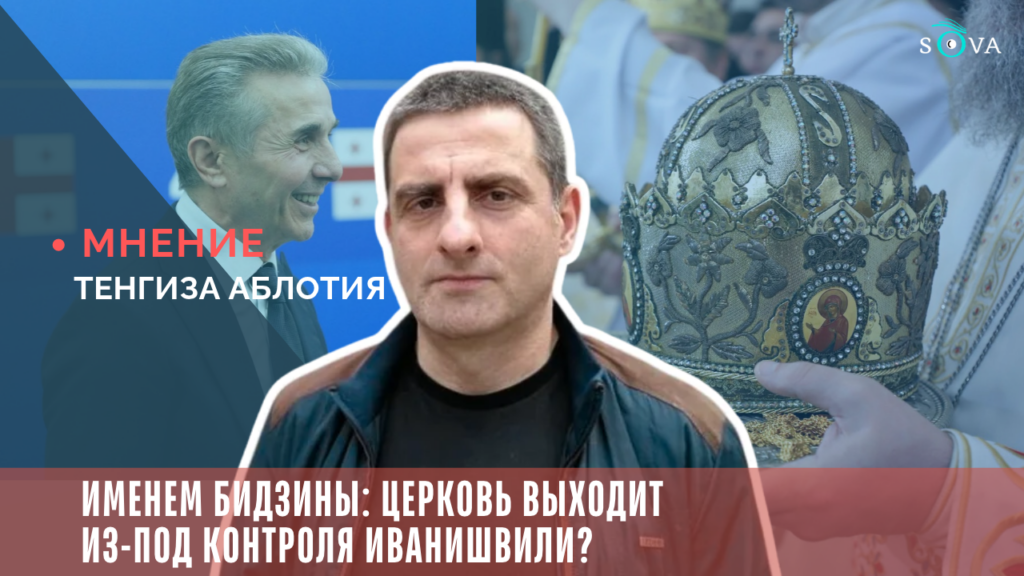
- The author’s views may not necessarily reflect the editorial stance of SOVA.
Throughout the rule of Georgian Dream, the Church has traditionally served as a steadfast ally of the authorities. Special ties with the clergy were established back in the era of Mikheil Saakashvili—whom, however, they genuinely despised.
There were plenty of reasons for this: an unyielding pro-Western orientation, confrontation with coreligionist Russia, and attempts to put the clergy in their place—alongside power, but not in power.
During his final years in office, Saakashvili made every effort to placate the austere Georgian traditionalists: he increased state budget funding for the Georgian Orthodox Church (GOC), granted land plots, and bestowed various privileges… Yet it was all in vain. They did not despise him any less.
Ultimately, in 2012, the Church almost unanimously made a political choice and positioned itself at the vanguard of the opposition—the now-ruling Georgian Dream. Bishops attended rallies, preached the required narratives from the pulpit, and played an active role in bringing about a change of power.
Georgian Dream rewarded them more than generously: the stream of state subsidies and luxury SUVs multiplied, and the clergy’s loyalty to the regime grew in step.
Following the death of the unquestioned moral authority, Catholicos-Patriarch Ilia II, the ruling party leveraged its customary electoral machinery to install its preferred figure—the Locum Tenens of the patriarchal throne—as the supreme hierarch of the GOC.
From that point forward, everything went like clockwork: the new Patriarch, Shio III, definitively chose a side, and that side was the ruling party. While Ilia II had at least sought to maintain the image of a spiritual leader for the entire nation, offering his blessing not only to government supporters but to its opponents as well, Shio III exhibits a political posture far more overtly loyal to the authorities.
The new head of the Georgian Orthodox Church frequently appears in public flanked by a full retinue of state officials—the president, the prime minister, cabinet ministers, and members of parliament. In short, there are no surprises, nor could there be.
That was how things seemed, until critical nuances began to surface.
Recently, a major dispute erupted between senior GOC hierarchs and the government. One of the most influential figures, Metropolitan Iobi, declared that Georgian Dream had outlived its mandate and that many clergymen had become like bureaucrats. In response, state propaganda launched an aggressive barrage of criticism against the head of the diocese.
Yet what is far more intriguing and significant in this episode is why it happened out of virtually nowhere—like a bolt from the blue. Why did senior GOC hierarchs, who in 2012 and for a long time thereafter faithfully served “Georgia, LLC” and its primary—and concurrently sole—shareholder, Bidzina Ivanishvili, suddenly break ranks?
It all comes down to a fundamental misreading of both the broader situation in Georgia and the standing of the Church.
There is a widespread perception that Georgia is something akin to Russia, only smaller and poorer; that Bidzina Ivanishvili, who in April 2024 launched a sweeping assault on democracy and civil society, will inevitably achieve his aims and transform Georgia into a quasi-Belarus.
The argument supporting this inevitability is straightforward: if Putin managed to do it in Russia, Bidzina can surely do it in Georgia.
The Church’s role is frequently examined through this same prism of supposed parity between Russian and Georgian societies. Proponents of this view see the GOC as merely a miniature replica of the Russian Orthodox Church (ROC). Consequently, whatever holds true for the Russian Orthodox Church must necessarily apply to the Georgian Church.
A great many people subscribe to this worldview, including critics of the current regime. The real trouble, however, is that Bidzina Ivanishvili believes it too—a deeply Soviet figure, shaped in Russia, who gauges developments in Georgia exclusively from behind the towering perimeters of his numerous private estates.
In reality, any systemic resemblance between Georgia and Russia is superficial; one need only scratch the surface for those critical distinctions to emerge.
The Russian Orthodox Church is an integral component of the bureaucratic vertical, a quasi-ministry divorced from genuine faith. Russia is a country where the Church owes nothing to its flock and unquestioningly executes every directive from the Kremlin. The ROC is, therefore, simply another cog in the state apparatus.
Evaluating the Georgian Orthodox Church in the same manner is a profound mistake, however similar outward appearances may seem. Unlike the Moscow Patriarchate, the Georgian Patriarchate is an autonomous political actor. While the GOC is eager to secure privileges from the state, it jealously preserves its paramount privilege: maintaining an independent voice.
The alliance between the Georgian authorities and the Church is not a superior-subordinate relationship; it is a transactional compact between two parallel entities. Shio III and his faction may signal their devotion to the regime as much as they like, but for the rest of the synod, that carries little weight.
As another Georgian hierarch, Metropolitan Giorgi (Jamdeliani), put it following the attacks on Father Iobi: “Do not presume to think of yourselves as our masters.”
Catholicos-Patriarch Ilia II commanded the moral stature required to keep the senior clergy in check. But today… can Shio III dictate terms to others?
“You are not Ilia; you are merely one of us, no better than the rest,” influential bishops seem to be telling him, as they have subjected Georgian Dream to fierce public criticism in recent weeks.
These GOC hierarchs share no common ground with pro-European integration demonstrators. They care nothing for the EU, NATO, human rights, or other European norms. What they do care about is state corruption, surging drug abuse among the youth, official patronage of the gambling industry, and the influx of migrants from Asian countries against the backdrop of Georgians emigrating en masse to Europe…
Georgian Dream is losing its traditional base—the conservative core of the populace that has always been its most reliable ally. This is an alarming trajectory; once deprived of the support of the flock and the conservative public, the regime will be left with only three pillars of power: the police, money, and administrative resources. In precisely that order.
What must Georgian Dream do to step back from this dangerous precipice? Perhaps recognize and accept that engineering an autocracy will not succeed, and that it must occasionally listen to public sentiment rather than relying exclusively on salaried propagandists. It needs to moderate its stance and return to the strategy of 2012–2023, when power was preserved not so much through brute force as through calculated political agility and tactical manipulation.