


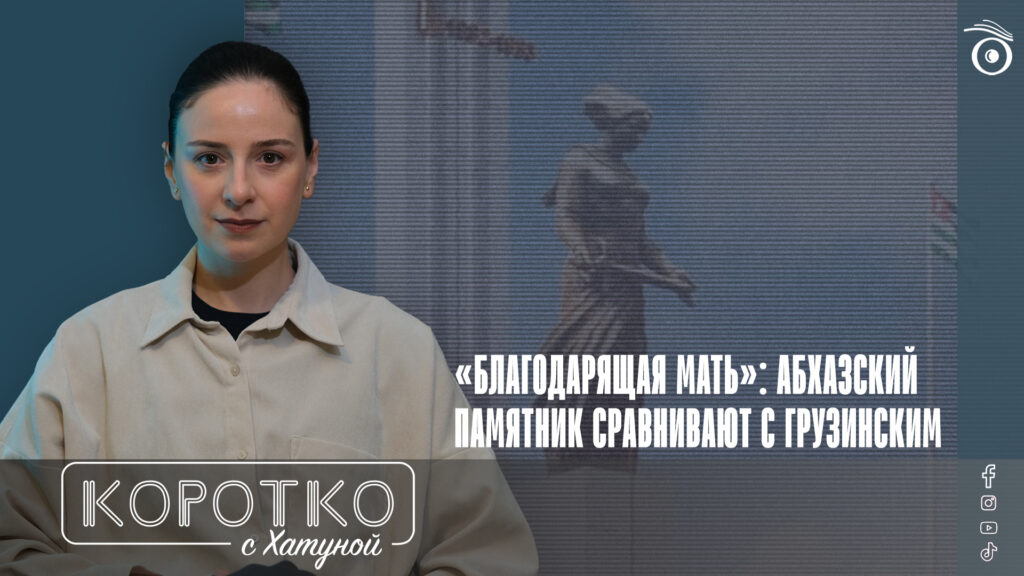
For several years, a monument to honor fallen defenders was being developed, coordinated, and approved in Abkhazia. It was stated that its core design would be based on the figure of Sataney-Guasha, a central character in the Abkhaz and Caucasian Nart epics. In the end, however, Abkhazians themselves concluded that the memorial closely resembles a symbol of Georgia—the “Mother of Kartli.”
The catalyst for heated debate across the Abkhaz segment of the internet was a post by Rismag Adzhindzhal, an advisor to the de facto president. “According to the information I have, a monument to those who fell defending the state border is planned for the town of Gal, and it will virtually copy the Tbilisi figure: a female figure holding a sword, but without a bowl,” he wrote, effectively accusing the Abkhaz artists of plagiarism.
The monument in question is planned to be erected in Gali, located just beyond the occupation line. The memorial is dedicated to those who died in the Georgian-Abkhaz war in the early 1990s. Notably, the “Mother of Kartli” monument—also known as “Mother Georgia”—was erected in Tbilisi in 1958. The statue symbolizes the Georgian national character: a female figure holding a bowl of wine in her left hand for friends, and a sword in her right hand for enemies.
A storm of criticism erupted on social media over the Abkhaz project. Users pointed out that local culture possesses an abundance of its own unique symbols. The concept itself also drew backlash, with critics arguing that depicting a woman bearing arms is un-Caucasian.
Fuel was added to the fire by the opacity of the process: it emerged that relevant commissions had spent three years approving the design, yet it was never presented to the broader public—even before fundraising for its construction began. Several commentators demanded open public consultations.
The project in Gali is the work of a married couple—artist Nugzar Logua and sculptor Tsira Akhba. Following the erupting controversy, Logua hurried to offer an explanation, insisting there was no plagiarism, everything was done according to regulations, and urging people not to succumb to provocations. On November 15, he appended the sketch of “The Grateful Mother” to an open letter to the public for the first time. In the comments, some noted a resemblance to the “Mother Armenia” monument in Yerevan, while others saw parallels to “The Motherland Calls” memorial complex in Volgograd.
Rismag Adzhindzhal soon deleted his original post and subsequently published a new one apologizing to the artists, though without retracting his stance. At the time the video was recorded, de facto Sukhumi had issued no official statements, while in Tbilisi the story went virtually unnoticed. Nonetheless, the controversy continues to reverberate, polarizing Abkhaz society into critics and defenders of “The Grateful Mother.”
In doing so, the dispute surrounding the monument has laid bare several critical issues: from local distrust toward the actions of de facto authorities to questions of identity and an acute sensitivity to anything that remotely reminds residents of the occupied region of Georgia.