


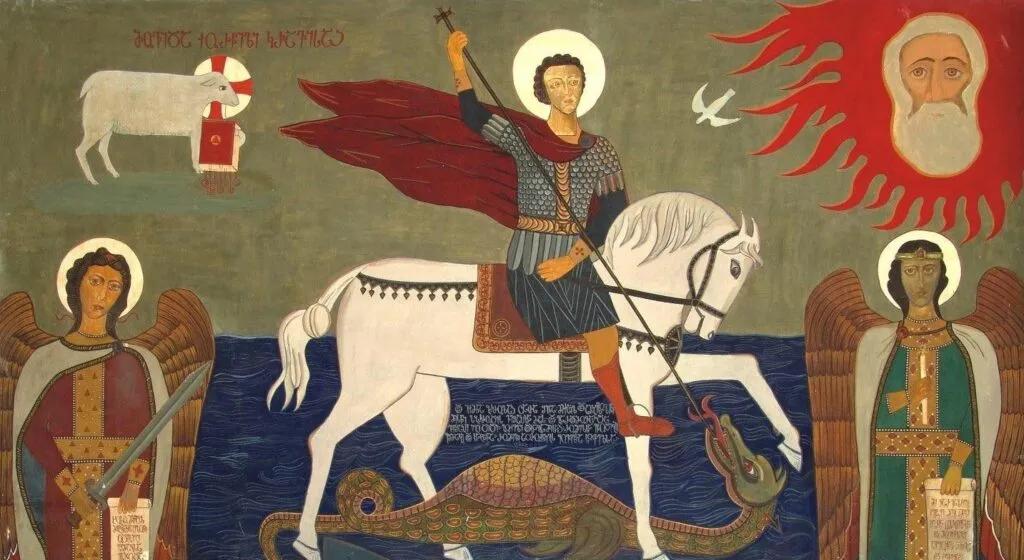
On November 23, the Georgian Orthodox Church celebrates one of its most revered religious feasts — Saint George’s Day, known locally as “Giorgoba.”
The veneration of Saint George in Georgia dates back to the dawn of Christianity. According to Arsen of Ikalto, Saint Nino, the Enlightener of Georgia, was a cousin of Saint George the Victorious. It was through her teachings that the country came to know the life and martyrdom of her illustrious relative.
Saint George is regarded as the patron saint of soldiers, farmers, shepherds, and travelers. Churches dedicated to Saint George, as well as their ancient ruins, are held in profound reverence across Georgia.
Sanctuaries honoring Saint George were erected not only in cities and villages, but also on mountain summits. In antiquity, armies raised some of these churches in fulfillment of vows made following military victories. Generals and monarchs personally took part in the construction, hauling stones with their own hands to build the temples.
According to sacred tradition, Emperor Diocletian ordered George to be subjected to torture until he renounced Christ. The saint was broken on the wheel: bound to a wheel mounted near an array of iron spikes and sharp blades. Victims subjected to this ordeal typically died from excruciating pain and severe blood loss. Believing Saint George was dead, the executioners removed his body from the wheel and threw him into a dungeon.
George lay motionless, bathed in blood, as if he had exchanged a commander’s cloak for an imperial purple mantle. Yet he was still alive; he had not yet drained the cup of suffering appointed to him. The martyrdom of Saint George was like a victor’s triumphal procession, and his death, a coronation. The Commemoration of the Torture on the Wheel of Saint George remains one of the most significant holidays in Georgia.