


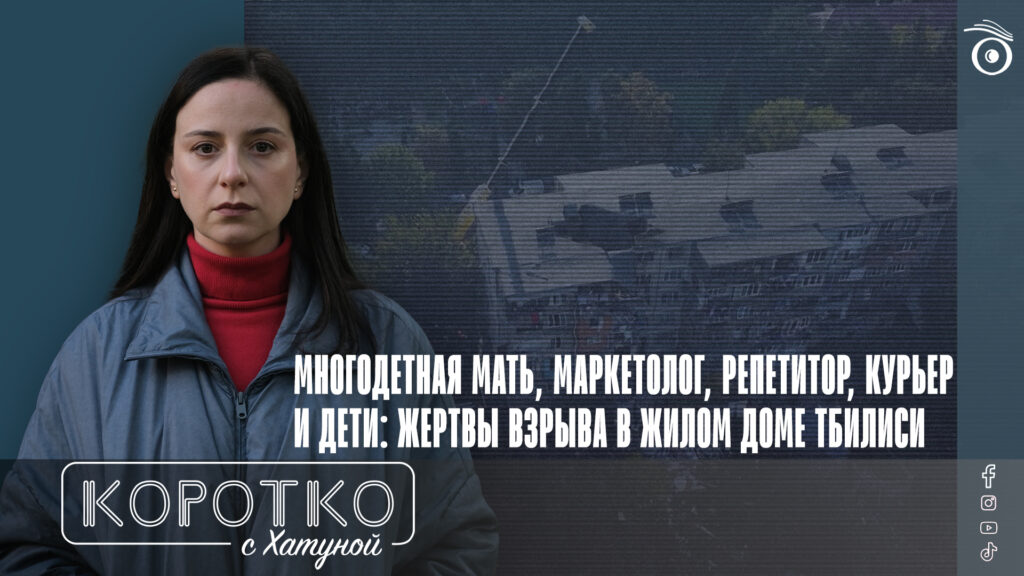
November 22 was declared a national day of mourning in Georgia. The country mourned the victims of the tragedy that struck the Ponichala district of Tbilisi. Two children were among the dead. Today, we remember those whose lives were cut short by this disaster.
On the morning of November 19, an explosion ripped through an older apartment block on the outskirts of Tbilisi, triggering a partial structural collapse of the building. The preliminary cause was an accumulation of natural gas in an apartment on the top—fifth—floor. Tbilisi Energy later reported that the subscriber registered at that address had not consumed gas since 2025, and that the building had undergone a comprehensive inspection earlier in the year. The company also stated that inspectors had been unable to gain access to the fifth-floor apartment during that inspection.
The explosion claimed six lives, including those of two children, and injured five residents. Behind the sterile official dispatches were real human lives extinguished in a single morning. Here are the stories of those who were lost that day.
Nino Chelidze and Seven-Year-Old Nutsa Pkhaladze
Thirty-eight-year-old Nino Chelidze was raising five children and worked at a local shop. On the morning of November 19, she saw her husband off to work, got the older children ready for school, and stayed home with seven-year-old Nutsiko and three-year-old Taya. Nino and Nutsa were killed in the explosion. Rescuers pulled little Taya alive from the rubble after roughly eight hours of search efforts. Doctors assess the child’s condition as satisfactory.
Veronika Vanishvili and Six-Year-Old Ariana Ristich
Thirty-three-year-old Veronika Vanishvili headed the marketing department at a casino in the capital. Colleagues described her as someone profoundly dedicated to her work. Her daughter, Ariana, attended Kindergarten No. 58 in Tbilisi, where teachers remember her as a bright, radiant, and open child. Following the tragedy, Veronika’s brother wrote on social media: “I no longer have a sister or a niece, Ariana… My little princess is gone.”
Lali Shishmanashvili
Fifty-five-year-old Lali (Lamara) lived on the ground floor. A philologist by education, she worked as a private tutor. Her twin daughters were home when the blast occurred; they managed to run outside and could hear their mother’s voice, but her bedroom door was trapped beneath fallen concrete slabs and debris—the girls were unable to break through to her. Lali was born in the Kakhetian village of Ikalto; a local social media page dedicated to her home village recalled that she wrote love poetry.
Jaba Sakevarashvili
Another victim of the explosion was 28-year-old Jaba. He worked as a courier for Georgian Post. According to management and coworkers, Jaba was a dependable, conscientious worker who could always be relied upon.
Following the explosion, five injured victims were transported to hospitals. Three remain under medical supervision, including two children—three-year-old Taya and an 11-year-old boy. A 31-year-old man who sustained burns over 87% of his body remains in critical condition on mechanical ventilation. Media outlets report that he is the owner of the apartment where the explosion occurred.
Two sections of the five-story building have been condemned as structurally unsafe: 28 families—143 people in total—have been left homeless. They are currently housed in temporary hotel accommodations. Municipal authorities have pledged to provide permanent housing, and the family of billionaire Bidzina Ivanishvili announced that they would purchase new apartments for the affected households.
Yet the crisis extends beyond a single building. The disaster in Ponichala is not an isolated breakdown, but part of an alarming trend. According to data from the Energy Ombudsman’s Office, 56 domestic gas explosions occurred in Georgia between 2019 and 2025. Over those seven years, gas blasts and carbon monoxide poisonings claimed at least 129 lives. Georgia lacks a unified, fully functioning regulatory oversight system for residential gas safety: accountability is blurred between distribution utility companies—which are unable to inspect premises behind locked doors—and the residents themselves. As long as this remains unresolved, the cost of any technical fault or negligence remains devastatingly high.