


- This text is published as part of the “Dekolonisierung Ost” (“Decolonising the East”) project in partnership with the German foundation taz Panter Stiftung.
How Russian visitors encounter a reality at odds with their familiar perceptions.
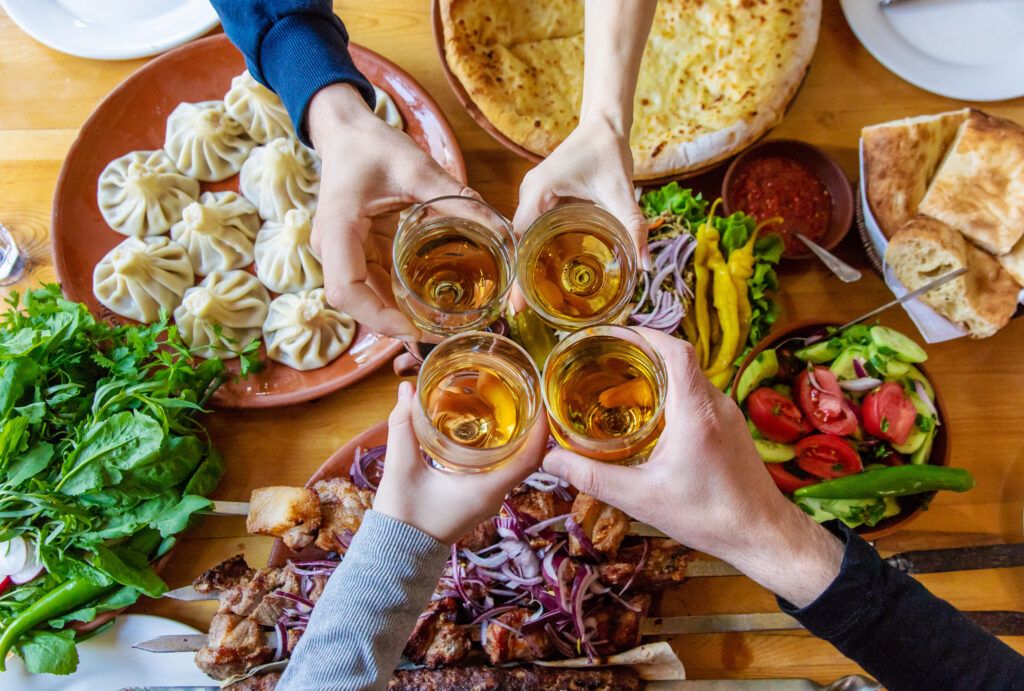
“For a Georgian, a guest is a gift from God. Everyone is welcome. We have wine, and Georgian cuisine is truly delicious.” With these words, Tbilisi Mayor Kakha Kaladze recently introduced his country to a Russian-speaking blogger.
Around the same time, the organisers of the electronic music festival Zion Festival announced they would no longer sell tickets to Russian citizens. Following fierce criticism, they softened the rule: Russians were allowed to attend, but first had to fill out a questionnaire acknowledging the Russian occupation of Georgian territories. This referred to Abkhazia and South Ossetia—two regions occupied by Russia following the 2008 war.
The mayor beckoned with hospitality. The festival organisers made hospitality conditional on a political requirement. Behind these episodes lies a deep conflict: the Georgian government fosters economic proximity with Russia, while part of society insists that hospitality must not be confused with political indifference.
Since the launch of Russia’s war of aggression against Ukraine in February 2022, more than 100,000 Russians have arrived in Georgia. Some fled political persecution; others escaped military mobilisation. Still others simply no longer wished to live in a country waging war.
For many, Georgia was an obvious choice. It shares a border with Russia, offers visa-free entry, and boasts a relatively low cost of living. Added to this was a sense of cultural familiarity. Many knew the country from Soviet films, songs, and stories—as a sun-drenched paradise of wine, mountains, and people ever-ready to welcome guests. But reality did not always match this image.
According to estimates by Transparency International Georgia, roughly 1.1 million people entered Georgia from Russia in 2022. Georgian Interior Ministry data shows that nearly 113,000 Russian citizens remained in the country and obtained residence permits.
In subsequent years, Russians continued to represent one of the largest groups of arrivals. Between July and September 2026 alone, according to official Russian statistics, 660,300 Russian citizens entered Georgia. These numbers point to an enduring appeal. Yet they reveal little about how encounters between guests and hosts actually unfold.
When Familiarity Turns into Disillusionment
“At clubs or parties, the connection would often break the moment someone said: ‘Oh, you’re from Russia.’ And people would shut down,” recalls Oleg. He moved from Moscow to Tbilisi in March 2022. During a previous visit, he had already been struck by the vibrant youth subculture: graffiti, punks, metalheads, dyed hair, and piercings.
He lived in the Georgian capital for two and a half years, learned the language, and tried to integrate into the local community. Once, at a club, several women approached him. But upon learning he was Russian, they cut the conversation short. “That was it. I went my own way.”
Oleg witnessed firsthand how quickly one’s origin can become an obstacle. He wanted to be seen as an individual, but was viewed first and foremost as a representative of a country that has posed a political and military threat to Georgia for decades. What he experienced as personal rejection may well have been an expression of historically grounded distrust for his interlocutors.
This tension is familiar to Teona as well. She has worked in tourism for nearly a decade and, as head of sales at a ski hotel, regularly deals with Russian guests. Georgian hospitality, she notes, has long been a brand across the post-Soviet space. Many visitors expect not just good service, but a very specific Georgia.
“But we are not merely a tourist backdrop where everyone is constantly smiling, singing, dancing, and pouring wine. We have our own lives, our own struggles, our own history, and our own view of what is happening. Some are disappointed when they encounter this side of Georgia too.”
Oleg does not want to be reduced to his Russian origins. Teona does not want to be pigeonholed into the image of the ever-welcoming Georgian host. Both want to be seen as individuals, rather than embodiments of national clichés. These notions have a long history, and shaking them off is no simple task.
Two Hundred Years, a Single Image
Russian dominion over Georgia began in 1801 with the annexation of the Kingdom of Kartli-Kakheti. A brief period of state independence from 1918 to 1921 was followed by seven decades of Soviet rule. The restoration of independence in 1991 ended political dependence on Moscow, but not the conflict with Russia. After the 2008 war, the Russian occupation of Abkhazia and South Ossetia became entrenched.
Yet Russia’s influence was never purely political or military. For generations, perceptions of Georgia were shaped by literature and, later, Soviet cinema. In the nineteenth century, Mikhail Lermontov portrayed Georgians as timid in his poem The Demon. Alexander Pushkin, writing in A Journey to Arzrum, praised their courage but deemed them in need of enlightenment.
Whether brave or timid, passionate or irrational, Georgians were described from the perspective of a culture that viewed itself as superior. Such characterisations served to frame Russian dominance as a civilising mission. In Soviet cinema, this portrayal took on a more benevolent guise.
In the cult 1977 film Mimino, Vakhtang Kikabidze portrays a Georgian pilot who dreams of a major aviation career while remaining deeply attached to his homeland. Mimino is proud of his roots and fiercely guards his dignity. Even with almost no money to his name, he is generous to a fault. Helping others matters more to him than personal success. He is spontaneous, spirited, occasionally naive, and overflowing with human warmth.
This was how many Soviet viewers came to know Georgians: charming, emotional, hospitable, and perhaps slightly unpredictable. Notably, both the director, Georgy Daneliya, and the lead actor, Kikabidze, were Georgian themselves. In other words, clichés were not merely imposed from outside—Georgians actively participated in shaping them. A flattering gaze from abroad could thus become woven into one’s own self-perception.
Therein lies the psychological trap of such stereotypes: they do not need to be derogatory to be constraining. Admiration, too, can pigeonhole people into prescribed traits. When someone is perpetually praised for hospitality, an expectation inevitably forms that they must remain hospitable under all circumstances.
“In traditional Georgian culture, the custom of hospitality was grounded, for instance, in absolute equality and a strict code of honour,” says historian Giorgi Tsomaya. Hosts would on occasion protect even enemies if they sought refuge. “A guest was indeed received as a messenger of heaven, but only so long as they respected the laws, boundaries, and rules of the house,” Tsomaya explains. Hospitality was therefore never unconditional subservience to a guest’s desires; it was predicated on mutual respect.
The enduring strength of stereotypes about Georgia was laid bare in the summer of 2026 by the Russian-language programme Stereotypes. On the show, Georgians living in Russia reinforced numerous traditional clichés about their compatriots—from the cult of virginity to Georgian men’s purported innate passion for women and wine. Even Mayor Kaladze, in referencing wine and fine food, leans on this well-worn trope—now repurposed as a tourist sales pitch.
Kikabidze, however, distanced himself from Russia following the 2008 war. He refused Russia’s Order of Friendship and never performed in the neighbouring country again. The very man who had embodied the quintessential charming Georgian for millions of Soviet citizens thus rejected political appropriation.
After February 2022
For a long time, myth and reality coexisted side by side. Georgia sold its postcard idyll, and Russian visitors bought into it. February 2022 brought the underlying contradictions to the surface. Russia’s war of aggression against Ukraine reawakened memories in Georgia of its own wars and displacements. At the same time, it deepened internal political fault lines.
The ruling Georgian Dream party, founded by Bidzina Ivanishvili—a billionaire who amassed his fortune in Russia—has sought to avoid provoking Moscow since coming to power in 2012. Although diplomatic ties have remained severed since 2008, economic links expanded. Officially, the government maintained its commitment to Euro-Atlantic integration.
Following the invasion of Ukraine, Georgia refrained from joining international sanctions against Russia. Georgian volunteers fighting on the Ukrainian side became targets of disinformation campaigns. Relations between Kyiv and Tbilisi soured. On 28 November 2024, the Georgian government announced that it would freeze its EU accession process until the end of 2028.
For a society where an overwhelming majority supports a European future, this triggered another wave of mass protests. Demonstrations persist, though turnout has waned. While the government maintains economic ties with Russia, a substantial segment of society is fighting for a political future unmoored from Moscow’s dictates. The debate over Georgia’s image is a reflection of this very conflict: those who see the country merely as a hospitable resort haven easily overlook the fact that its citizens are striving for political self-determination and public recognition.
Oleg left Tbilisi in the autumn of 2024 and relocated to Berlin. He still speaks Georgian and refuses to speak ill of the country: “I don’t rule out returning.”
Teona still sells hotel rooms to Russian visitors. She does not expect them to share all of their hosts’ political views. But she wants them to see Georgia as a country with its own history and its own challenges.
And Russian citizens continue to travel to Georgia. Some still seek the familiar realm portrayed in Soviet films. Others discover a society that is far more diverse, contradictory, and politicised than the caricature they grew up with.
For some, this comes as a disappointment. Others are willing to reconsider their assumptions. For behind the expectation of limitless hospitality often lies a desire for the hosts to remain just as they are imagined. Yet hospitality does not mean surrendering one’s own history, one’s own boundaries, and one’s own dignity.