


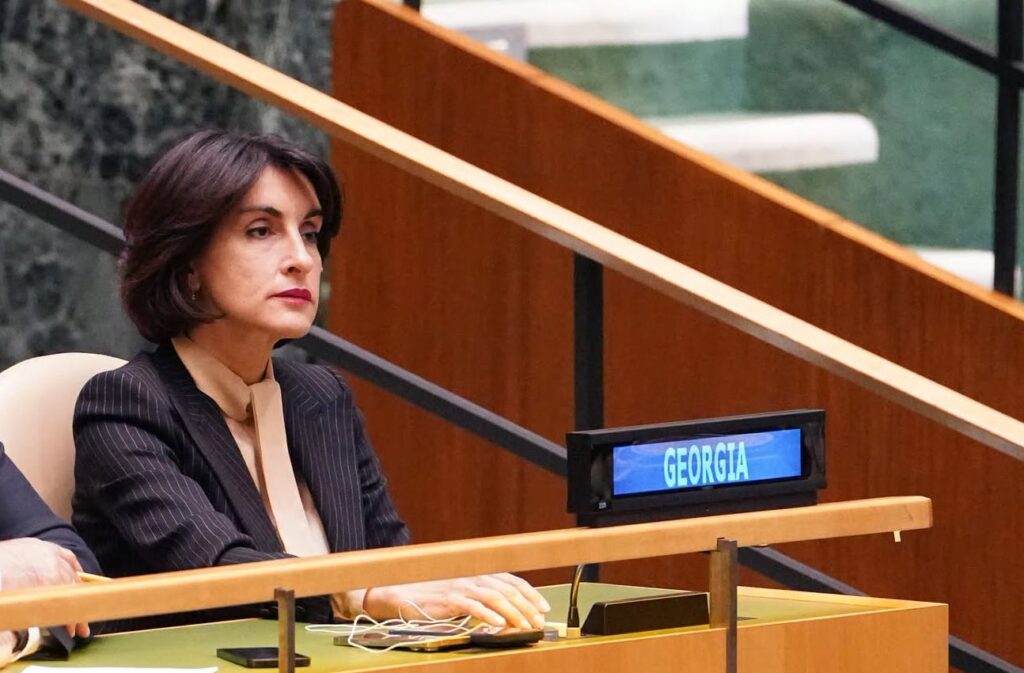
Georgia’s Minister of Foreign Affairs, Maka Bochorishvili, has refuted circulated reports regarding the potential holding of Georgian-Russian negotiations in Tbilisi or Moscow. She made these remarks on air during the program “Topic of the Day” on the First Channel of Georgia.
“There is neither a proposal nor a decision, and this is not on the agenda. Therefore, I believe it is wrong to discuss these matters prematurely,” said the Foreign Minister.
Maka Bochorishvili also commented on the statement made by the Foreign Minister of Belarus, who noted on the eve of November 25 that the meeting in Minsk had demonstrated very positive progress in terms of relations and mutual trust between the two countries, which would allow future negotiations to be moved directly to the capitals of both states.
“The Belarusian side is not a participant in these meetings and does not possess information regarding their content or outcomes. No one other than us or Russia can assess what outcome this meeting yielded and what consequences it entailed. Accordingly, the necessity of meetings and their continuation is a decision for the parties involved, not for those who, in this case, play no role in either the substance or the organization of these negotiations.
The Belarusian side took the steps necessary to host the meeting in Minsk and did everything to ensure it was organized without any disruption. We are, of course, grateful for that. However, there are no agreements regarding the continuation of the meetings or subsequent steps. Should the need for a next meeting arise, the parties will discuss where it is more appropriate to hold it under the specific prevailing circumstances and taking into account real needs,” Bochorishvili stated.
When asked how she views the statement by Sergey Lavrov regarding Russia’s interest in normalizing relations with Georgia and his welcoming of Tbilisi’s willingness not to shy away from contacts with the Russian Federation, Bochorishvili emphasized: if Russia genuinely wants to normalize relations with Georgia, there is nothing to hide here, and everyone is well aware of what steps and by whom must be taken to achieve any progress in this direction.
“So merely voicing a desire is not enough. If there is a desire, we must see concrete actions and concrete steps—what exactly is meant by the implementation of this intention. On our part, this desire cannot be realized: we are not the country that needs to take any steps toward the Russian Federation,” Bochorishvili stated.
Negotiations in Minsk
On November 19, the first meeting between the Special Representative of the Prime Minister of Georgia for Relations with Russia, Giorgi Zurabashvili, and Russia’s Deputy Foreign Minister, Mikhail Galuzin, was held in Minsk.
According to a statement by the Georgian government, the parties “reached a number of agreements.” The Georgian government did not specify what these agreements were. It was also noted that Zurabashvili and Galuzin discussed trade and economic, as well as cultural and humanitarian relations, along with existing challenges in these spheres.
“The need to continue the dialogue in order to achieve concrete results was emphasized.”
In addition, the sides discussed the security situation in the region.
The Russian Foreign Ministry issued a similar statement. Moscow stated that an “in-depth exchange of views on pressing issues of bilateral engagement, with an emphasis on trade, economic, cultural, and humanitarian cooperation,” took place between Zurabashvili and Galuzin.
“A number of practical agreements were reached. Issues of regional security were discussed,” the Russian MFA noted.
Later, the ministry’s official spokeswoman, Maria Zakharova, also commented on the meeting. According to her, the parties conducted an “in-depth exchange of views on pressing issues of bilateral interaction, primarily in the trade, economic, cultural, and humanitarian spheres.” Zakharova added that this negotiation format would continue in the interests of further developing cooperation between Moscow and Tbilisi.
Georgian Foreign Minister Maka Bochorishvili, for her part, stated that the negotiation format with Russia is necessary, as it addresses issues dictated by “the interests of Georgia and the interests of its citizens”: “These matters require, above all, urgent discussion and direct dialogue.” The minister also added that the Georgian side had raised no objections regarding the selection of Minsk as the venue for the first meeting between the two countries’ special envoys.
On November 22, Russian Deputy Foreign Minister Mikhail Galuzin announced that Moscow and Tbilisi had agreed to hold direct talks on a regular basis. On November 26, Russian Foreign Minister Sergey Lavrov, while in Minsk, stated that Moscow is interested in restoring normal relations with Tbilisi and views the Georgian side’s disposition favorably.
In turn, the Georgian Prime Minister’s special envoy, Giorgi Zurabashvili, said that, in reality, the talks in the capital of Belarus were not simple. According to him, Moscow’s positive public appraisals of the actions of Georgian Dream (the ruling political party in Georgia) actually conceal an underlying negative attitude toward the government in Tbilisi.