


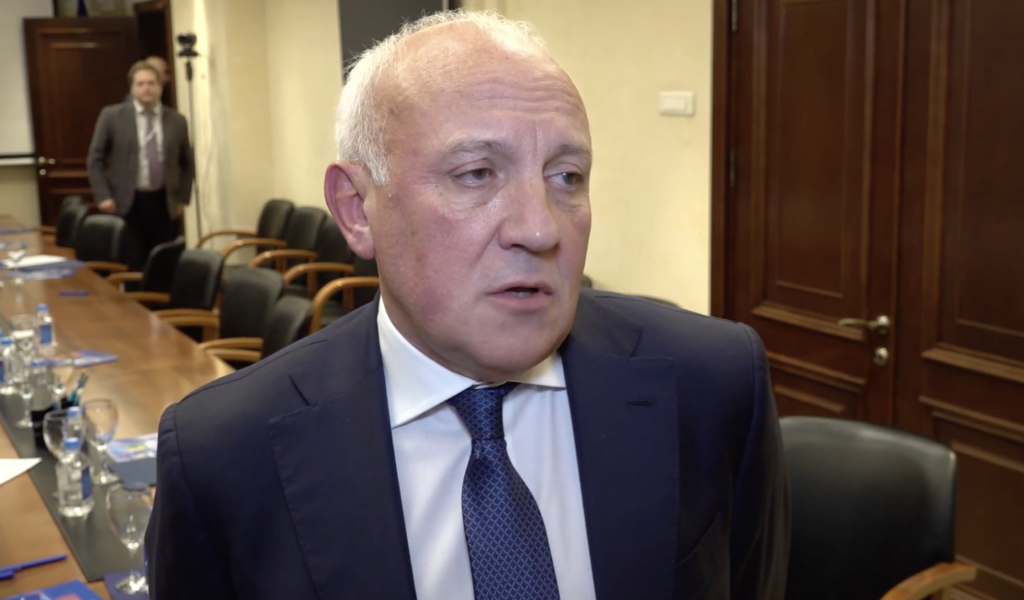
Prior to the meeting in Minsk between Giorgi Zurabashvili, the Special Representative of the Prime Minister of Georgia, and Mikhail Galuzin, Deputy Foreign Minister of the Russian Federation, talks were held in Tbilisi with Yuri Balashov, co-chairman of the Georgian-Russian Chamber of Commerce. This information was confirmed by Prime Minister Irakli Kobakhidze.
According to Kobakhidze, Balashov initially promised that all Georgian companies would be removed from the sanctions list by the end of the year; however, he subsequently shifted his position, and an identical stance was reiterated during the meeting with Galuzin.
Journalists questioned Kobakhidze on whether he had advance knowledge of Moscow’s intentions to impose sanctions on two additional Georgian enterprises, as well as about the Tbilisi meeting referenced by pro-Russian politician and businessman Mamuka Pipia.
“Regarding the meeting: there is Mr. Balashov, who, if I am not mistaken, serves as co-chairman of the Georgian-Russian Chamber of Commerce. Discussions were held with him prior to the meeting with Galuzin. He gave an assurance that by the end of the year, all companies would be removed from the list. However, his position then changed, and later, at the meeting with Galuzin, we heard the exact same rhetoric, which was completely incomprehensible,” Kobakhidze stated.
The remark triggered a heated exchange with the press. When asked what the country’s leadership hopes to achieve in the de-occupation process when Moscow has “screwed them over” even on wine exports, Kobakhidze shifted the blame to the previous administration.
“You were screwed over when 20% of the territories were occupied, and if I were you, I would keep quiet: it was your party that surrendered 20% to the Russian Federation, so you had better not lecture anyone about getting ‘screwed over’,” Kobakhidze told the reporters.
The prime minister also addressed the broader state of Georgian-Russian relations and the dialogue framework. He characterized the climate between the two states as “extremely difficult,” pointing out that the Russian Federation continues to occupy a fifth of Georgian territory and proceeded with so-called diplomatic recognition. Kobakhidze stressed that the current government had “inherited” this status quo, and that resolving the crisis demands consistency and patient engagement.
Talks in Minsk
On November 19, the first meeting between Giorgi Zurabashvili, the Georgian Prime Minister’s Special Representative for relations with Russia, and Mikhail Galuzin, Russia’s Deputy Minister of Foreign Affairs, took place in Minsk.
According to a statement by the Georgian government, the sides “reached a series of agreements.” The government did not specify what those entailed. It was also noted that Zurabashvili and Galuzin reviewed trade, economic, cultural, and humanitarian relations, as well as existing challenges in these areas.
“The need to continue dialogue in order to achieve tangible results was emphasized.”
In addition, the parties addressed regional security matters.
The Russian Ministry of Foreign Affairs (MFA) issued a statement of similar tenor. Moscow stated that Zurabashvili and Galuzin engaged in a “substantive exchange of views on key bilateral issues, with a focus on trade, economic, cultural, and humanitarian cooperation.”
“A series of practical agreements was reached. Regional security issues were also discussed,” the Russian MFA noted.
The meeting was later commented on by the ministry’s official spokesperson, Maria Zakharova. According to her, the parties conducted a “thorough exchange of views on pressing issues of bilateral engagement, primarily in the trade, economic, cultural, and humanitarian fields.” Zakharova added that this negotiation format would continue to advance the development of cooperation between Moscow and Tbilisi.
Georgian Foreign Minister Maka Bochorishvili, for her part, stated that the negotiation format with Russia is essential, as it addresses issues dictated by “the interests of Georgia and its citizens”: “These matters require, above all, urgent discussion and direct dialogue.” The minister also added that the Georgian side had no objections to selecting Minsk as the venue for the initial meeting between the two countries’ special representatives.
On November 22, Russian Deputy Foreign Minister Mikhail Galuzin announced that Moscow and Tbilisi had agreed to hold direct talks on a regular basis. On November 26, Russian Foreign Minister Sergey Lavrov, while in Minsk, stated that Moscow is interested in restoring normalized relations with Tbilisi and views the Georgian stance favorably.
Meanwhile, the Georgian Prime Minister’s special envoy, Giorgi Zurabashvili, noted that the talks in the Belarusian capital were far from straightforward. According to him, behind Moscow’s positive public remarks regarding the actions of Georgian Dream lies an underlying negative attitude toward the government in Tbilisi.