


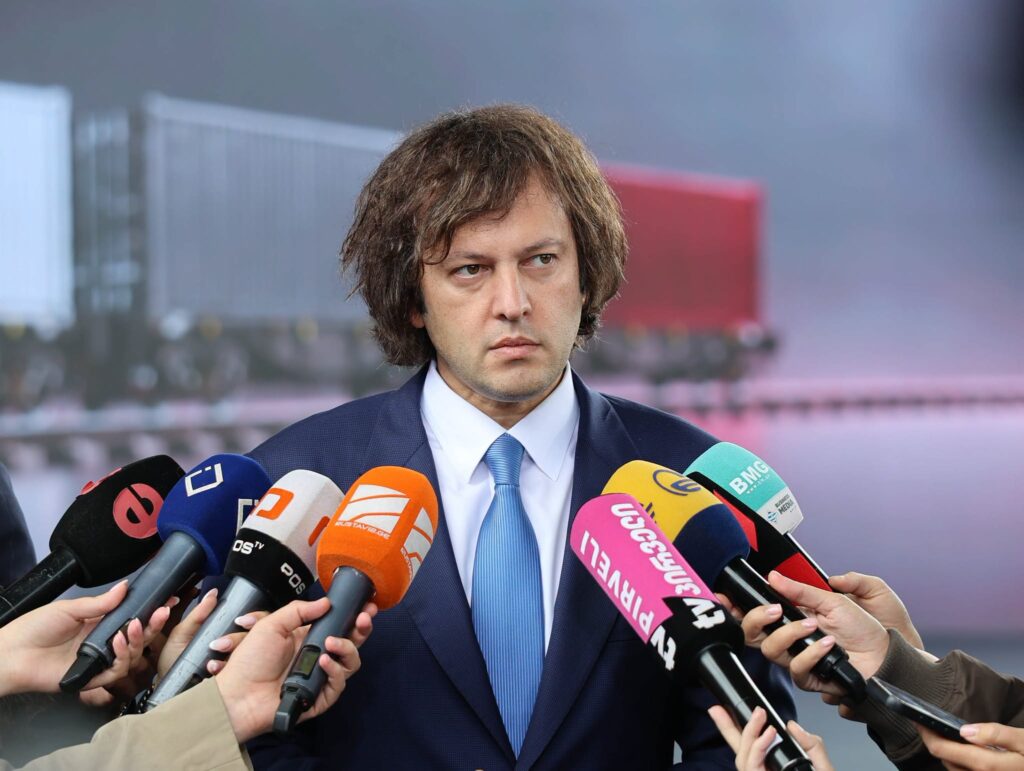
Georgian Prime Minister Irakli Kobakhidze has stated that mid-level Russian officials may have been bribed by the “Deep State.” He made the remark in response to statements made by his special envoy for relations with Russia, Giorgi Zurabashvili, who said following talks with Mikhail Galuzin that Moscow’s actions were aimed against the ruling Georgian Dream government. In particular, this concerns Russia’s plans to impose an embargo on additional Georgian wine producers.
“I welcome the public briefing provided by the special representative. Transparency as a whole is very important. As you know, when it comes to negotiations with the European Union, we propose an open and transparent process. Society must be informed about the substance of any negotiations, and this must also be ensured in the case of talks with Russia.
As for my special representative’s assessment, I naturally agree with it. Our expectations regarding the wine issue were that this problem should have been resolved in the simplest way possible. Mr. Galuzin raised three issues: wine quality, the financing of the war in Ukraine’s interests, and the involvement of companies in anti-Russian propaganda. Regarding all seven companies, each of these three points is absurd.
Accordingly, the grounds for imposing sanctions against these companies are also absurd. We expected that following the negotiations, this list would be completely annulled. Instead, however, we received a proposal under which two companies could be added to the list, while certain others would be removed. This is the wrong approach. Compiling this list in the first place was already a flawed approach, and naturally, the new initiative warrants the same assessment. For us, this is surprising.
As for the general assessment and approach: we have grown accustomed to the fact that within the European bureaucracy, there are officials bribed by the ‘Deep State’ who make decisions that run directly counter to European interests. Another characteristic trait of theirs is making statements and taking actions without any substantiation, including with regard to Georgia.
Unfortunately, we are observing the same trend during these negotiations as well. Here, too, everything is quite simple: the ‘Deep State’ wields considerable influence, and it is possible that there are bribed mid-level officials here as well.
I believe that bribing mid-level officials is entirely possible. Dialogue is necessary, and that is precisely what the special representative spoke about,” Irakli Kobakhidze said.
Talks in Minsk
On November 19, the first meeting between the Georgian Prime Minister’s Special Representative for Relations with Russia, Giorgi Zurabashvili, and Russian Deputy Foreign Minister Mikhail Galuzin took place in Minsk.
According to a statement by the Georgian government, the parties “reached a number of agreements.” The Georgian government did not specify what these were. It was also noted that Zurabashvili and Galuzin discussed trade, economic, cultural, and humanitarian relations, as well as current challenges in these areas.
“The need to continue dialogue in order to achieve tangible results was emphasized.”
In addition, the parties discussed the regional security situation.
The Russian Ministry of Foreign Affairs (MFA) released a similar statement. Moscow said that Zurabashvili and Galuzin held a “thorough exchange of views on pressing issues of bilateral engagement, with an emphasis on trade, economic, cultural, and humanitarian cooperation.”
“A number of practical agreements were reached. Issues of regional security were discussed,” the Russian MFA noted.
Later, the ministry’s official spokeswoman, Maria Zakharova, also commented on the meeting. According to her, the parties held a “thorough exchange of views on pressing issues of bilateral engagement, primarily in the trade, economic, cultural, and humanitarian spheres.” Zakharova added that this negotiation format would continue in the interest of further developing cooperation between Moscow and Tbilisi.
Georgian Foreign Minister Maka Bochorishvili, for her part, stated that the negotiation format with Russia is necessary because it addresses matters dictated by “the interests of Georgia and the interests of its citizens”: “These topics require, above all, urgent discussion and direct dialogue.” The minister added that the Georgian side had no objections regarding the choice of Minsk as the venue for the first meeting between the two countries’ special representatives.
Later, Bochorishvili refuted reports that future talks might be held in Moscow or Tbilisi. “There is neither a proposal nor a decision, and it is not on the agenda. Therefore, I consider it wrong to discuss these matters prematurely,” the foreign minister said.
On November 22, Russian Deputy Foreign Minister Mikhail Galuzin reported that Moscow and Tbilisi had agreed to hold direct talks on a regular basis. On November 26, Russian Foreign Minister Sergey Lavrov, speaking in Minsk, stated that Moscow was interested in restoring normal relations with Tbilisi and welcomed the Georgian side’s constructive stance.
Meanwhile, the Georgian Prime Minister’s special envoy, Giorgi Zurabashvili, said that the talks in the Belarusian capital were by no means straightforward. According to him, Moscow’s positive public appraisals of the Georgian Dream’s actions in fact conceal a negative posture toward the government in Tbilisi.